Masaku Janet, Mutungi Faith, Gichuki Paul M, Okoyo Collins, Njomo Doris W, Njenga Sammy M
Eastern and Southern Africa Centre of International Parasite Control (ESACIPAC), Kenya Medical Research Institute (KEMRI), P.O. Box 54840, Nairobi, 00200 Kenya.
Trop Med Health. 2017 Jul 1;45:15. doi: 10.1186/s41182-017-0055-8. eCollection 2017.
Schistosome infection and soil-transmitted helminths (STHs) are major public health problems in many developing countries where they contribute to the suffering of populations living in poor settings. A cross-sectional survey was conducted in four rural villages in central region of Kenya to provide information on the status of schistosome and STH infections. Previous studies conducted in the area among primary school children showed that there were high STH and infections. This paper presents the results of a parasitological investigation and the associated risk factors of infection among adults living in the study villages.
A total of 495 adults (18-84 years) from systematically selected households were sampled during this cross-sectional survey. They were interviewed and screened for and STHs using duplicate Kato-Katz thick smears. Comparison of prevalence by age group and gender was explored by confidence interval plots, and 95% CI were obtained by generalized least squares (GLS) random effects model. Risk factors associated with infection were determined using mixed effects logistic regression at 95% CI taking into account household clusters.
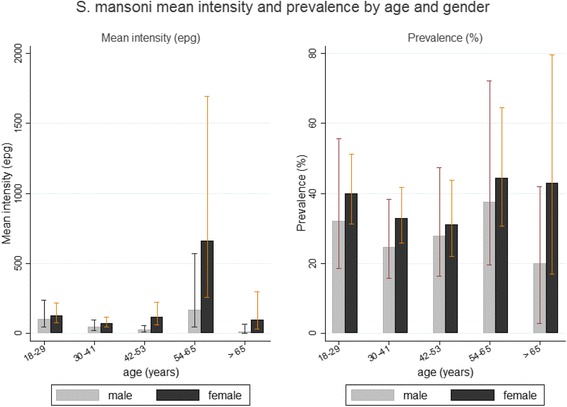
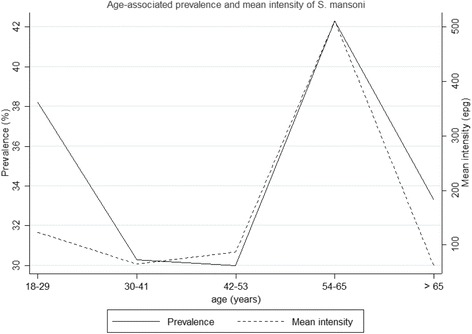
The study revealed that the prevalence of infection was 33.5% (95% CI 29.6-38.0) among adults in the study villages, while the prevalence of STH infection was 0.2% (95% CI 0-1.4) with hookworm being the only detected STH species. However, the village and education level were the only risk factors which showed significant evidence of association with infections.
The current study shows that adult communities in the study area were highly infected with . The study suggests that it may be necessary to develop contemporary approaches towards preventive chemotherapy interventions to adults in high endemic areas to complement the ongoing school-based deworming programme.
血吸虫感染和土壤传播的蠕虫(STH)是许多发展中国家的主要公共卫生问题,给生活在贫困环境中的人们带来痛苦。在肯尼亚中部地区的四个乡村进行了一项横断面调查,以提供有关血吸虫和STH感染状况的信息。此前在该地区对小学生进行的研究表明,STH感染率很高。本文介绍了一项寄生虫学调查结果以及研究村庄中成年居民感染的相关危险因素。
在这项横断面调查中,从系统选取的家庭中抽取了495名成年人(18 - 84岁)。对他们进行访谈,并使用重复的加藤厚涂片法筛查血吸虫和STH。通过置信区间图探讨按年龄组和性别的患病率比较,并通过广义最小二乘法(GLS)随机效应模型获得95%置信区间。在考虑家庭聚类的情况下,使用95%置信区间的混合效应逻辑回归确定与血吸虫感染相关的危险因素。
研究显示,研究村庄中成年人的血吸虫感染率为33.5%(95%置信区间29.6 - 38.0),而STH感染率为0.2%(95%置信区间0 - 1.4),钩虫是唯一检测到的STH种类。然而,村庄和教育水平是仅有的显示出与血吸虫感染有显著关联证据的危险因素。
当前研究表明,研究区域内的成年人群体血吸虫感染率很高。该研究表明,可能有必要针对高流行地区的成年人制定当代预防性化疗干预方法,以补充正在进行的基于学校的驱虫计划。