Trivellone Valeria, Bougeard Stephanie, Giavi Simone, Krebs Patrik, Balseiro Diego, Dray Stephane, Moretti Marco
Biodiversity and Conservation Biology Swiss Federal Research Institute WSL Birmensdorf Switzerland.
Laboratory of Soil Biodiversity University of Neuchâtel Neuchâtel Switzerland.
Ecol Evol. 2017 May 23;7(13):4745-4754. doi: 10.1002/ece3.3061. eCollection 2017 Jul.
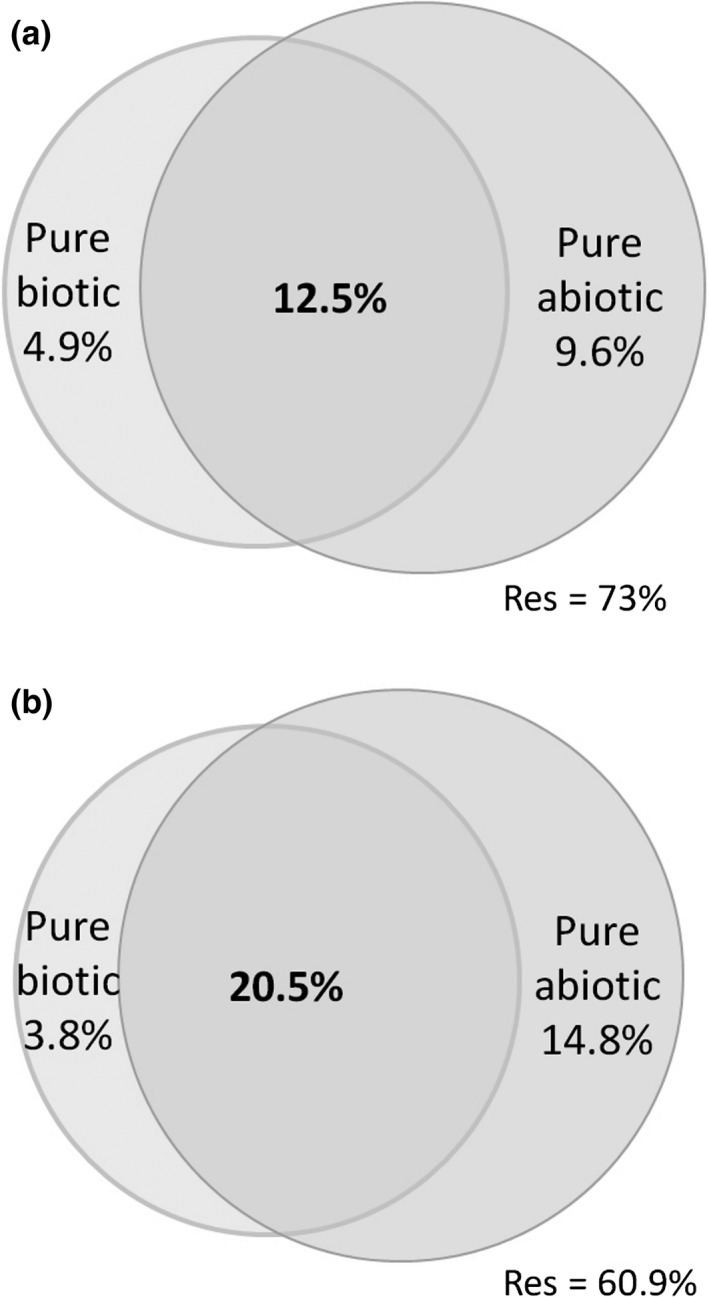
Species assemblages are the results of various processes, including dispersion and habitat filtering. Disentangling the effects of these different processes is challenging for statistical analysis, especially when biotic interactions should be considered. In this study, we used plants (producers) and leafhoppers (phytophagous) as model organisms, and we investigated the relative importance of abiotic versus biotic factors that shape community assemblages, and we infer on their biotic interactions by applying three-step statistical analysis. We applied a novel statistical analysis, that is, multiblock Redundancy Analysis (mbRA, step 1) and showed that 51.8% and 54.1% of the overall variation in plant and leafhopper assemblages are, respectively, explained by the two multiblock models. The most important blocks of variables to explain the variations in plant and leafhopper assemblages were local topography and biotic factors. Variation partitioning analysis (step 2) showed that pure abiotic filtering and pure biotic processes were relatively less important than their combinations, suggesting that biotic relationships are strongly structured by abiotic conditions. Pairwise co-occurrence analysis (step 3) on generalist leafhoppers and the most common plants identified 40 segregated species pairs (mainly between plant species) and 16 aggregated pairs (mainly between leafhopper species). Pairwise analysis on specialist leafhoppers and potential host plants clearly revealed aggregated patterns. Plant segregation suggests heterogeneous resource availability and competitive interactions, while leafhopper aggregation suggests host feeding differentiation at the local level, different feeding microhabitats on host plants, and similar environmental requirements of the species. Using the novel mbRA, we disentangle for the first time the relative importance of more than five distinct groups of variables shaping local species communities. We highlighted the important role of abiotic processes mediated by bottom-up effects of plants on leafhopper communities. Our results revealed that in-field structure diversification and trophic interactions are the main factors causing the co-occurrence patterns observed.
物种组合是包括扩散和生境筛选在内的各种过程的结果。区分这些不同过程的影响对于统计分析来说具有挑战性,尤其是在需要考虑生物相互作用的情况下。在本研究中,我们以植物(生产者)和叶蝉(植食性昆虫)作为模式生物,研究了塑造群落组合的非生物因素与生物因素的相对重要性,并通过三步统计分析推断它们之间的生物相互作用。我们应用了一种新颖的统计分析方法,即多块冗余分析(mbRA,第一步),结果表明,两个多块模型分别解释了植物组合和叶蝉组合中51.8%和54.1%的总体变异。解释植物组合和叶蝉组合变异的最重要变量块是局部地形和生物因素。变异分解分析(第二步)表明,纯非生物筛选和纯生物过程相对不如它们的组合重要,这表明生物关系在很大程度上由非生物条件构建。对多食性叶蝉和最常见植物进行的成对共存分析(第三步)确定了40对分离的物种对(主要是植物物种之间)和16对聚集的物种对(主要是叶蝉物种之间)。对专食性叶蝉和潜在寄主植物的成对分析清楚地揭示了聚集模式。植物的分离表明资源可用性的异质性和竞争相互作用,而叶蝉的聚集表明在局部水平上寄主取食的分化、寄主植物上不同的取食微生境以及物种相似的环境需求。使用新颖的mbRA,我们首次区分了塑造当地物种群落的五个以上不同变量组的相对重要性。我们强调了植物对叶蝉群落的自下而上效应介导的非生物过程的重要作用。我们的结果表明,田间结构多样化和营养相互作用是导致观察到的共存模式的主要因素。