Lin Kai, Yang Ronghui, Zheng Zhongnan, Zhou Yan, Geng Yang, Hu Yabin, Wu Sai, Wu Wei
Department of Biochemistry and Molecular Biology, School of Basic Medical Sciences, Capital Medical University, Beijing, China.
Institute of Brain Tumor, Beijing Institute for Brain Disorders, Capital Medical University, Beijing, China.
Cell Death Discov. 2017 Jul 3;3:17025. doi: 10.1038/cddiscovery.2017.25. eCollection 2017.
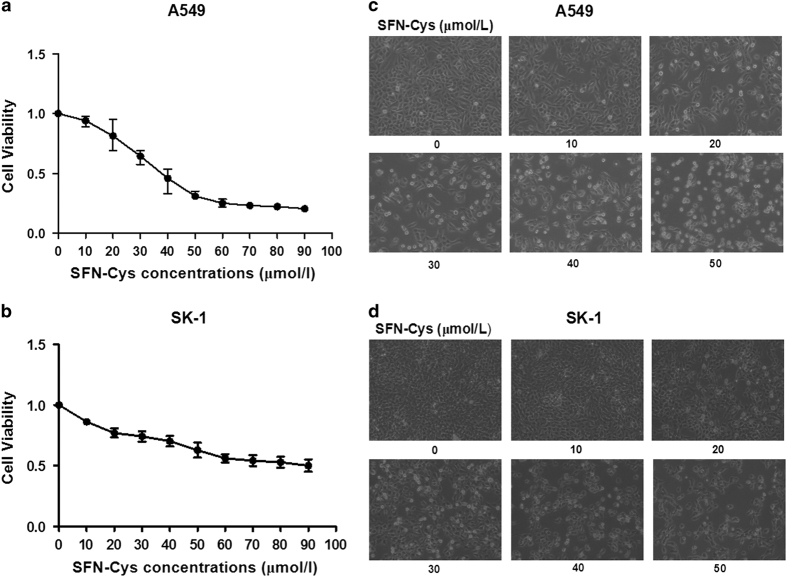
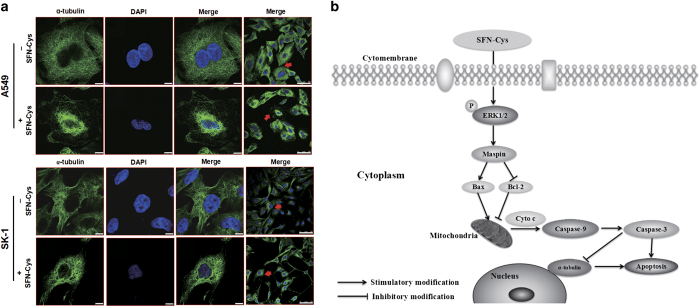
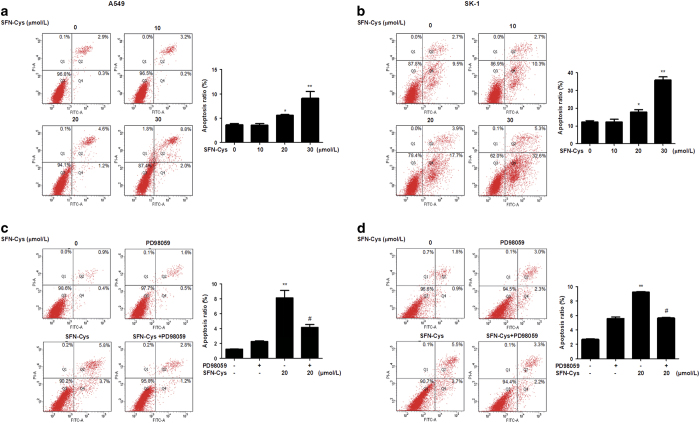
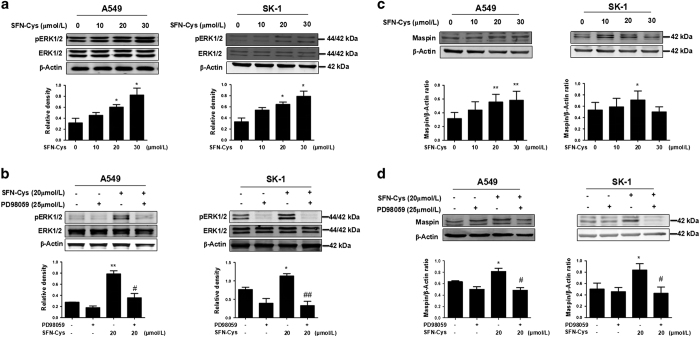
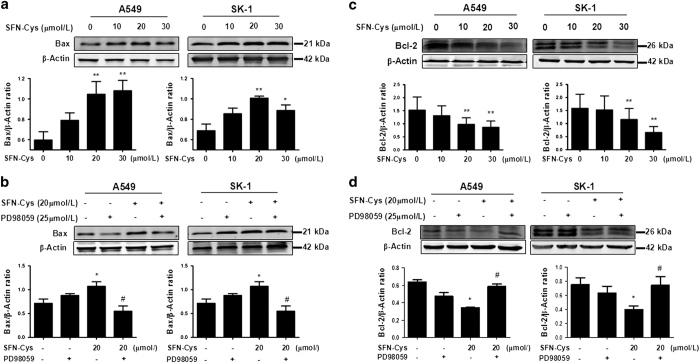
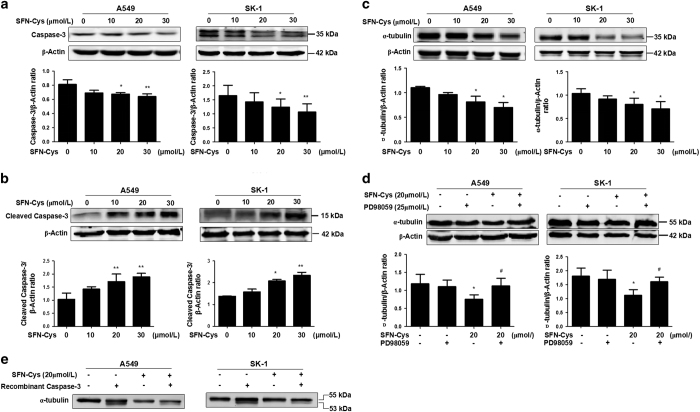
Sulforaphane (SFN) was demonstrated to induce apoptosis in a variety of cancers via multiple mechanisms. However, owing to a short half-life in circulation, SFN was not used for clinical treatment yet. Interestingly, SFN analog, sulforaphane-cysteine (SFN-Cys) has a longer half-life in metabolism, and we previously demonstrated that SFN-Cys inhibited invasion in human prostate cancer cells. Here, we would investigate whether SFN-Cys induces apoptosis and find the underlying mechanisms in human non-small cell lung cancer (NSCLC) cells. Western blots were used to test the molecular linkages among extracellular signal-regulated kinases 1/2 (ERK1/2) and downstream signal molecules. Flow cytometry and fluorescence microscopy were used to detect cell death. Cell proliferation assay showed that SFN-Cys inhibited cell viability following a dose-dependent manner. Abnormal cell morphology was viewed after the cells were exposed to SFN-Cys. Flow cytometry showed that SFN-Cys induced cell apoptosis via a dose-dependent manner. Further, SFN-Cys triggered the activation of ERK1/2, which resulted in the upregulation of maspin, Bax, cleaved caspase-3 and downregulation of pro-caspase-3, Bcl-2, -tubulin. Meanwhile, we demonstrated that recombinant caspase-3 cleaved -tubulin in the lysate of cells, which were treated by SFN-Cys. These data indicated that SFN-Cys activated the ERK1/2-mediated mitochondria signaling pathway with maspin upregulation and -tubulin downregulation leading to apoptosis. These findings will help to develop a novel therapeutic to target NSCLC cells.
萝卜硫素(SFN)已被证明可通过多种机制诱导多种癌症细胞凋亡。然而,由于其在血液循环中的半衰期较短,SFN尚未用于临床治疗。有趣的是,SFN类似物萝卜硫素-半胱氨酸(SFN-Cys)在代谢过程中的半衰期更长,并且我们之前证明SFN-Cys可抑制人前列腺癌细胞的侵袭。在此,我们将研究SFN-Cys是否诱导人非小细胞肺癌(NSCLC)细胞凋亡并找出潜在机制。使用蛋白质免疫印迹法检测细胞外信号调节激酶1/2(ERK1/2)与下游信号分子之间的分子联系。使用流式细胞术和荧光显微镜检测细胞死亡情况。细胞增殖试验表明,SFN-Cys以剂量依赖的方式抑制细胞活力。细胞暴露于SFN-Cys后可见异常细胞形态。流式细胞术表明,SFN-Cys以剂量依赖的方式诱导细胞凋亡。此外,SFN-Cys触发ERK1/2的激活,导致maspin、Bax、裂解的半胱天冬酶-3上调,以及原半胱天冬酶-3、Bcl-2、微管蛋白下调。同时,我们证明重组半胱天冬酶-3可裂解经SFN-Cys处理的细胞裂解物中的微管蛋白。这些数据表明,SFN-Cys通过上调maspin和下调微管蛋白激活ERK1/2介导的线粒体信号通路,从而导致细胞凋亡。这些发现将有助于开发一种针对NSCLC细胞的新型治疗方法。