Bauer Benjamin U, Könenkamp Laura, Stöter Melanie, Wolf Annika, Ganter Martin, Steffen Imke, Runge Martin
Clinic for Swine and Small Ruminants, University of Veterinary Medicine Hannover, Foundation, Bischofsholer Damm 15, 30173 Hannover, Germany.
Institute for Biochemistry and Research Center for Emerging Infections and Zoonoses, University of Veterinary Medicine Hannover, Foundation, Bünteweg 17, 30559 Hannover, Germany.
One Health. 2021 Feb 20;12:100227. doi: 10.1016/j.onehlt.2021.100227. eCollection 2021 Jun.
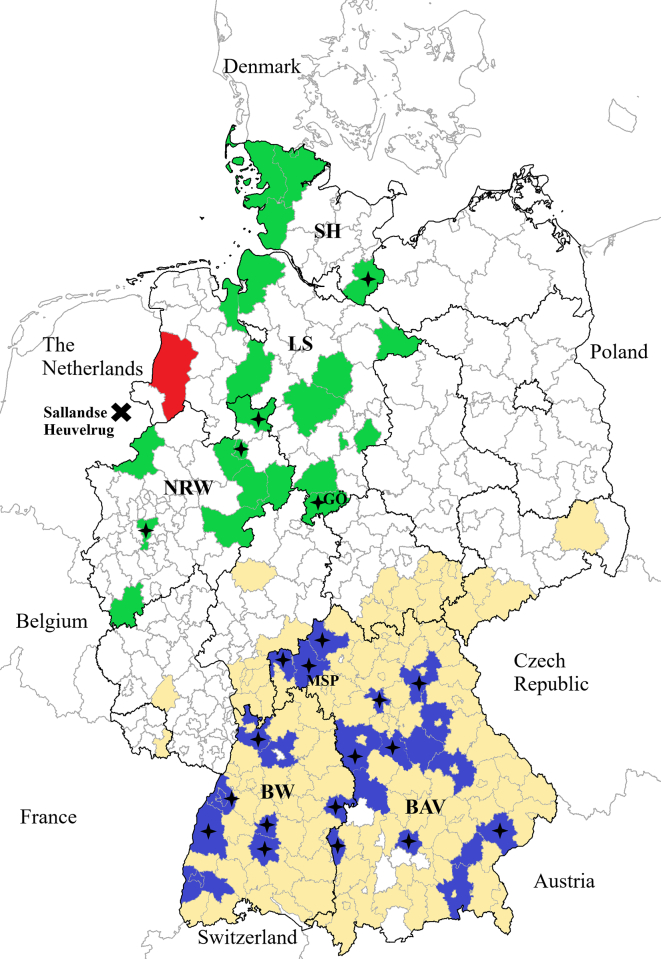
Tick-borne encephalitis virus (TBEV) is one of the most common zoonotic vector-borne infections in Europe. An appropriate awareness is crucial to react quickly and efficiently to protect humans from this pathogen. From winter 2017 until spring 2018 serum samples were collected from 71 small ruminant flocks (3174 animals) in five German federal states. The sera were examined for TBEV antibodies by ELISA and serum neutralization test. In the TBEV risk areas, there was a coincidence in 14 districts between seropositive small ruminants and the occurrence of human TBE cases in 2017. In eight districts, the TBEV infection could not be detected in small ruminants although human cases were reported. In contrast, in five districts, small ruminants tested TBEV seropositive without notified human TBE cases in 2017. A changing pattern of TBEV circulation in the environment was observed by the absence of antibodies in a defined high-risk area. In the non-TBE risk areas, seropositive small ruminants were found in five districts. In two districts with a low human incidence the infection was missed by the small ruminant sentinels. An intra-herd prevalence of 12.5% was determined in a goat flock in the non-TBE risk area in 2017, two years prior the first autochthone human case was reported. All sheep and goats in this flock were examined for TBEV antibodies for three years. Individual follow-up of twelve small ruminants was possible and revealed mostly a short lifespan of TBEV antibodies of less than one year. The probability to identify TBEV seropositive sheep flocks was enhanced in flocks kept for landscape conservation or which were shepherded ( < 0.05). Our preliminary observations clearly demonstrated the successful utilization of small ruminants as sentinel animals for TBEV.
蜱传脑炎病毒(TBEV)是欧洲最常见的人畜共患媒介传播感染之一。提高适当的认识对于迅速有效地做出反应以保护人类免受这种病原体侵害至关重要。从2017年冬季到2018年春季,在德国五个联邦州的71个小反刍动物群(3174只动物)中采集了血清样本。通过酶联免疫吸附测定(ELISA)和血清中和试验检测血清中的TBEV抗体。在TBEV风险区域,2017年有14个地区的小反刍动物血清呈阳性与人类TBE病例的发生存在巧合。在8个地区,尽管报告了人类病例,但在小反刍动物中未检测到TBEV感染。相反,在5个地区,小反刍动物检测TBEV血清呈阳性,但2017年未报告人类TBE病例。通过在一个确定的高风险区域中没有抗体,观察到环境中TBEV传播模式的变化。在非TBE风险区域,5个地区发现了血清呈阳性的小反刍动物。在两个人类发病率较低的地区,小反刍动物哨兵未发现感染情况。2017年,在非TBE风险区域的一个山羊群中确定群内患病率为12.5%,这是在报告首例本地人类病例的两年前。对该群中的所有绵羊和山羊进行了三年的TBEV抗体检测。对12只小反刍动物进行了个体跟踪,结果显示TBEV抗体的寿命大多较短,不到一年。在用于景观保护或放牧的羊群中,识别TBEV血清呈阳性绵羊群的概率增加(<0.05)。我们的初步观察清楚地表明,成功地将小反刍动物用作TBEV的哨兵动物。