Gonzalez Gaëlle, Bournez Laure, Moraes Rayane Amaral, Marine Dumarest, Galon Clémence, Vorimore Fabien, Cochin Maxime, Nougairède Antoine, Hennechart-Collette Catherine, Perelle Sylvie, Leparc-Goffart Isabelle, Durand Guillaume André, Grard Gilda, Bénet Thomas, Danjou Nathalie, Blanchin Martine, Lacour Sandrine A, Franck Boué, Chenut Guillaume, Mainguet Catherine, Simon Catherine, Brémont Laurence, Zientara Stephan, Moutailler Sara, Martin-Latil Sandra, Dheilly Nolwenn M, Beck Cécile, Lecollinet Sylvie
ANSES, INRAE, Ecole Nationale Vétérinaire d'Alfort, UMR VIROLOGIE, Laboratoire de Santé Animale, Maisons-Alfort, France.
ANSES, Nancy Laboratory for Rabies and Wildlife, Malzéville, France.
Front Microbiol. 2022 Apr 11;13:863725. doi: 10.3389/fmicb.2022.863725. eCollection 2022.
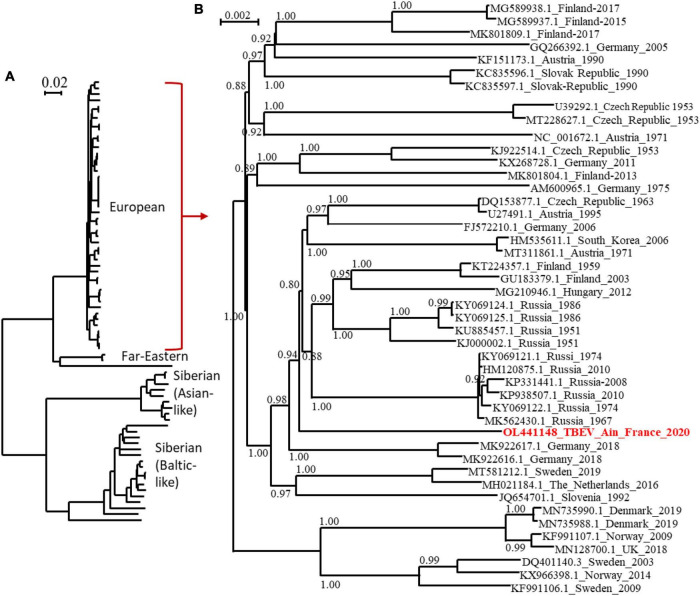
Tick-borne encephalitis virus' (TBEV) geographic range and the human incidence are increasing throughout Europe, putting a number of non-endemic regions and countries at risk of outbreaks. In spring 2020, there was an outbreak of tick-born encephalitis (TBE) in Ain, Eastern France, where the virus had never been detected before. All patients but one had consumed traditional unpasteurised raw goat cheese from a local producer. We conducted an investigation in the suspected farm using an integrative One Health approach. Our methodology included (i) the detection of virus in cheese and milk products, (ii) serological testing of all animals in the suspected farm and surrounding farms, (iii) an analysis of the landscape and localisation of wooded area, (iv) the capture of questing ticks and small mammals for virus detection and estimating enzootic hazard, and (v) virus isolation and genome sequencing. This approach allowed us to confirm the alimentary origin of the TBE outbreak and witness in real-time the seroconversion of recently exposed individuals and excretion of virus in goat milk. In addition, we identified a wooded focus area where and around which there is a risk of TBEV exposure. We provide the first TBEV isolate responsible for the first alimentary-transmitted TBE in France, obtained its full-length genome sequence, and found that it belongs to the European subtype of TBEV. TBEV is now a notifiable human disease in France, which should facilitate surveillance of its incidence and distribution throughout France.
蜱传脑炎病毒(TBEV)在欧洲的地理分布范围和人类感染发病率正在不断增加,使一些非流行地区和国家面临疫情爆发的风险。2020年春季,法国东部的安省爆发了蜱传脑炎(TBE),此前该病毒从未在该地被检测到。除一名患者外,所有患者均食用了当地生产商生产的传统未巴氏杀菌的生山羊奶酪。我们采用综合“同一健康”方法对疑似农场展开调查。我们的方法包括:(i)检测奶酪和奶制品中的病毒;(ii)对疑似农场及周边农场的所有动物进行血清学检测;(iii)分析林地的景观和位置;(iv)捕捉伺机而动的蜱虫和小型哺乳动物以检测病毒并评估动物疫病流行风险;(v)病毒分离和基因组测序。这种方法使我们能够确认此次TBE疫情的食物源,并实时见证近期暴露个体的血清转化以及病毒在山羊奶中的排泄情况。此外,我们确定了一个有TBEV暴露风险的林地重点区域及其周边区域。我们提供了导致法国首例经食物传播的TBE的首个TBEV分离株,获得了其全长基因组序列,并发现它属于TBEV的欧洲亚型。TBE现在是法国的一种须通报的人类疾病,这应有助于监测其在法国的发病率和分布情况。