Bless Philipp Justus, Schmutz Claudia, Mäusezahl Daniel
Swiss Tropical and Public Health Institute, Socinstrasse 57, P. O. Box 4002, Basel, Switzerland.
University of Basel, Petersplatz 1, P. O. Box 4001, Basel, Switzerland.
BMC Res Notes. 2017 Jul 11;10(1):266. doi: 10.1186/s13104-017-2587-8.
Campylobacteriosis is the most frequently reported foodborne disease in Europe with a notification rate of 71 per 100,000 population in the European Union in 2014. Surveillance data show a clear seasonality whereby case numbers peak during summer months in entire Europe and at the turn of the year, especially in Germany and Switzerland. A detailed description of European surveillance data by country at the turn of the year was missing so far. The objectives of the presented work were to describe national surveillance data of The European Surveillance System for 14 countries during winter times and to generate hypotheses for the observed seasonality of campylobacteriosis cases.
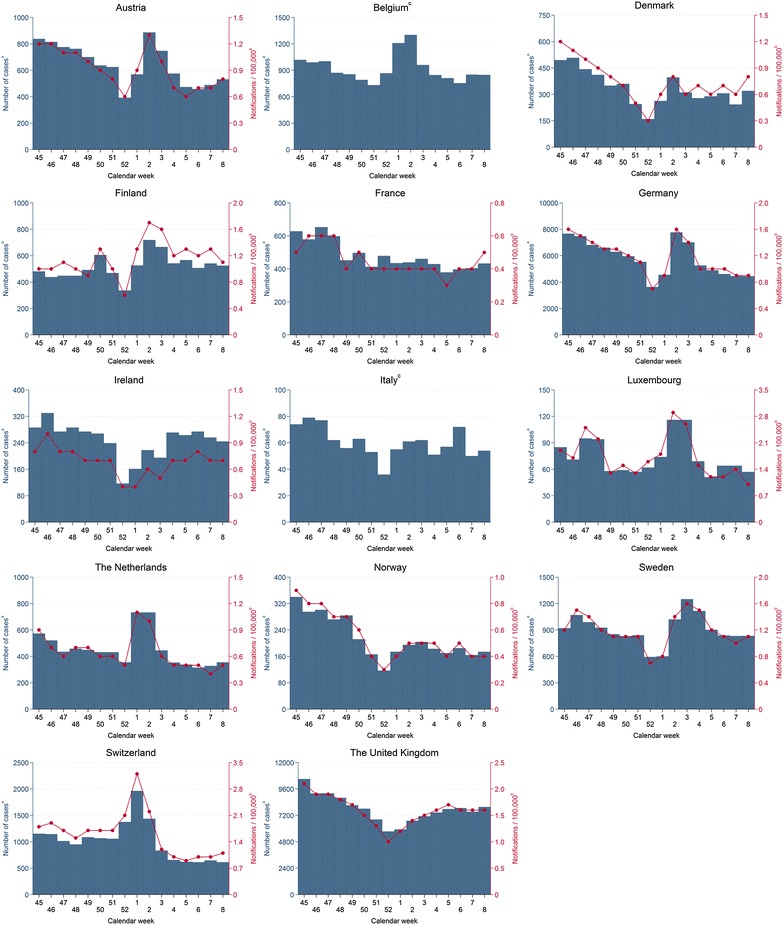
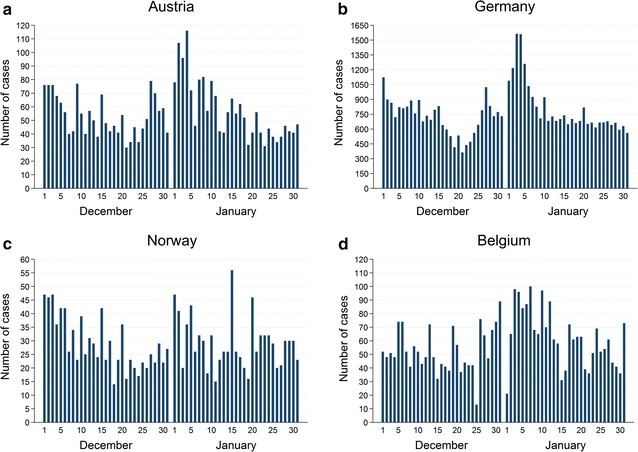
The analysis included 317,986 cases notified between calendar weeks 45 and 8 of winter seasons 2006/2007-2013/2014. Winter peaks in weekly case notifications and notification rates were observed for Austria, Belgium, Finland, Germany, Luxembourg, The Netherlands, Switzerland and Sweden while for Denmark, France, Ireland, Italy, Norway and the United Kingdom no unusual increase was observed. Generally, weekly notification rates peaked in calendar week 1 or 2 after a strong decline in the last week of December and reached values of a multiple of the observed notification rates in the weeks before or after the peak e.g. up to 6.5 notifications per 100,000 population per week in Luxembourg. Disease onset of cases notified during winter peaks occurred predominantly in calendar weeks 52 and 1 and point towards risk exposures around Christmas and New Year. The consumption of meat fondue or table top grilling poses such a risk and is popular in many countries with an observed winter peak. Additionally, increased travel activities over the festive season could foster campylobacteriosis transmission. Surveillance artefacts (e.g. reporting delays due to public holidays) should be excluded as causes for country-specific winter peaks before investigating risk exposures.
弯曲杆菌病是欧洲报告最多的食源性疾病,2014年欧盟的通报率为每10万人中有71例。监测数据显示出明显的季节性,即整个欧洲的病例数在夏季以及岁末年初达到峰值,尤其是在德国和瑞士。到目前为止,尚缺乏按国家对欧洲岁末年初监测数据的详细描述。本研究的目的是描述欧洲监测系统中14个国家冬季的国家监测数据,并对观察到的弯曲杆菌病病例季节性提出假设。
分析纳入了2006/2007 - 2013/2014年冬季第45周至第8周通报的317,986例病例。奥地利、比利时、芬兰、德国、卢森堡、荷兰、瑞士和瑞典观察到每周病例通报数和通报率出现冬季峰值,而丹麦、法国、爱尔兰、意大利、挪威和英国未观察到异常增加。一般来说,每周通报率在12月最后一周大幅下降后于第1或第2日历周达到峰值,峰值周的通报率是峰值前后几周观察到的通报率的数倍,例如卢森堡高达每10万人每周6.5例通报。冬季峰值期间通报病例的发病主要发生在第52和第1日历周,表明在圣诞节和新年前后存在风险暴露。食用肉类火锅或桌面烧烤会带来此类风险,并且在许多观察到冬季峰值的国家很受欢迎。此外,节日期间旅行活动增加可能会促进弯曲杆菌病的传播。在调查风险暴露之前,应排除监测假象(例如因公共假日导致的报告延迟)作为特定国家冬季峰值的原因。