Department of Human Ecology, Korea National Open University, 86, Daehak-ro, Jongno-gu, Seoul, 03087, Republic of Korea.
Antioxidants Research Laboratory, Jean Mayer USDA Human Nutrition Research Center on Aging, Tufts University, Boston, MA, 02111, USA.
Eur J Nutr. 2018 Sep;57(6):2069-2079. doi: 10.1007/s00394-017-1480-5. Epub 2017 Jul 10.
Almonds have shown to beneficially modify some cardiovascular risk factors in clinical trials conducted in diverse ethnic populations but this relationship has never been tested in Koreans. Thus, we tested the impact of almonds consumed as a snack within the context of a typical Korean diet on cardiovascular risk factors.
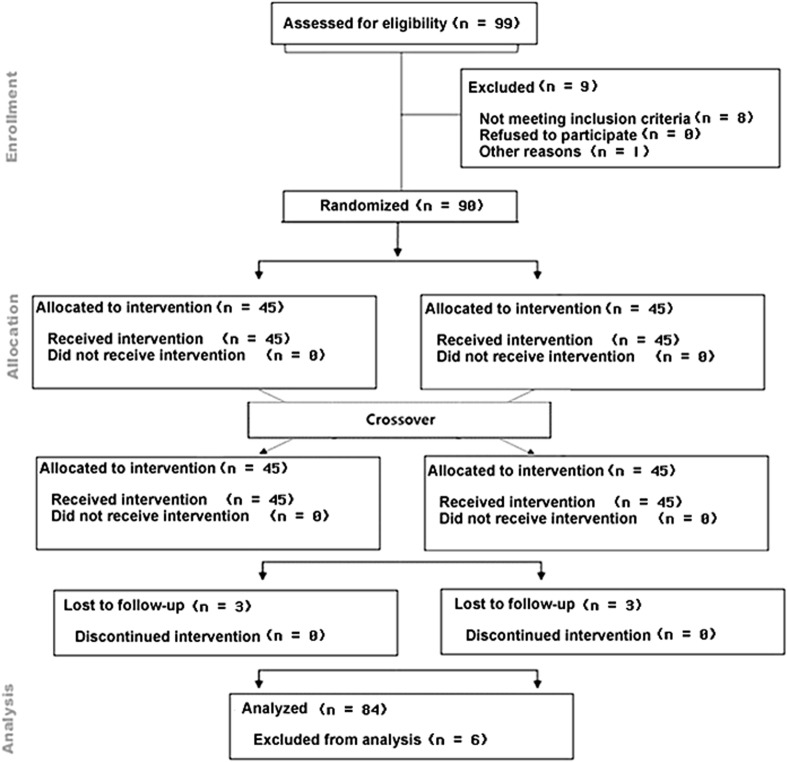
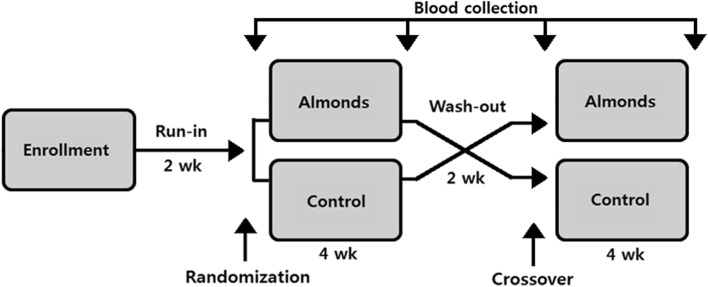
We conducted a randomized, crossover trial in a free-living setting with a 2-week run-in period, two 4-week intervention phases, and a 2-week washout period between interventions. Eighty four overweight/obese participants (11 M/73 F; 52.4 ± 0.6 year; 25.4 ± 0.22 kg/m) consumed either 56 g of almonds or isocaloric cookies daily for 4 weeks.
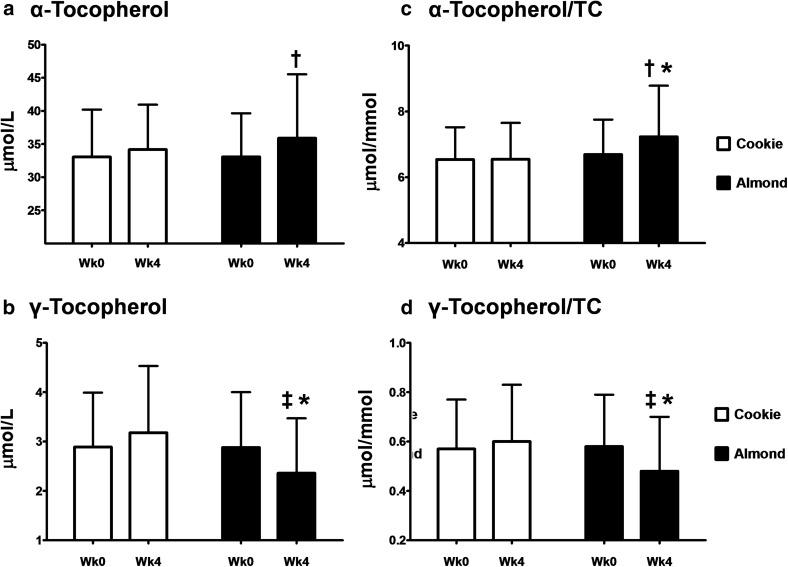
Mean % daily energy intake at baseline was 64.8, 21.3, and 14.9% from carbohydrate, fat, and protein, respectively. The addition of 56 g of almonds daily decreased carbohydrate energy to 55.0%, increased fat to 32.0%, and maintained protein at 14.7%. Consuming the almonds increased intake of MUFA by 192.3%, PUFA by 84.5%, vitamin E by 102.7%, and dietary fiber by 11.8% and decreased % energy from carbohydrate by 14.1%. Total caloric intake was increased by the almonds, but body weight, waist circumference, and body composition were not affected. Almonds in overweight and obese Korean adults decreased TC, LDL-C, and non-HDL-C by 5.5, 4.6, and 6.4%, respectively, compared to the cookie control (P ≤ 0.05). Almonds increased plasma α-tocopherol by 8.5% (P ≤ 0.05) from the baseline and tended to increase its value as compared to cookies (P = 0.055). Neither the almonds nor cookies altered plasma protein carbonyls, MDA or oxLDL. Of serum inflammatory markers, IL-10 was decreased by almond intake (P ≤ 0.05), and ICAM-1, IL-1β, and IL-6 tended to be lower with almonds, compared to the cookies.
Almonds at 56 g/day consumed as a snack favorably modified the Korean diet by increasing MUFA, PUFA, vitamin E, and dietary fiber intake and decreasing % energy intake from carbohydrate. Almonds also enhanced plasma α-tocopherol status and serum TC and LDL-C in overweight and obese Koreans. Thus, including almonds in typical Korean diets as a snack can help healthy overweight/obese individuals improve nutritional status and reduce their risk for CVD.
杏仁已被证明可在不同种族人群的临床试验中有益地改变某些心血管风险因素,但这种关系尚未在韩国人身上进行过测试。因此,我们测试了在典型的韩国饮食中作为零食食用杏仁对心血管风险因素的影响。
我们在自由生活环境中进行了一项随机、交叉试验,有 2 周的导入期、2 个 4 周的干预期和干预期之间的 2 周洗脱期。84 名超重/肥胖参与者(11 名男性/73 名女性;52.4±0.6 岁;25.4±0.22kg/m)每天食用 56 克杏仁或等热量的饼干,持续 4 周。
基线时每日能量摄入的平均百分比分别为碳水化合物 64.8%、脂肪 21.3%和蛋白质 14.9%。每天添加 56 克杏仁可将碳水化合物能量降低到 55.0%,增加脂肪到 32.0%,并保持蛋白质在 14.7%。食用杏仁可使单不饱和脂肪酸增加 192.3%,多不饱和脂肪酸增加 84.5%,维生素 E 增加 102.7%,膳食纤维增加 11.8%,碳水化合物能量减少 14.1%。杏仁增加了总热量摄入,但体重、腰围和身体成分没有变化。与饼干对照相比,杏仁可使超重和肥胖的韩国成年人的 TC、LDL-C 和非 HDL-C 分别降低 5.5%、4.6%和 6.4%(P≤0.05)。杏仁可使血浆 α-生育酚增加 8.5%(P≤0.05),与饼干相比,其增加趋势更明显(P=0.055)。杏仁和饼干均未改变血浆蛋白羰基、MDA 或 oxLDL。在血清炎症标志物中,杏仁摄入可降低 IL-10(P≤0.05),与饼干相比,IL-1β和 IL-6 的水平也趋于降低。
作为零食每天食用 56 克杏仁可通过增加 MUFA、PUFA、维生素 E 和膳食纤维的摄入以及减少碳水化合物的能量摄入,有利地改善韩国饮食。杏仁还可改善超重和肥胖韩国人的血浆 α-生育酚状态和血清 TC 和 LDL-C。因此,将杏仁作为零食纳入典型的韩国饮食中,可以帮助健康的超重/肥胖人群改善营养状况,降低 CVD 风险。