Li Jingjing, Gu Zhennan, Pan Yong, Wang Shunhe, Chen Haiqin, Zhang Hao, Chen Wei, Chen Yong Q
State Key Laboratory of Food Science and Technology, Jiangnan University, Wuxi, 214122, People's Republic of China.
School of Food Science and Technology, Jiangnan University, Wuxi, 214122, People's Republic of China.
Lipids Health Dis. 2017 Jul 11;16(1):136. doi: 10.1186/s12944-017-0529-z.
α-linolenic acid (ALA) is an n-3 polyunsaturated fatty acid (PUFA) and the substrate for long-chain n-3 PUFAs. The beneficial effects of ALA on chronic diseases are still in dispute, unlike those of eicosapentaenoic acid (EPA) and docosahexaenoic acid (DHA).
The primary objective of this investigation was to evaluate the efficiency of ALA uptake from a vegetable oil source and its subsequent conversion to n-3 long-chain PUFAs (LCPUFAs) in the tissues of growing mice, and to investigate its protective role in a prostate cancer animal model. We carried out the investigation in prostate-specific Pten-knockout mice with specified low-ALA (L-ALA, 2.5%) and high-ALA (H-ALA, 7.5%) diets. Total fatty acids in blood, liver, epididymal fat pad, prostate were detected and prostate weight were adjusted for body weight (mg/25 g).
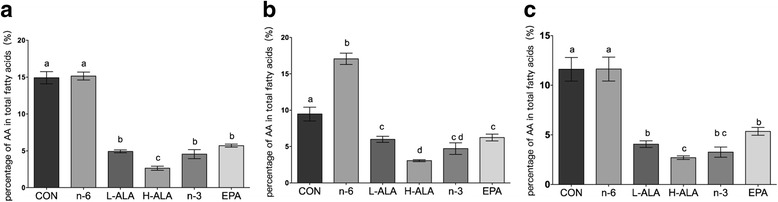
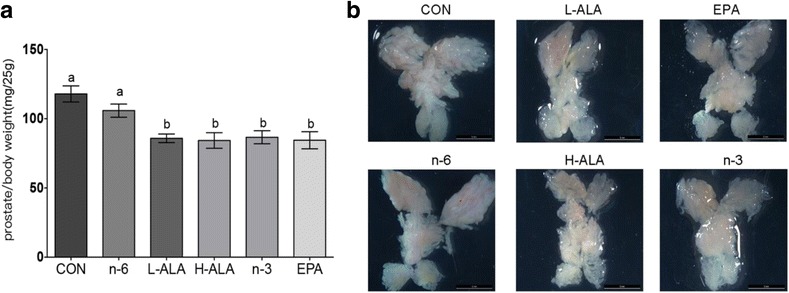
We found that dietary ALA triggered significant increases in ALA, EPA, docosapentaenoic acid (DPA) and DHA levels and a significant decrease in arachidonic acid levels during the mice's growth stage. A dose-dependent effect was observed for ALA, EPA and DPA, but not DHA. Furthermore, the average prostate weights in the L-ALA and H-ALA groups were lower than those in the control and n-6 groups, and similar to those in the EPA and n-3 groups.
Our data suggest that dietary supplementation with ALA is an efficient means of improving n-3 LCPUFAs in vivo, and it has a biologically effective role to play in prostate cancer, similar to that of fish oils.
α-亚麻酸(ALA)是一种n-3多不饱和脂肪酸(PUFA),也是长链n-3多不饱和脂肪酸的底物。与二十碳五烯酸(EPA)和二十二碳六烯酸(DHA)不同,ALA对慢性病的有益作用仍存在争议。
本研究的主要目的是评估植物油来源的ALA在生长小鼠组织中的摄取效率及其随后向n-3长链多不饱和脂肪酸(LCPUFAs)的转化,并研究其在前列腺癌动物模型中的保护作用。我们对前列腺特异性Pten基因敲除小鼠进行了研究,分别给予特定的低ALA(L-ALA,2.5%)和高ALA(H-ALA,7.5%)饮食。检测血液、肝脏、附睾脂肪垫、前列腺中的总脂肪酸,并根据体重调整前列腺重量(mg/25g)。
我们发现,在小鼠生长阶段,饮食中的ALA会导致ALA、EPA、二十二碳五烯酸(DPA)和DHA水平显著升高,花生四烯酸水平显著降低。观察到ALA、EPA和DPA存在剂量依赖性效应,但DHA不存在。此外,L-ALA组和H-ALA组的平均前列腺重量低于对照组和n-6组,与EPA组和n-3组相似。
我们的数据表明,饮食中补充ALA是提高体内n-3 LCPUFAs的有效方法,并且它在前列腺癌中具有生物学有效作用,类似于鱼油。