Yan Huirong, Zhang Senmiao, Yang Li, Jiang Mingjuan, Xin Yujie, Liao Xuefei, Li Yanling, Lu Jianhong
Hunan Cancer Hospital/The Affiliated Cancer Hospital of Xiangya School of Medicine, Central South University, Changsha 410013, China.
Department of Medical Microbiology, School of Basic Medical Science, Central South University, Changsha 410078, China.
J Pers Med. 2024 Feb 28;14(3):260. doi: 10.3390/jpm14030260.
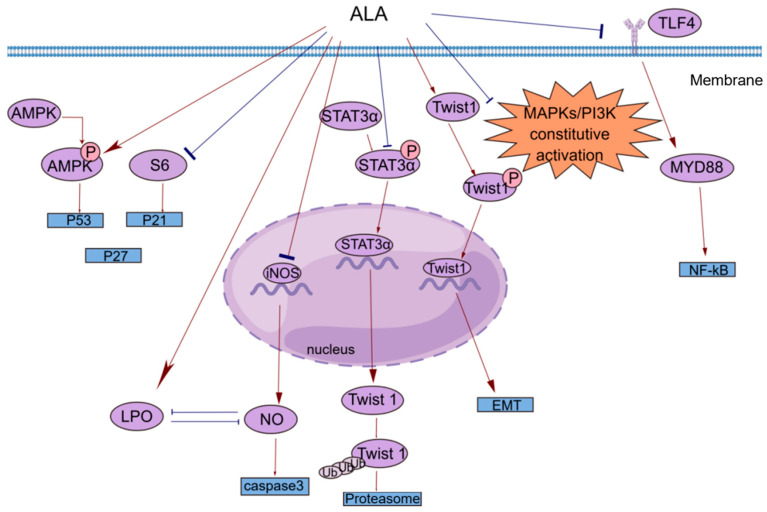
α-linolenic acid (ALA), which is a member of the n-3 polyunsaturated fatty acid (n-3 PUFA) family, has often been ignored due to a lack of information. ALA has gradually attracted increased attention due to its nutritional and medicinal advantages. Studies have shown that ALA exerts beneficial effects on a variety of diseases, including cancer. In this review, we summarize the antitumor effects of ALA in the context of cell biology, including the inhibition of proliferation, the induction of apoptosis, the inhibition of metastasis and angiogenesis, and antioxidant effects. In addition, studies have shown that ALA can be used as a drug carrier or exert positive clinical effects when combined with drugs. Therefore, the use of ALA in clinical treatments is very promising and valuable.
α-亚麻酸(ALA)是n-3多不饱和脂肪酸(n-3 PUFA)家族的一员,由于信息匮乏,它常常被忽视。由于其营养和药用优势,ALA逐渐引起了越来越多的关注。研究表明,ALA对包括癌症在内的多种疾病具有有益作用。在这篇综述中,我们在细胞生物学背景下总结了ALA的抗肿瘤作用,包括抑制增殖、诱导凋亡、抑制转移和血管生成以及抗氧化作用。此外,研究表明ALA可以用作药物载体或与药物联合使用时发挥积极的临床效果。因此,ALA在临床治疗中的应用非常有前景且具有价值。