Ross Andy, Kelly Yvonne, Sacker Amanda
Research Department of Epidemiology and Public Health, ESRC International Centre for Lifecourse Studies in Society and Health, University College London, 1-19 Torrington Place, London, WC1E 6BT, UK.
Soc Psychiatry Psychiatr Epidemiol. 2017 Sep;52(9):1147-1158. doi: 10.1007/s00127-017-1419-4. Epub 2017 Jul 11.
Previous research on time trends of young people's mental health in Britain has produced conflicting findings: evidence for deterioration in mental health during the late 20th century followed by stability and slight improvement during the early 21st century is contrasted with evidence showing continued deterioration. The present study adds to the evidence base by assessing time trends in means, variances, and both low and high psychological distress scores covering a similar period.
GHQ-12 (Likert scale) was regressed on time (adjusting for age) using a sample of young people aged 16-24 between 1991 and 2008 from the British Household Panel Study. Change in variance was assessed using Levene's homogeneity of variance test across 9-year intervals. Polarisation was assessed by a comparison of the prevalence of scores ≥1 standard deviation and ≥1.5 standard deviations above and below the pooled mean.
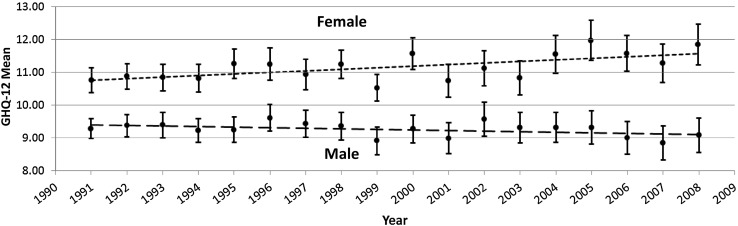
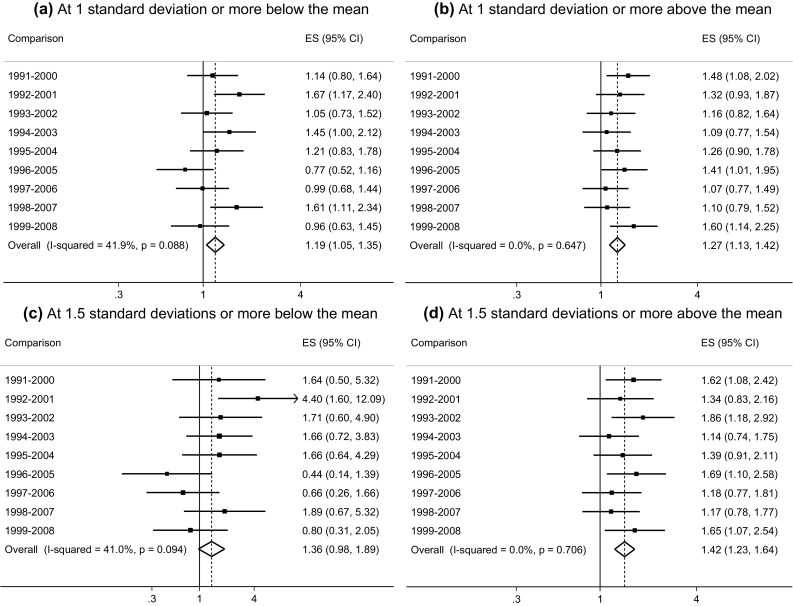
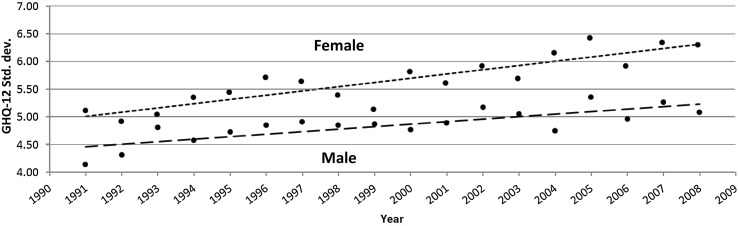
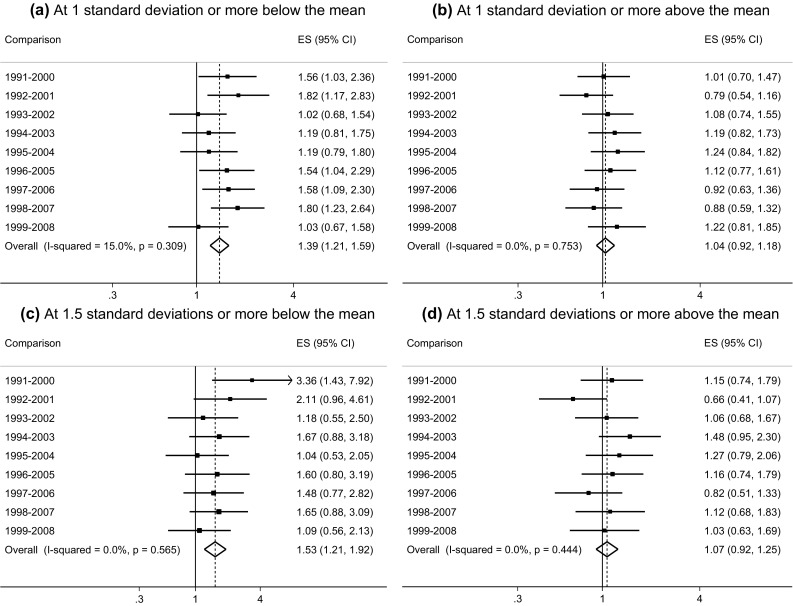
There was a small but significant increase in mean GHQ-12 among young women (b 0.048; 95% CI 0.016, 0.080) only. Variance increased significantly (p < 0.05) across 9-year intervals in seven out of nine comparisons for women and in six out of nine comparisons for men. There were significant increases in low (OR: 1.19; 95% CI 1.05, 1.35), high (OR: 1.27; 95% CI 1.13, 1.42), and very high scores (OR: 1.42; 95% CI 1.23, 1.64) for young women, and increases in low (OR: 1.39; 95% CI 1.21, 1.59) and very low (OR: 1.53; 95% CI 1.21, 1.92) scores for young men.
The evidence suggests a polarisation of the psychological distress of young women in Britain between 1991 and 2008.
此前关于英国年轻人心理健康时间趋势的研究结果相互矛盾:有证据表明20世纪末心理健康状况恶化,随后在21世纪初保持稳定并略有改善,但也有证据显示持续恶化。本研究通过评估相似时期内均值、方差以及低心理困扰得分和高心理困扰得分的时间趋势,为证据库增添内容。
使用英国家庭调查中1991年至2008年期间16至24岁年轻人的样本,将一般健康问卷12项(李克特量表)对时间进行回归分析(调整年龄因素)。使用Levene方差齐性检验评估9年间隔期内的方差变化。通过比较得分高于和低于合并均值1个标准差及1.5个标准差的患病率来评估两极分化情况。
仅年轻女性的一般健康问卷12项均值有小幅但显著的增加(b 0.048;95%置信区间0.016,0.080)。在女性的九次比较中有七次、男性的九次比较中有六次,9年间隔期内方差显著增加(p < 0.05)。年轻女性的低得分(比值比:1.19;95%置信区间1.05,1.35)、高得分(比值比:1.27;95%置信区间1.13,1.42)和极高得分(比值比:1.42;95%置信区间1.23,1.64)显著增加,年轻男性的低得分(比值比:1.39;95%置信区间1.21,1.59)和极低得分(比值比:1.53;95%置信区间1.21,1.92)增加。
证据表明1991年至2008年期间英国年轻女性心理困扰存在两极分化。