Okawa Hikohiro, Morokuma Seiichi, Maehara Kana, Arata Akiko, Ohmura Yoshiyuki, Horinouchi Takashi, Konishi Yukuo, Kato Kiyoko
Department of Obstetrics and Gynecology, Graduate School of Medical Sciences, Kyushu University, Fukuoka, Japan.
Research Center for Environmental and Developmental Medical Sciences, Kyushu University, Fukuoka, Japan.
PLoS One. 2017 Jul 12;12(7):e0178722. doi: 10.1371/journal.pone.0178722. eCollection 2017.
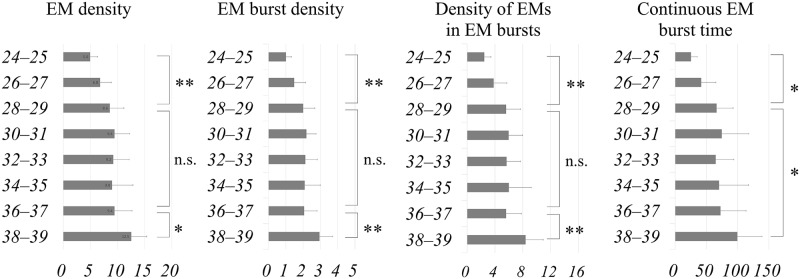
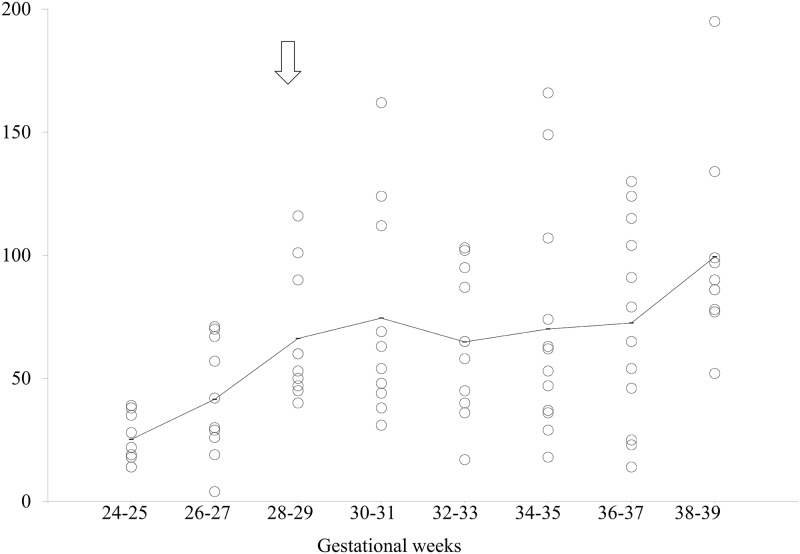
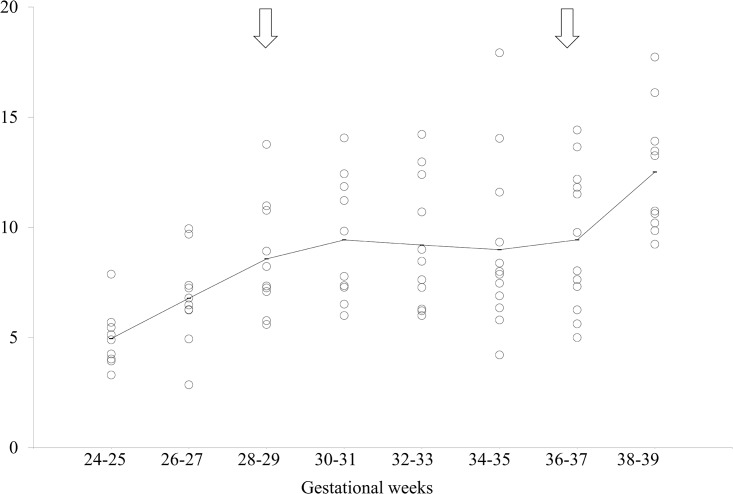
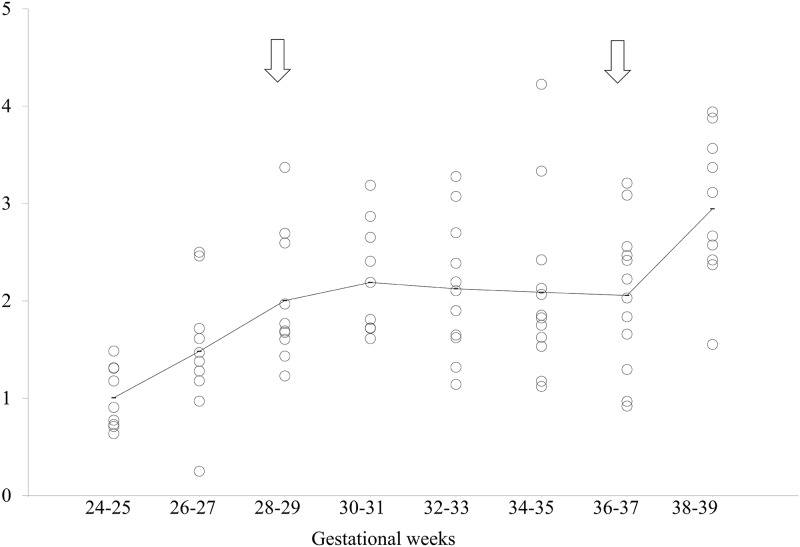
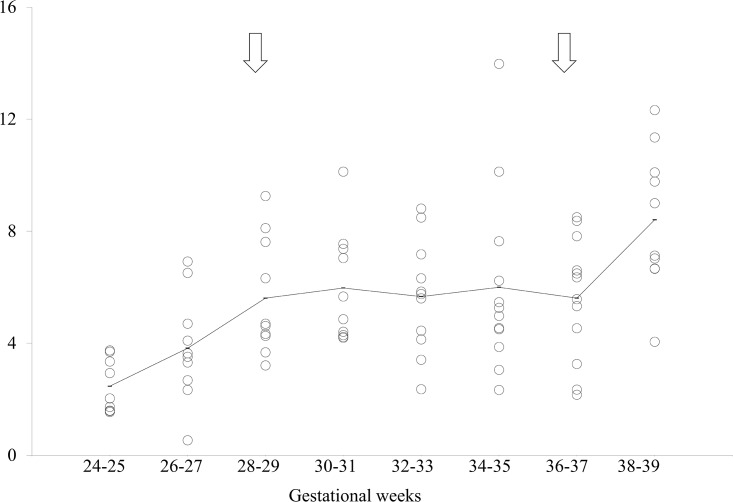
Rapid eye movement (REM) sleep occurs throughout a relatively large proportion of early development, and normal REM activity appears to be required for healthy brain development. The eye movements (EMs) observed during REM sleep are the most distinctive characteristics of this state. EMs are used as an index of neurological function postnatally, but no specific indices of EM activity exist for fetuses. We aimed to identify and characterize EM activity, particularly EM bursts suggestive of REM periods, in fetuses with a gestational age between 24 and 39 weeks. This cross-sectional study included 84 normal singleton pregnancies. Fetal EMs were monitored using real-time ultrasonography for 60 min and recorded as videos. The videos were manually converted into a time series of EM events, which were then analyzed by piecewise linear regression for various EM characteristics, including EM density, EM burst density, density of EMs in EM bursts, and continuous EM burst time. Two critical points for EM density, EM burst density, and density of EMs in EM bursts were evident at gestation weeks 28-29 and 36-37. Overall EM activity in human fetuses increased until 28-29 weeks of gestation, then again from 36-37 to 38-39 weeks of gestation. These findings may be useful for creating indices of fetal neurological function for prognostic purposes.
快速眼动(REM)睡眠在早期发育的相当大比例时间内都会出现,正常的REM活动似乎是健康大脑发育所必需的。REM睡眠期间观察到的眼球运动(EMs)是这种状态最显著的特征。出生后,EMs被用作神经功能的指标,但对于胎儿来说,不存在EM活动的特定指标。我们旨在识别和描述胎龄在24至39周之间的胎儿的EM活动,特别是提示REM期的EM爆发。这项横断面研究纳入了84例正常单胎妊娠。使用实时超声对胎儿的EMs进行60分钟监测,并记录为视频。这些视频被手动转换为EM事件的时间序列,然后通过分段线性回归分析各种EM特征,包括EM密度、EM爆发密度、EM爆发中的EM密度以及连续EM爆发时间。在妊娠第28 - 29周和36 - 37周时,EM密度、EM爆发密度以及EM爆发中的EM密度出现两个关键点。人类胎儿的总体EM活动在妊娠28 - 29周前增加,然后在妊娠36 - 37周至38 - 39周时再次增加。这些发现可能有助于创建用于预后目的的胎儿神经功能指标。