Karimi Neamat, Rashedi Jalil, Mahdavi Poor Behroz, Arabi Sepideh, Ghorbani Maryam, Tahmasebpour Nahideh, Asgharzadeh Mohammad
Department of Biochemistry, School of Medicine, Ardabil University of Medical Sciences, Ardabil, Iran.
Department of Laboratory Science, Faculty of Paramedicine, Tabriz University of Medical Sciences, Tabriz, Iran.
Gastroenterol Hepatol Bed Bench. 2017 Spring;10(2):102-107.
The present study was conducted to survey the potential cytotoxic influence of freeze-dried aqueous extract of its fruits on gastrointestinal cell lines, namely AGS (human gastric carcinoma) and KYSE30 (human esophageal squamous cell carcinoma.
Rosemary () is a wild medicinal plant shown to have anticancer activity. Carnosic and rosmarinic acids are compounds, obtained from it through several extraction methods.
The aqueous extract of the fruits of was freeze-dried, and KYSE30 and AGS cancer cell lines were treated with crude extract. Cytotoxic effect of the extracts on the cell lines was examined using 3-(4, 5-Dimethylthiazol-2-yl)-2,5-diphenyltetrazolium bromide (MTT) and neutral red assay. Apoptotic cells were detected with ethidium bromide/acridine orange (EB/AO). Cell-cycle distributions were evaluated by flow cytometry.
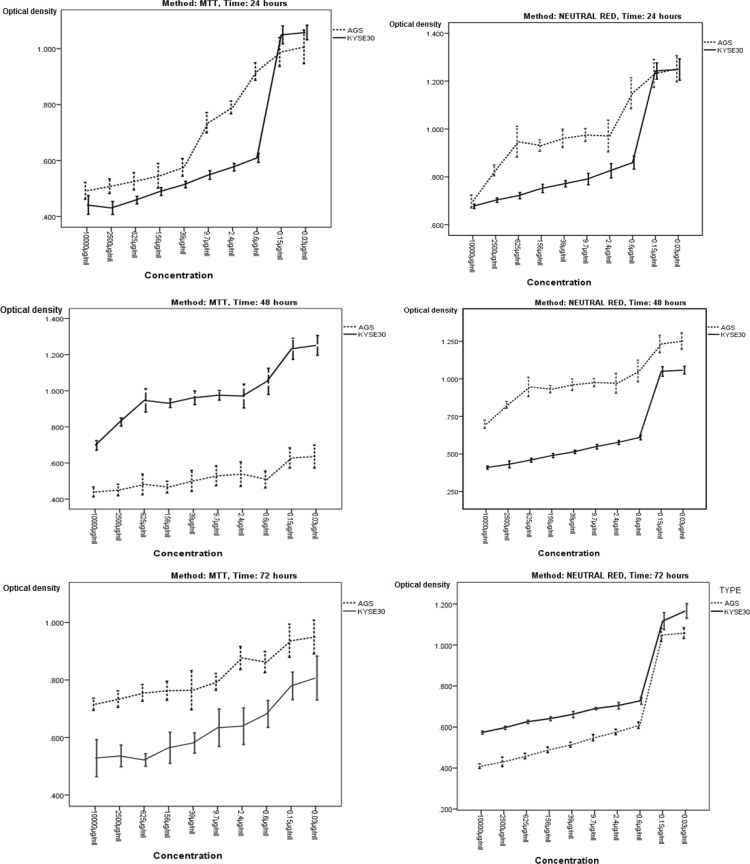
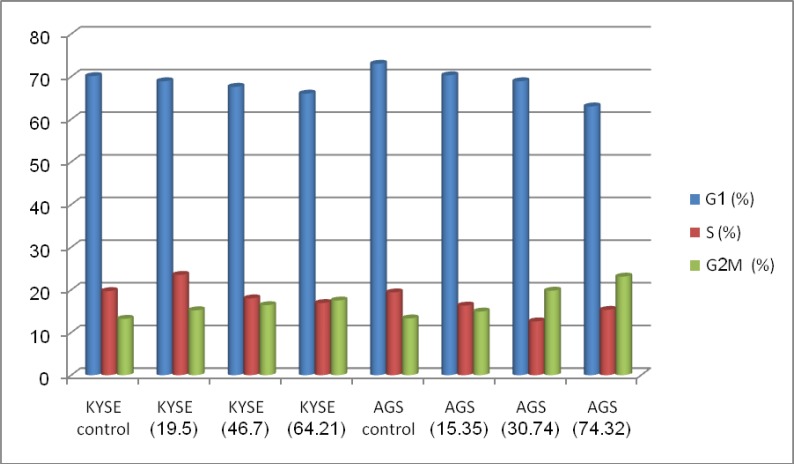
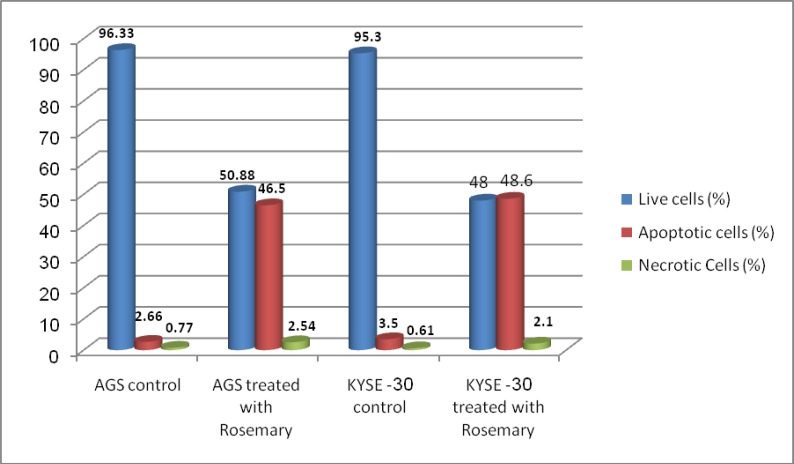
IC50 values were 4.1, 1.8 and 1.3 mg/mL for AGS cell lines after 24, 48 and 72 hours by MTT assay, respectively, and 4.4, 2.1 and 1.1 mg/mL by neutral red assay, respectively. IC50 values for KYSE30 cell lines were 600, 180 and 150 mg/mL after 24, 48 and 72 hours by MTT assay, and 860, 270 and 230 mg/mL by neutral red. EB/AO staining increased in apoptotic cells. After 24 h of treatment at different concentrations, significant increases and decreases in population were shown at G2/M and G1 phases, respectively.
The aqueous extract of the fruits of was freeze-dried, and KYSE30 and AGS cancer cell lines were treated with crude extract. Cytotoxic effect of the extracts on the cell lines was examined using 3-(4, 5-Dimethylthiazol-2-yl)-2,5-diphenyltetrazolium bromide (MTT) and neutral red assay. Apoptotic cells were detected with ethidium bromide/acridine orange (EB/AO). Cell-cycle distributions were evaluated by flow cytometry.
本研究旨在调查其果实冻干水提取物对胃肠道细胞系,即AGS(人胃癌)和KYSE30(人食管鳞状细胞癌)的潜在细胞毒性影响。
迷迭香是一种具有抗癌活性的野生药用植物。通过多种提取方法可从其中获得鼠尾草酸和迷迭香酸。
将迷迭香果实的水提取物冻干,并用粗提取物处理KYSE30和AGS癌细胞系。使用3-(4,5-二甲基噻唑-2-基)-2,5-二苯基四氮唑溴盐(MTT)和中性红试验检测提取物对细胞系的细胞毒性作用。用溴化乙锭/吖啶橙(EB/AO)检测凋亡细胞。通过流式细胞术评估细胞周期分布。
MTT试验中,AGS细胞系在24、48和72小时后的IC50值分别为4.1、1.8和1.3mg/mL,中性红试验中分别为4.4、2.1和1.1mg/mL。KYSE30细胞系在24、48和72小时后的MTT试验IC50值分别为600、180和150mg/mL,中性红试验中分别为860、270和230mg/mL。EB/AO染色在凋亡细胞中增加。在不同浓度处理24小时后,G2/M期细胞群体显著增加,G1期细胞群体显著减少。
将迷迭香果实的水提取物冻干,并用粗提取物处理KYSE30和AGS癌细胞系。使用3-(4,5-二甲基噻唑-2-基)-2,5-二苯基四氮唑溴盐(MTT)和中性红试验检测提取物对细胞系的细胞毒性作用。用溴化乙锭/吖啶橙(EB/AO)检测凋亡细胞。通过流式细胞术评估细胞周期分布。