Geerts Caroline C, van Dillen Jeroen, Klomp Trudy, Lagro-Janssen Antoine L M, de Jonge Ank
Department of Midwifery Science, Academie Verloskunde Amsterdam Groningen (AVAG) and the EMGO Institute for Health and Care Research, VU University Medical Center Amsterdam, Van der Boechorststraat 7, 1081 BT, Amsterdam, The Netherlands.
Department of Obstetrics and Gynaecology, Radboud University Medical Center Nijmegen, Geert Grooteplein Zuid 10, 6525 GA, Nijmegen, the Netherlands.
BMC Pregnancy Childbirth. 2017 Jul 14;17(1):229. doi: 10.1186/s12884-017-1410-9.
The caregiver has an important influence on women's birth experiences. When transfer of care during labour is necessary, care is handed over from one caregiver to the other, and this might influence satisfaction with care. It is speculated that satisfaction with care is affected in particular for women who need to be transferred from home to hospital. We examined the level of satisfaction with the caregiver among women with planned home versus planned hospital birth in midwife-led care.
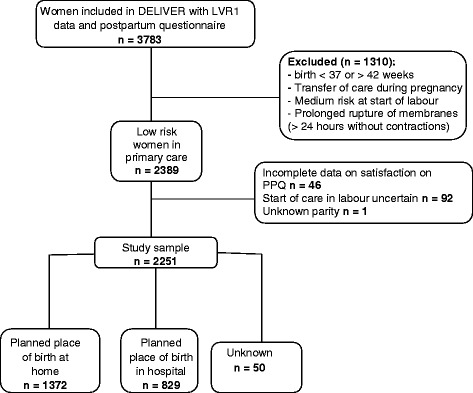
We used data from the prospective multicentre DELIVER (Data EersteLIjns VERloskunde) cohort-study, conducted in 2009 and 2010 in the Netherlands. Women filled in a postpartum questionnaire which contained elements of the Consumer Quality index. This instrument measures 'general rate of satisfaction with the caregiver' (scale from 1 to 10, with cut-off of below 9) and 'quality of treatment by the caregiver' (containing 7 items on a 4 point Likert scale, with cut-off of mean of 4 or lower).
Women who planned a home birth (n = 1372) significantly more often rated 'quality of treatment by caregiver' high than women who planned a hospital birth (n = 829). Primiparous women who planned a home birth significantly more often had a high rate (9 or 10) for 'general satisfaction with caregiver' (adj.OR 1.48; 95% CI 1.1, 2.0). Also, primiparous women who planned a home birth and had care transferred during labour (331/553; 60%) significantly more often had a high rate (9 or 10) for 'general satisfaction' compared to those who planned a hospital birth and who had care transferred (1.44; 1.0-2.1). Furthermore, they significantly more often rated 'quality of treatment by caregiver' high, than 276/414 (67%) primiparous women who planned a hospital birth and who had care transferred (1.65; 1.2-2.3). No differences were observed for multiparous women who had planned home or hospital birth and who had care transferred.
Planning home birth is associated to a good experience of quality of care by the caregiver. Transferred planned home birth compared to a transferred planned hospital birth does not lead to a more negative experience of care received from the caregiver.
护理人员对女性的分娩体验有重要影响。分娩期间如有必要进行护理交接,护理工作会从一名护理人员转交给另一名,这可能会影响护理满意度。据推测,对于那些需要从家中转至医院的女性来说,护理满意度尤其会受到影响。我们调查了在助产士主导的护理模式下,计划在家分娩与计划在医院分娩的女性对护理人员的满意度水平。
我们使用了2009年和2010年在荷兰进行的前瞻性多中心DELIVER(首诊产科学数据)队列研究的数据。女性填写了一份包含消费者质量指数要素的产后问卷。该工具测量“对护理人员的总体满意度”(1至10分制,临界值为9分以下)和“护理人员的治疗质量”(包含7个项目,采用4分李克特量表,临界值为平均分4分或更低)。
计划在家分娩的女性(n = 1372)比计划在医院分娩的女性(n = 829)更常给予“护理人员的治疗质量”高分。计划在家分娩的初产妇对“护理人员的总体满意度”给出高分(9分或10分)的比例显著更高(校正比值比1.48;95%置信区间1.1,2.0)。此外,计划在家分娩且在分娩期间护理发生交接的初产妇(331/553;60%)对“总体满意度”给出高分(9分或10分)的比例显著高于计划在医院分娩且护理发生交接的初产妇(1.44;1.0 - 2.1)。此外,她们给予“护理人员的治疗质量”高分的比例也显著高于计划在医院分娩且护理发生交接的276/414(67%)初产妇(1.65;1.2 - 2.3)。对于计划在家或医院分娩且护理发生交接的经产妇,未观察到差异。
计划在家分娩与护理人员提供的优质护理体验相关。与计划在医院分娩且护理发生交接相比,计划在家分娩且护理发生交接并不会导致从护理人员处获得的护理体验更负面。