Kwak Jueun, Jeong Hyunsuk, Chun Sungha, Bahk Ji Hoon, Park Misun, Byun Youngseol, Lee Jina, Yim Hyeon Woo
Catholic Medical Center, Seoul, Republic of Korea.
Department of Preventive Medicine, College of Medicine, The Catholic University of Korea, Seoul, Republic of Korea.
BMJ Open. 2017 Jul 12;7(7):e013984. doi: 10.1136/bmjopen-2016-013984.
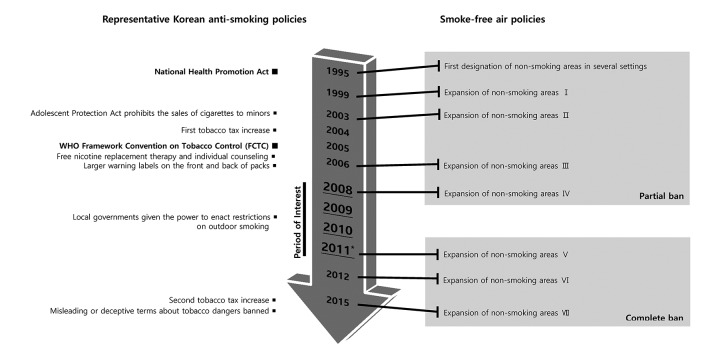
Since the Health Promotion Act was introduced in Korea in 1995, anti-smoking policies and regulations have undergone numerous revisions, and non-smoking areas have gradually been expanded. The purpose of this study was to examine the impact of a partial legislative ban on adolescent exposure to secondhand smoke using objective urinary cotinine levels in a nationwide representative sample.
Urine cotinine levels were measured in the Korea National Health and Nutrition Examination Survey from 2008 to 2011. This study was a trend analysis of 4 years of national survey data from 2197 Korean youth aged 10-18 years. Among non-smokers, the 75th percentile urinary cotinine level was estimated. We also considered the number of household smokers.
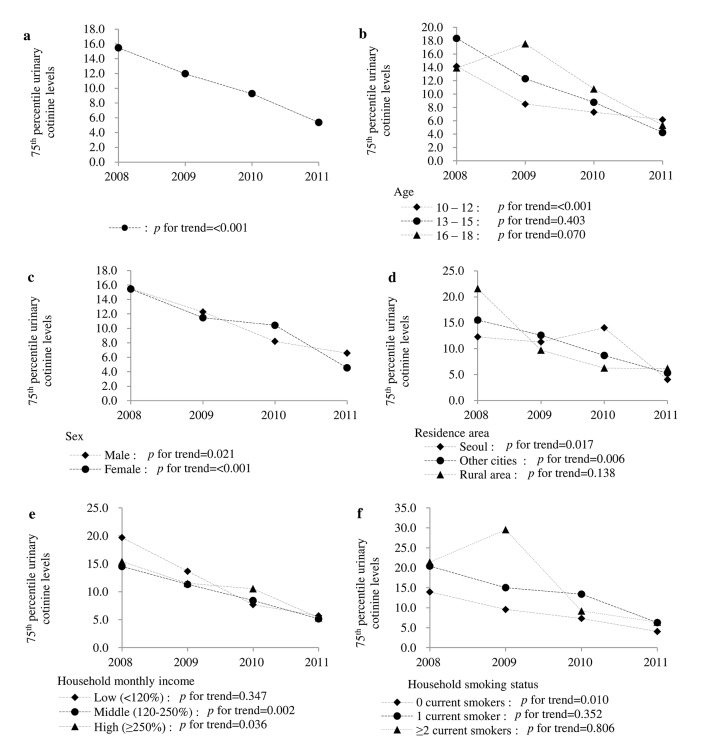
The 75th percentile urine cotinine level of non-smokers showed a significant decreasing trend from 2008 to 2011, from 15.47 to 5.37 ng/mL, respectively. Urine cotinine did not decline significantly in non-smokers living with smokers during the study period. The results did not show a statistically significant reduction in smoking rate in adolescents from 2008 to 2011, although there was a trend towards a decrease (p=0.081).
Based on urine cotinine levels, government-initiated anti-smoking policies have only been effective among highly exposed non-smoking adolescents during the study period. Further study needs to evaluate whether or not the legislative ban affects domestic smoking exposure.
自1995年韩国引入《健康促进法》以来,反吸烟政策和法规历经多次修订,无烟区也在逐步扩大。本研究旨在通过全国代表性样本中客观的尿可替宁水平,探讨部分立法禁令对青少年接触二手烟的影响。
在2008年至2011年的韩国国民健康与营养检查调查中测量尿可替宁水平。本研究对来自2197名10 - 18岁韩国青少年的4年全国调查数据进行趋势分析。在非吸烟者中,估计尿可替宁水平的第75百分位数。我们还考虑了家庭吸烟者的数量。
非吸烟者尿可替宁水平的第75百分位数在2008年至2011年呈显著下降趋势,分别从15.47降至5.37 ng/mL。在研究期间,与吸烟者同住的非吸烟者尿可替宁水平没有显著下降。尽管有下降趋势(p = 0.081),但2008年至2011年青少年吸烟率并未显示出统计学上的显著降低。
基于尿可替宁水平,政府发起的反吸烟政策在研究期间仅对接触二手烟程度高的非吸烟青少年有效。需要进一步研究来评估立法禁令是否会影响家庭内吸烟暴露情况。