Department of Organic Chemistry, Indian Association for the Cultivation of Science, Jadavpur, Kolkata-700032, India.
Nat Commun. 2017 Jul 14;8:16103. doi: 10.1038/ncomms16103.
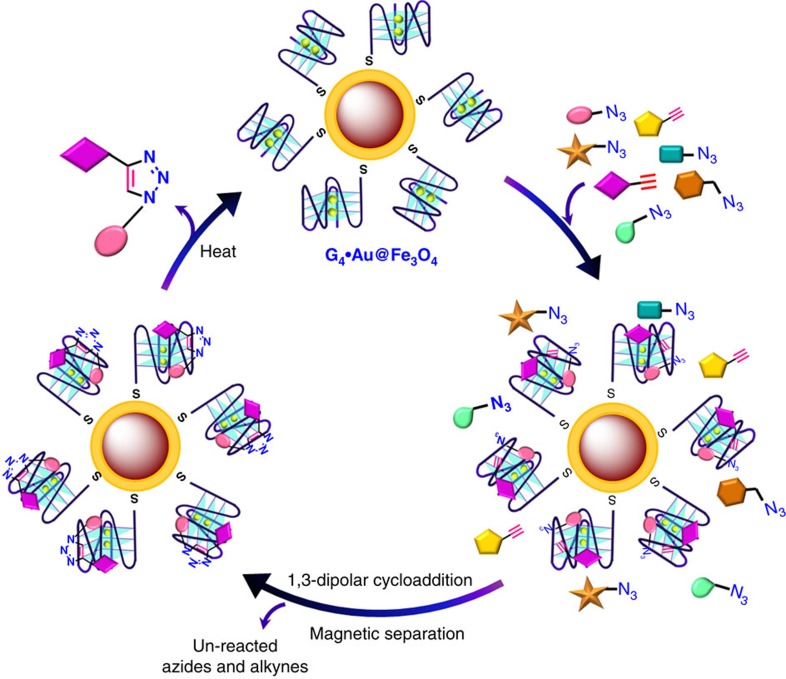
The development of small molecules is essential to modulate the cellular functions of biological targets in living system. Target Guided Synthesis (TGS) approaches have been used for the identification of potent small molecules for biological targets. We herein demonstrate an innovative example of TGS using DNA nano-templates that promote Huisgen cycloaddition from an array of azide and alkyne fragments. A G-quadruplex and a control duplex DNA nano-template have been prepared by assembling the DNA structures on gold-coated magnetic nanoparticles. The DNA nano-templates facilitate the regioselective formation of 1,4-substituted triazole products, which are easily isolated by magnetic decantation. The G-quadruplex nano-template can be easily recovered and reused for five reaction cycles. The major triazole product, generated by the G-quadruplex inhibits c-MYC expression by directly targeting the c-MYC promoter G-quadruplex. This work highlights that the nano-TGS approach may serve as a valuable strategy to generate target-selective ligands for drug discovery.
小分子的发展对于调节生物靶标在活系统中的细胞功能至关重要。靶向导向合成(TGS)方法已被用于鉴定针对生物靶标的有效小分子。本文展示了一种使用 DNA 纳米模板的创新 TGS 示例,该模板可促进叠氮化物和炔烃片段阵列中的 Huisgen 环加成。通过在金涂覆的磁性纳米颗粒上组装 DNA 结构,制备了 G-四链体和对照双链 DNA 纳米模板。DNA 纳米模板促进了 1,4-取代三唑产物的区域选择性形成,这些产物可通过磁沉淀轻松分离。G-四链体纳米模板可轻松回收并重复使用五次反应循环。由 G-四链体生成的主要三唑产物可通过直接靶向 c-MYC 启动子 G-四链体来抑制 c-MYC 表达。这项工作强调了纳米 TGS 方法可能成为发现药物的靶标选择性配体的有价值策略。