Vondras Amanda M, Commisso Mauro, Guzzo Flavia, Deluc Laurent G
Deluc Laboratory, Department of Horticulture, Oregon State University, CorvallisOR, United States.
Guzzo Laboratory, Department of Biotechnology, University of VeronaVerona, Italy.
Front Plant Sci. 2017 Jun 30;8:1108. doi: 10.3389/fpls.2017.01108. eCollection 2017.
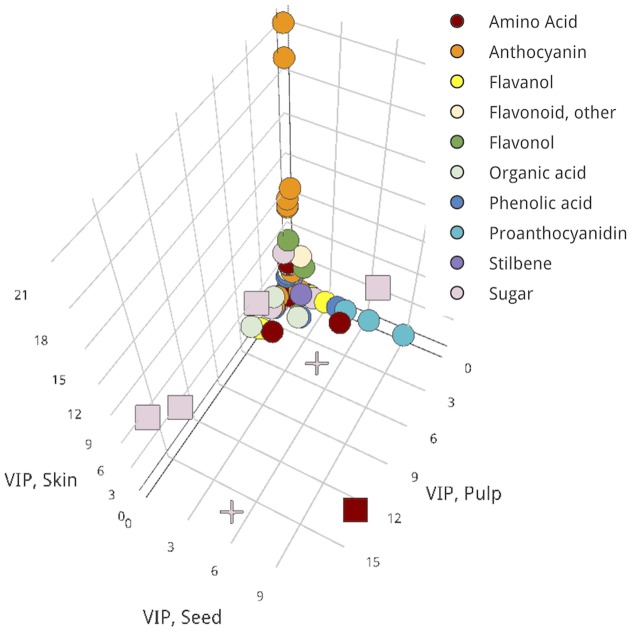
Uneven ripening in is increasingly recognized as a phenomenon of interest, with substantial implications for fruit and wine composition and quality. This study sought to determine whether variation late in ripening (∼Modified Eichhorn-Lorenz stage 39) was associated with developmental differences that were observable as fruits within a cluster initiated ripening (véraison). Four developmentally distinct ripening classes of berries were tagged at cluster véraison, sampled at three times late in ripening, and subjected to untargeted HPLC-MS to measure variation in amino acids, sugars, organic acids, and phenolic metabolites in skin, pulp, and seed tissues separately. Variability was described using predominantly two strategies. In the first, multivariate analysis (Orthogonal Projections to Latent Structures-Discriminant Analysis, OPLS-DA) was used to determine whether fruits were still distinguishable per their developmental position at véraison and to identify which metabolites accounted for these distinctions. The same technique was used to assess changes in each tissue over time. In a second strategy and for each annotated metabolite, the variance across the ripening classes at each time point was measured to show whether intra-cluster variance (ICV) was growing, shrinking, or constant over the period observed. Indeed, berries could be segregated by OPLS-DA late in ripening based on their developmental position at véraison, though the four ripening classes were aggregated into two larger ripening groups. Further, not all tissues were dynamic over the period examined. Although pulp tissues could be segregated by time sampled, this was not true for seed and only moderately so for skin. Ripening group differences in seed and skin, rather than the time fruit was sampled, were better able to define berries. Metabolites also experienced significant reductions in ICV between single pairs of time points, but never across the entire experiment. Metabolites often exhibited a combination of ICV expansion, contraction and persistence. Finally, we observed significant differences in the abundance of some metabolites between ripening classes that suggest the berries that initiated ripening first remained developmentally ahead of the lagging fruit even late in the ripening phase. This presents a challenge to producers who would seek to harvest at uniformity or at a predefined level of variation.
葡萄成熟不均日益被视为一种值得关注的现象,对果实和葡萄酒的成分及品质有重大影响。本研究旨在确定成熟后期(约改良艾希霍恩 - 洛伦兹阶段39)的变化是否与发育差异相关,这种差异在一串葡萄中的果实开始成熟(转色期)时即可观察到。在葡萄串转色期对四类发育明显不同的成熟浆果进行标记,在成熟后期分三次采样,并分别对果皮、果肉和种子组织进行非靶向高效液相色谱 - 质谱分析,以测量氨基酸、糖、有机酸和酚类代谢物的变化。变异性主要用两种策略来描述。第一种策略是使用多变量分析(正交投影到潜在结构 - 判别分析,OPLS - DA)来确定果实根据其在转色期的发育位置是否仍可区分,并识别哪些代谢物导致了这些差异。同样的技术用于评估每个组织随时间的变化。第二种策略是针对每种注释的代谢物,测量每个时间点成熟类别之间的方差,以显示在观察期内串内方差(ICV)是增加、减少还是保持不变。事实上,在成熟后期,通过OPLS - DA可以根据果实转色期的发育位置将浆果分开,尽管这四类成熟浆果被合并为两个更大的成熟组。此外,并非所有组织在研究期间都是动态变化的。虽然果肉组织可以根据采样时间分开,但种子组织并非如此,果皮组织只是适度如此。种子和果皮的成熟组差异,而非果实采样时间,更能区分浆果。代谢物在单个时间点对之间的ICV也有显著降低,但在整个实验过程中从未出现这种情况。代谢物通常表现出ICV扩张、收缩和持续的组合。最后,我们观察到成熟类别之间某些代谢物丰度存在显著差异,这表明即使在成熟后期,最早开始成熟的浆果在发育上仍领先于滞后的果实。这给试图统一收获或以预定义的变异水平收获的生产者带来了挑战。