MRC Centre for Global Infectious Disease Analysis; and the Abdul Latif Jameel Institute for Disease and Emergency Analytics, School of Public Health, Imperial College London, London, United Kingdom.
Department of Genetics, University of Cambridge, Cambridge, United Kingdom.
PLoS Negl Trop Dis. 2022 Jul 11;16(7):e0010592. doi: 10.1371/journal.pntd.0010592. eCollection 2022 Jul.
Dengue virus (DENV) infection is a global health concern of increasing magnitude. To target intervention strategies, accurate estimates of the force of infection (FOI) are necessary. Catalytic models have been widely used to estimate DENV FOI and rely on a binary classification of serostatus as seropositive or seronegative, according to pre-defined antibody thresholds. Previous work has demonstrated the use of thresholds can cause serostatus misclassification and biased estimates. In contrast, mixture models do not rely on thresholds and use the full distribution of antibody titres. To date, there has been limited application of mixture models to estimate DENV FOI.
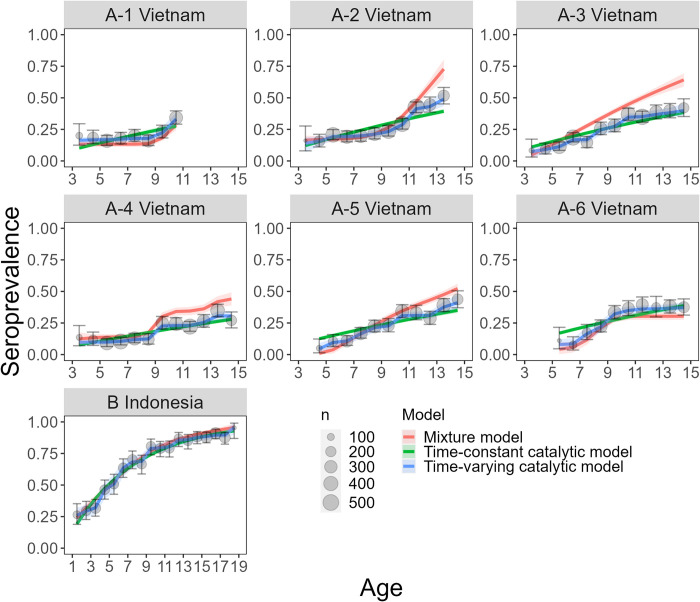
We compare the application of mixture models and time-constant and time-varying catalytic models to simulated data and to serological data collected in Vietnam from 2004 to 2009 (N ≥ 2178) and Indonesia in 2014 (N = 3194).
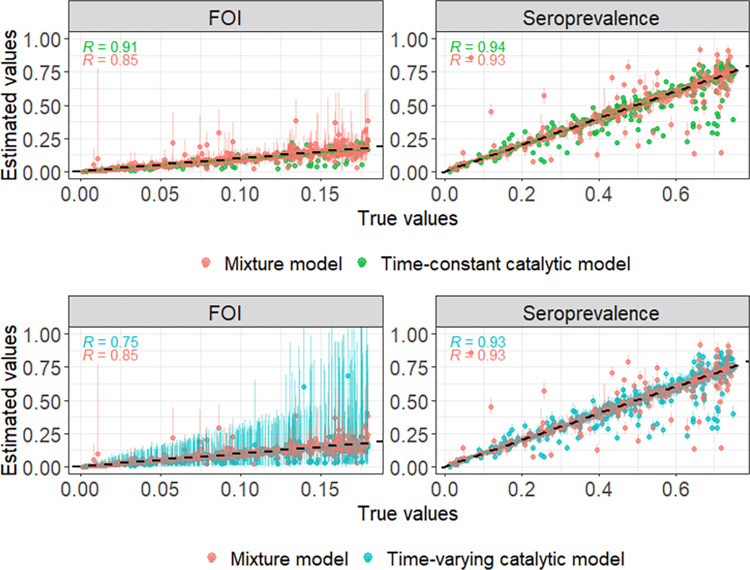
The simulation study showed larger mean FOI estimate bias from the time-constant and time-varying catalytic models (-0.007 (95% Confidence Interval (CI): -0.069, 0.029) and -0.006 (95% CI -0.095, 0.043)) than from the mixture model (0.001 (95% CI -0.036, 0.065)). Coverage of the true FOI was > 95% for estimates from both the time-varying catalytic and mixture model, however the latter had reduced uncertainty. When applied to real data from Vietnam, the mixture model frequently produced higher FOI and seroprevalence estimates than the catalytic models.
Our results suggest mixture models represent valid, potentially less biased, alternatives to catalytic models, which could be particularly useful when estimating FOI from data with largely overlapping antibody titre distributions.
登革热病毒(DENV)感染是一个日益严重的全球健康问题。为了制定干预策略,需要准确估计感染力度(FOI)。催化模型已被广泛用于估计 DENV FOI,并根据预先定义的抗体阈值将血清状态分为阳性或阴性。先前的研究表明,使用阈值会导致血清状态分类错误和估计值偏差。相比之下,混合模型不依赖于阈值,而是使用抗体滴度的全分布。迄今为止,混合模型在估计 DENV FOI 方面的应用有限。
我们比较了混合模型和时不变和时变催化模型在模拟数据以及 2004 年至 2009 年在越南(N≥2178)和 2014 年在印度尼西亚(N=3194)收集的血清学数据中的应用。
模拟研究表明,时不变和时变催化模型的平均 FOI 估计偏差较大(-0.007(95%置信区间(CI):-0.069,0.029)和-0.006(95%CI-0.095,0.043)),而混合模型的偏差较小(0.001(95%CI-0.036,0.065))。来自时变催化和混合模型的估计值的真实 FOI 覆盖率均>95%,但后者的不确定性较低。当应用于来自越南的真实数据时,混合模型经常产生比催化模型更高的 FOI 和血清流行率估计值。
我们的研究结果表明,混合模型是催化模型的有效、潜在偏差较小的替代方法,当估计具有大量重叠抗体滴度分布的数据中的 FOI 时,可能特别有用。