Choi Ho Jin, Jang So-Young, Hwang Eun Seong
Department of Life Science, University of Seoul, Seoul 130-743, Korea.
Mol Cells. 2015 Oct;38(10):918-24. doi: 10.14348/molcells.2015.0168. Epub 2015 Oct 7.
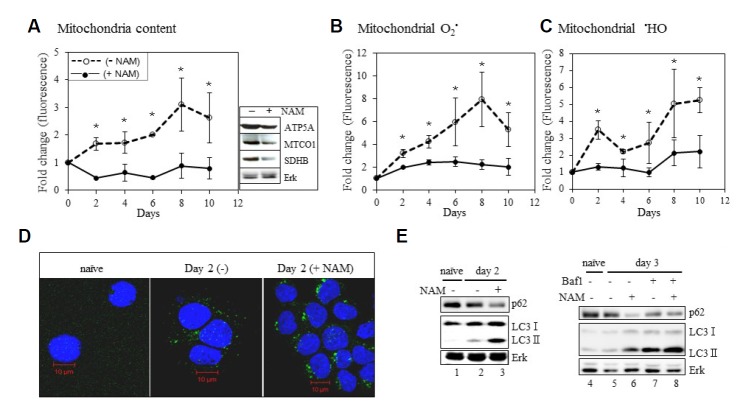
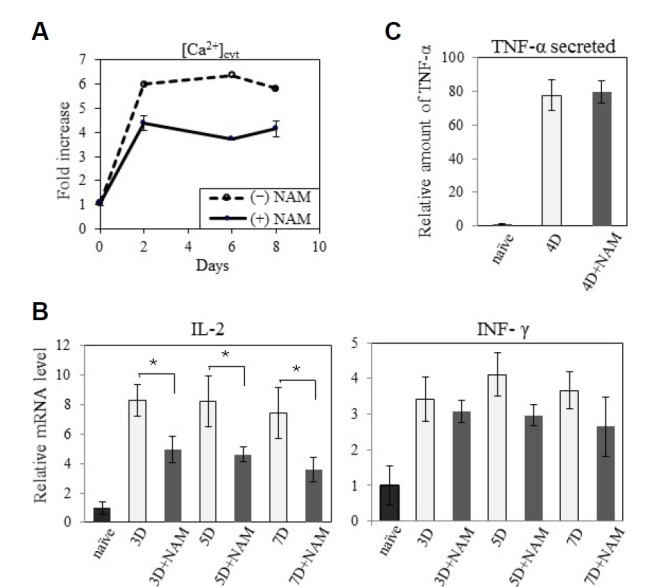
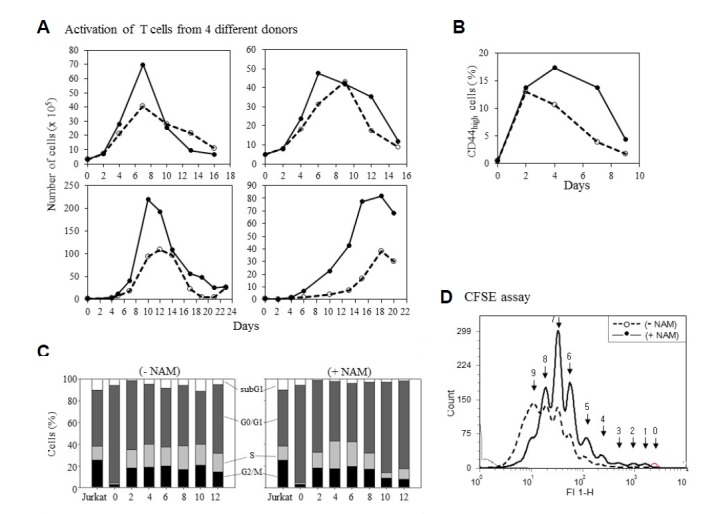
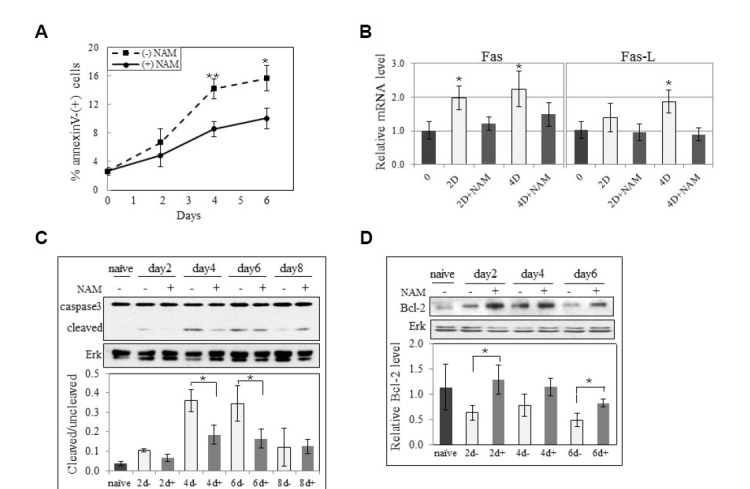
During T cell activation, mitochondrial content increases to meet the high energy demand of rapid cell proliferation. With this increase, the level of reactive oxygen species (ROS) also increases and causes the rapid apoptotic death of activated cells, thereby facilitating T cell homeostasis. Nicotinamide (NAM) has previously been shown to enhance mitochondria quality and extend the replicative life span of human fibroblasts. In this study, we examined the effect of NAM on CD8(+) T cell activation. NAM treatment attenuated the increase of mitochondrial content and ROS in T cells activated by CD3/CD28 antibodies. This was accompanied by an accelerated and higher-level clonal expansion resulting from attenuated apoptotic death but not increased division of the activated cells. Attenuation of ROS-triggered pro-apoptotic events and upregulation of Bcl-2 expression appeared to be involved. Although cells activated in the presence of NAM exhibited compromised cytokine gene expression, our results suggest a means to augment the size of T cell expansion during activation without consuming their limited replicative potential.
在T细胞活化过程中,线粒体含量增加以满足细胞快速增殖的高能量需求。随着这种增加,活性氧(ROS)水平也会升高,并导致活化细胞迅速凋亡死亡,从而促进T细胞稳态。烟酰胺(NAM)先前已被证明可提高线粒体质量并延长人成纤维细胞的复制寿命。在本研究中,我们检测了NAM对CD8(+) T细胞活化的影响。NAM处理减弱了由CD3/CD28抗体激活的T细胞中线粒体含量和ROS的增加。这伴随着克隆扩增加速且水平更高,这是由于凋亡死亡减弱而非活化细胞的分裂增加所致。ROS触发的促凋亡事件的减弱和Bcl-2表达的上调似乎与之有关。尽管在NAM存在下活化的细胞表现出细胞因子基因表达受损,但我们的结果表明了一种在活化过程中增加T细胞扩增规模的方法,而不消耗其有限的复制潜力。