Wei Feng, Ma Chengyuan, Zhou Tong, Dong Xuechao, Luo Qinghua, Geng Li, Ding Lijuan, Zhang Yandong, Zhang Li, Li Nan, Li Yang, Liu Yan
Department of Hepatobiliary & Pancreas, the First Hospital of Jilin University, Changchun, Jilin, 130021, China.
Department of neurosurgery, the First Hospital of Jilin University, Changchun, Jilin, 130021, China.
Mol Cancer. 2017 Jul 25;16(1):132. doi: 10.1186/s12943-017-0694-8.
Although gemcitabine-based chemotherapy has been established as a core multimodal therapy for non-small cell lung cancer (NSCLC) treatment, its clinical efficacy remains limited by the development of acquired resistance following tumor metastasis and relapse. In this study, we investigated how gemcitabine-resistant (GR) cells contribute to the development of NSCLC tumor malignancy via exosome-mediated transfer of microRNAs.
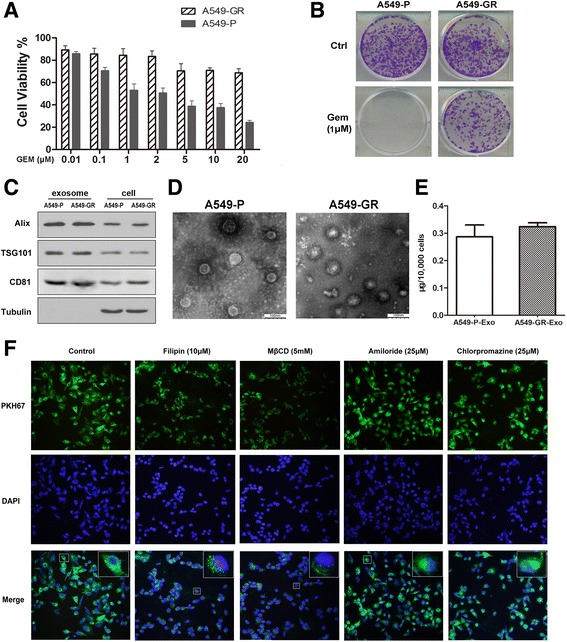
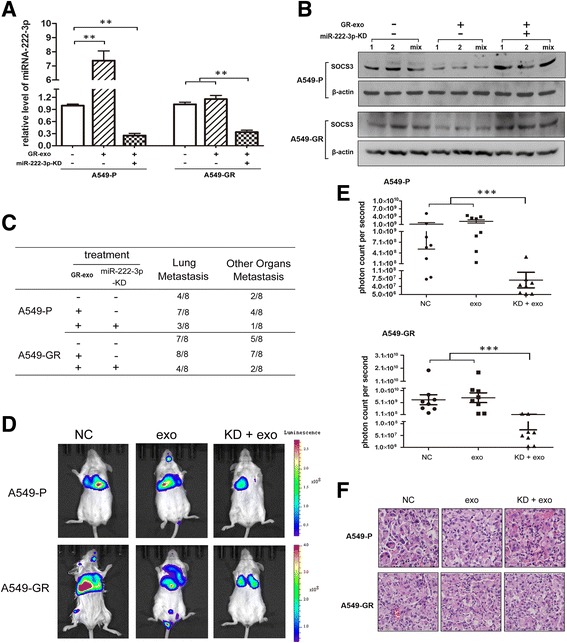
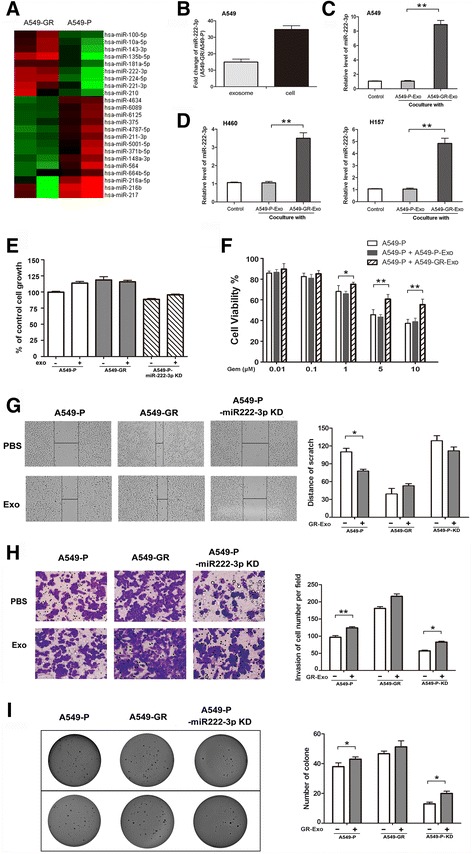
We first studied the mechanism of exosome internalization via PKH-67 staining and an immunofluorescence assay, then confirmed our finding by transmission electron microscopy and western blot analysis. Candidate miRNAs were identified through microarray analysis. Thereafter, RT-PCR, MTS, Transwell and soft agar assays were performed to assess the role of exosomic miR-222-3p in vitro. A 3' untranslated region reporter assay was applied to identify the target of miR-222-3p. A lung metastasis mouse model was constructed to evaluate tumor growth and metastasis in vivo. Finally, clinical samples were used for correlation analysis between exosomic miR-222-3p levels and patients' response to gemcitabine.
A549-GR-derived exosomes were internalized by receipt cells via caveolin- and lipid raft-dependent endocytosis, which allowed the transfer of miR-222-3p. Exosomic miR-222-3p enhanced the proliferation, gemcitabine resistance, migration, invasion, and anti-anoikis of parental sensitive cells by directly targeting the promoter of SOCS3. In addition, a higher level of exosomic miR-222-3p in sera usually predicted worse prognosis in NSCLC patients.
Our data demonstrate that exosomic-miR-222-3p functions as a principal regulator of gemcitabine resistance and malignant characteristics by targeting SOCS3. The exosomic miR-222-3p level in sera may be a potential prognostic biomarker for predicting gemcitabine sensitivity in NSCLC patients.
尽管以吉西他滨为基础的化疗已被确立为非小细胞肺癌(NSCLC)治疗的核心多模式疗法,但其临床疗效仍受肿瘤转移和复发后获得性耐药的发展所限。在本研究中,我们调查了吉西他滨耐药(GR)细胞如何通过外泌体介导的微小RNA转移促进NSCLC肿瘤恶性进展。
我们首先通过PKH-67染色和免疫荧光测定研究外泌体内化机制,然后通过透射电子显微镜和蛋白质印迹分析证实我们的发现。通过微阵列分析鉴定候选微小RNA。此后,进行逆转录-聚合酶链反应(RT-PCR)、MTS、Transwell和软琼脂试验以评估外泌体miR-222-3p在体外的作用。应用3'非翻译区报告基因试验鉴定miR-222-3p的靶标。构建肺转移小鼠模型以评估体内肿瘤生长和转移。最后,使用临床样本进行外泌体miR-222-3p水平与患者对吉西他滨反应之间的相关性分析。
A549-GR来源的外泌体通过小窝蛋白和脂筏依赖性内吞作用被受体细胞内化,这使得miR-222-3p得以转移。外泌体miR-222-3p通过直接靶向SOCS3的启动子增强亲本敏感细胞的增殖、吉西他滨耐药性、迁移、侵袭和抗失巢凋亡能力。此外,血清中外泌体miR-222-3p水平较高通常预示NSCLC患者预后较差。
我们的数据表明,外泌体-miR-222-3p通过靶向SOCS3发挥吉西他滨耐药和恶性特征的主要调节因子作用。血清中外泌体miR-222-3p水平可能是预测NSCLC患者吉西他滨敏感性的潜在预后生物标志物。