Barker Holly V, Niblock Michael, Lee Youn-Bok, Shaw Christopher E, Gallo Jean-Marc
Department of Basic and Clinical Neuroscience, Maurice Wohl Clinical Neuroscience Institute, Institute of Psychiatry, Psychology and Neuroscience, King's College LondonLondon, United Kingdom.
Front Cell Neurosci. 2017 Jul 11;11:195. doi: 10.3389/fncel.2017.00195. eCollection 2017.
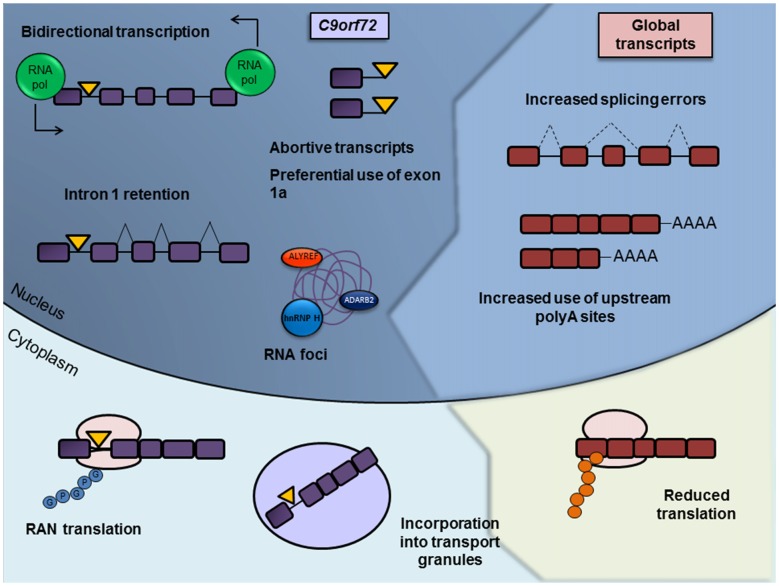
A large GGGGCC hexanucleotide repeat expansion in the first intron or promoter region of the gene is the most common genetic cause of familial and sporadic Amyotrophic lateral sclerosis (ALS), a devastating degenerative disease of motor neurons, and of Frontotemporal Dementia (FTD), the second most common form of presenile dementia after Alzheimer's disease. -associated ALS/FTD is a multifaceted disease both in terms of its clinical presentation and the misregulated cellular pathways contributing to disease progression. Among the numerous pathways misregulated in -associated ALS/FTD, altered RNA processing has consistently appeared at the forefront of research. This includes bidirectional transcription of the repeat sequence, accumulation of repeat RNA into nuclear foci sequestering specific RNA-binding proteins (RBPs) and translation of RNA repeats into dipeptide repeat proteins (DPRs) by repeat-associated non-AUG (RAN)-initiated translation. Over the past few years the true extent of RNA misprocessing in -associated ALS/FTD has begun to emerge and disruptions have been identified in almost all aspects of the life of an RNA molecule, including release from RNA polymerase II, translation in the cytoplasm and degradation. Furthermore, several alterations have been identified in the processing of the RNA itself, in terms of its transcription, splicing and localization. This review article aims to consolidate our current knowledge on the consequence of the repeat expansion on RNA processing and draws attention to the mechanisms by which several aspects of molecular pathology converge to perturb every stage of RNA metabolism.
该基因第一个内含子或启动子区域的一个大的GGGGCC六核苷酸重复序列扩增是家族性和散发性肌萎缩侧索硬化症(ALS)最常见的遗传病因,ALS是一种毁灭性的运动神经元退行性疾病,也是额颞叶痴呆(FTD)的病因,FTD是仅次于阿尔茨海默病的第二常见的早老性痴呆形式。与该重复序列相关的ALS/FTD在临床表现和导致疾病进展的细胞通路失调方面都是一种多方面的疾病。在与该重复序列相关的ALS/FTD中失调的众多通路中,RNA加工改变一直处于研究的前沿。这包括重复序列的双向转录、重复RNA积累形成核聚集体从而隔离特定的RNA结合蛋白(RBP),以及通过重复序列相关的非AUG(RAN)起始翻译将RNA重复序列翻译成二肽重复蛋白(DPR)。在过去几年中,与该重复序列相关的ALS/FTD中RNA错误加工的真实程度已开始显现,并且在RNA分子生命的几乎所有方面都发现了破坏,包括从RNA聚合酶II释放、在细胞质中的翻译和降解。此外,在该RNA本身的加工过程中,就其转录、剪接和定位而言,已经发现了一些改变。这篇综述文章旨在巩固我们目前关于该重复序列扩增对RNA加工影响的知识,并提请注意分子病理学的几个方面汇聚在一起扰乱RNA代谢每个阶段的机制。