Nam Jin Young, Kim Juyeong, Cho Kyoung Hee, Choi Jaewoo, Shin Jaeyong, Park Eun-Cheol
Department of Public Health, Graduate School, Yonsei University, Seoul, Republic of Korea.
Institute of Health Services Research, Yonsei University, Seoul, Republic of Korea.
BMC Psychiatry. 2017 Jul 28;17(1):274. doi: 10.1186/s12888-017-1439-3.
Previous studies have examined associations between sitting time and negative health outcomes and mental health. However, the relationship between overall sitting time and major depressive disorder (MDD) in South Korea has not been studied. This study examined the association between MDD and overall sitting time and physical activity in South Koreans.
Data from the sixth Korean National Health and Nutrition Examination Survey (KNHANES), a cross-sectional, nationally representative survey, were analyzed. Total participants were 4145 in 2014. MDD was assessed using the Patient Health Questionnaire (PHQ-9). Participants' data regarding self-reported sitting time and physical activity were analyzed via multiple logistic regression.
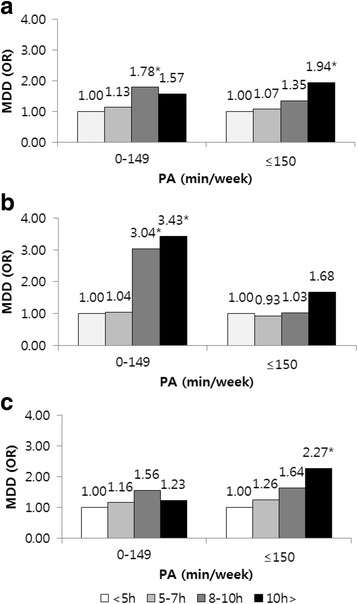
Results showed that people who sat for 8-10 h (OR: 1.56, 95% CI: 1.15-2.11) or more than 10 h (OR: 1.71, 95% CI: 1.23-2.39) had increased risk of MDD compared to those who sat for less than 5 h a day. Subgroup analysis showed that the strongest effect of reported sitting time on risk of MDD was found in men with lower levels of physical activity who sat for 8 to 10 h (OR: 3.04, 95% CI: 1.15-8.01) or more than 10 h (OR: 3.43, 95% CI: 1.26-9.35). Level of physical activity was not an independent predictor for MDD.
Sitting for long periods was associated with greater risk of MDD in South Korean adults. Reducing sitting time in people with MDD could help to prevent associated physical health problems and may improve mental health.
以往的研究探讨了久坐时间与不良健康结局及心理健康之间的关联。然而,韩国总体久坐时间与重度抑郁症(MDD)之间的关系尚未得到研究。本研究调查了韩国人MDD与总体久坐时间及身体活动之间的关联。
分析了韩国第六次全国健康与营养检查调查(KNHANES)的数据,这是一项具有全国代表性的横断面调查。2014年的总参与者为4145人。使用患者健康问卷(PHQ-9)评估MDD。通过多因素逻辑回归分析参与者自我报告的久坐时间和身体活动数据。
结果显示,与每天久坐时间少于5小时的人相比,久坐8至10小时(比值比:1.56,95%置信区间:1.15 - 2.11)或超过10小时(比值比:1.71,95%置信区间:1.23 - 2.39)的人患MDD的风险增加。亚组分析表明,在身体活动水平较低的男性中,报告的久坐时间对MDD风险的影响最强,这些男性久坐8至10小时(比值比:3.04,95%置信区间:1.15 - 8.01)或超过10小时(比值比:3.43,95%置信区间:1.26 - 9.35)。身体活动水平不是MDD的独立预测因素。
在韩国成年人中,长时间久坐与患MDD的风险更高有关。减少MDD患者的久坐时间可能有助于预防相关的身体健康问题,并可能改善心理健康。