An Dong, House Philip, Barry Christopher, Turpin Andrew, McKendrick Allison M, Chauhan Balwantray C, Manners Siobhan, Graham Stuart L, Yu Dao-Yi, Morgan William H
Center for Ophthalmology and Visual Science, Lions Eye Institute, The University of Western Australia, Perth, Australia.
School of Computing and Information Systems, The University of Melbourne, Melbourne, Victoria, Australia.
PLoS One. 2017 Jul 28;12(7):e0182316. doi: 10.1371/journal.pone.0182316. eCollection 2017.
To explore the potential relationship between optic disc haemorrhage, venous pulsation pressure (VPP), ocular perfusion pressures and visual field change in glaucomatous and glaucoma suspect eyes.
This prospective observational study examined 155 open angle glaucoma or glaucoma suspect eyes from 78 patients over 5 years. Patients were followed with 3 monthly non-mydriatic disc photographs, 6 monthly standard automated perimetry and annual ophthalmodynamometry. The number of disc haemorrhages in each hemidisc was counted across the study period. Visual field rate of change was calculated using linear regression on the sensitivity of each location over time, then averaged for the matching hemifield. VPP and central retinal artery diastolic pressure (CRADP) were calculated from the measured ophthalmodynanometric forces (ODF). The difference between brachial artery diastolic pressure (DiastBP) and CRADP was calculated as an index of possible flow pathology along the carotid and ophthalmic arteries.
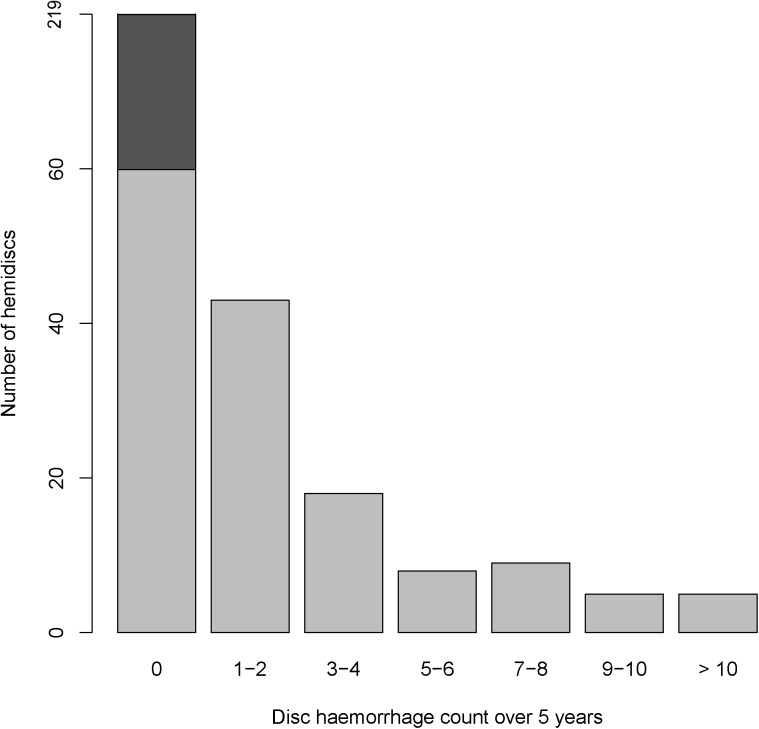
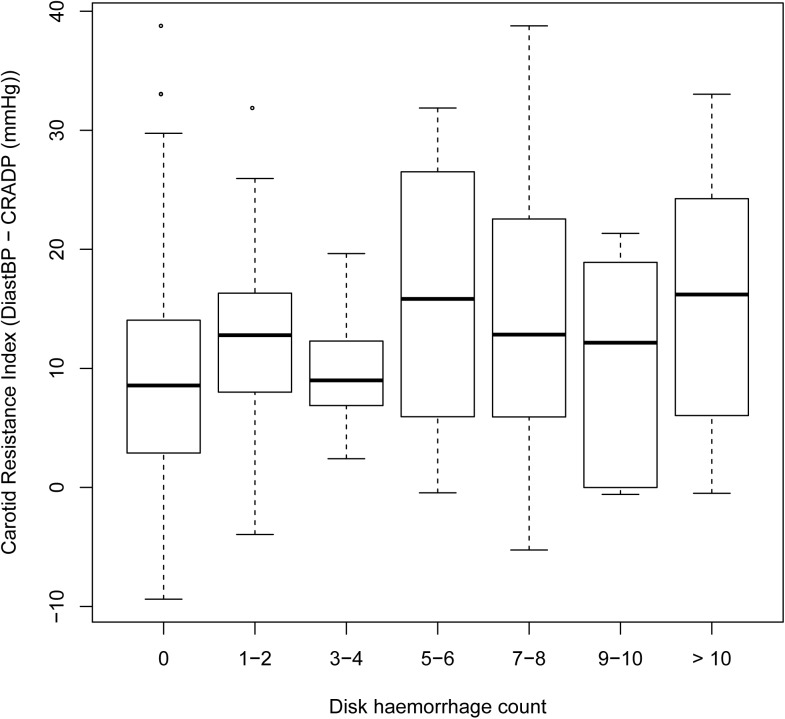
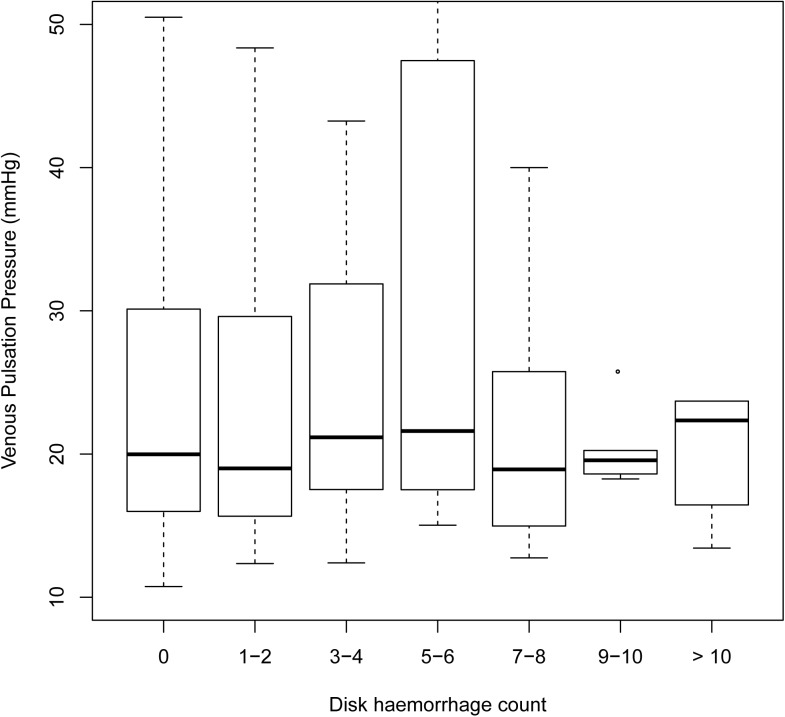
Mean age of the cohort was 71.9 ± 7.3 Years. 76 out of 155 eyes (49%) followed for a mean period of 64.2 months had at least 1 disc haemorrhage. 62 (81.6%) of these 76 eyes had recurrent haemorrhages, with a mean of 5.94 recurrences over 64.2 months. Using univariate analysis, rate of visual field change (P<0.0001), VPP (P = 0.0069), alternative ocular perfusion pressure (CRADP-VPP, P = 0.0036), carotid resistance index (DiastBP-CRADP, P = 0.0108) and mean brachial blood pressure (P = 0.0203) were significantly associated with the number of disc haemorrhages. Using multivariate analysis, increased baseline visual field sensitivity (P = 0.0243, coefficient = 0.0275) was significantly associated with disc haemorrhage, in conjunction with higher VPP (P = 0.0029, coefficient = 0.0631), higher mean blood pressure (P = 0.0113, coefficient = 0.0190), higher carotid resistance index (P = 0.0172, coefficient = 0.0566), and rate of visual field loss (P<0.0001, coefficient = -2.0695).
Higher VPP was associated with disc haemorrhage and implicates the involvement of venous pathology, but the effect size is small. Additionally, a greater carotid resistance index suggests that flow pathology in the ophthalmic or carotid arteries may be associated with disc haemorrhage.
探讨青光眼及青光眼可疑患者眼内视盘出血、静脉搏动压(VPP)、眼灌注压与视野变化之间的潜在关系。
这项前瞻性观察性研究在5年时间里对78例患者的155只开角型青光眼或青光眼可疑眼进行了检查。每3个月对患者进行一次不散瞳眼底照相,每6个月进行一次标准自动视野检查,每年进行一次眼动脉压测量。在整个研究期间统计每个半视盘内的出血数量。使用线性回归分析每个位置随时间的敏感度变化,计算视野变化率,然后对匹配的半视野进行平均。根据测量的眼动脉压(ODF)计算VPP和视网膜中央动脉舒张压(CRADP)。计算肱动脉舒张压(DiastBP)与CRADP之间的差值,作为颈动脉和眼动脉可能存在血流病变的指标。
该队列的平均年龄为71.9±7.3岁。155只眼中有76只(49%)平均随访64.2个月,至少发生过1次视盘出血。这76只眼中有62只(81.6%)反复出血,在64.2个月内平均出血5.94次。单因素分析显示,视野变化率(P<0.0001)、VPP(P = 0.0069)、替代眼灌注压(CRADP-VPP,P = 0.0036)、颈动脉阻力指数(DiastBP-CRADP,P = 0.0108)和平均肱动脉血压(P = 0.0203)与视盘出血数量显著相关。多因素分析显示,基线视野敏感度增加(P = 0.0243,系数 = 0.0275)与视盘出血显著相关,同时还与较高的VPP(P = 0.0029,系数 = 0.0631)、较高的平均血压(P = 0.0113,系数 = 0.0190)、较高的颈动脉阻力指数(P = 0.0172,系数 = 0.0566)以及视野缺损率(P<0.0001,系数 = -2.0695)有关。
较高的VPP与视盘出血相关,提示存在静脉病变,但效应量较小。此外,较高的颈动脉阻力指数表明眼动脉或颈动脉的血流病变可能与视盘出血有关。