Osuka Yosuke, Jung Songee, Kim Taeho, Okubo Yoshiro, Kim Eunbi, Tanaka Kiyoji
Research Team for Promoting Independence of the Elderly, Tokyo Metropolitan Institute of Gerontology, Itabashi, 173-0015, Tokyo, Japan.
Faculty of Health and Sport Sciences, University of Tsukuba, Tsukuba, 305-8577, Ibaraki, Japan.
BMC Geriatr. 2017 Jul 31;17(1):170. doi: 10.1186/s12877-017-0554-9.
Family support can help older adults better adhere to exercise routine, but it remains unclear whether an exercise program targeting older married couples would have stronger effects on exercise adherence than would a program for individuals. The purpose of this study was to determine the effects of an exercise program on the exercise adherence of older married couples over a 24-week follow-up period.
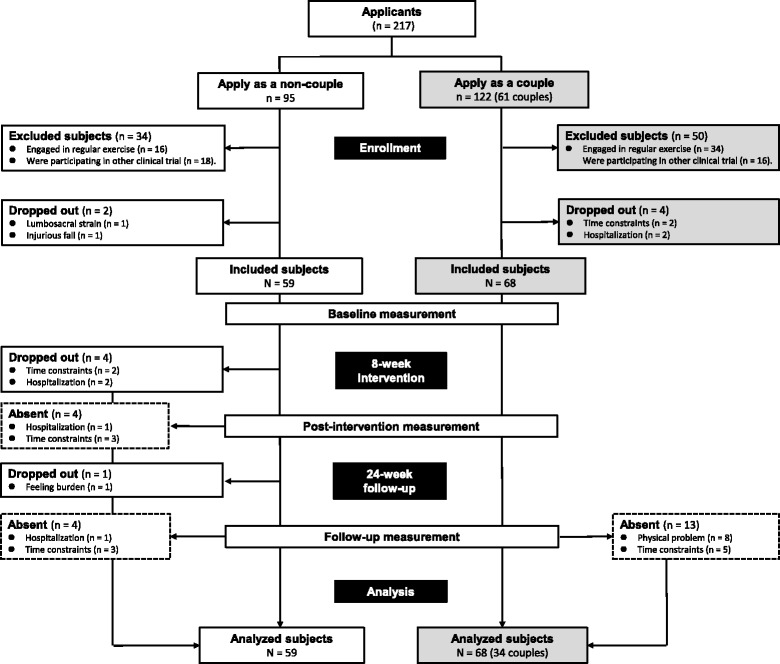
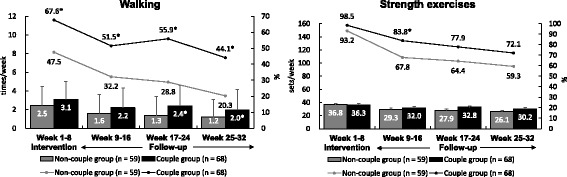
Thirty-four older married couples and 59 older adults participated in this study as couple and non-couple groups (CG and NCG, respectively). All participants attended an 8-week supervised program (once a week and a home-based exercise program comprising walking and strength exercises) and then participated in a follow-up measurement (24 weeks after post-intervention measurement). Exercise adherence was prospectively measured via an exercise habituation diary during the follow-up period-specifically, we asked them to record practice rates for walking (≥2 days/week) and strength exercises (≥6 items for 2 days/week). A multivariate logistic regression analysis was conducted to obtain the CG's odds ratios (ORs) and 95% confidence intervals (CIs) for adherence to walking and strength exercise adjusted for potential confounders (with NCG as the reference).
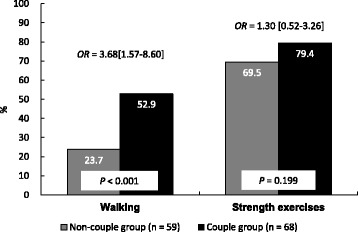
Although the adherence rate of walking exercise in the CG was significantly higher than that in the NCG (29.2%; P < 0.001), there was no significant difference in the adherence rate of strength exercise between the two groups (P = 0.199). The multivariate logistic regression analysis showed that CG had significantly higher odds of adherence to walking exercise compared with the NCG (3.68 [1.57-8.60]). However, the odds of adherence to strength exercise did not significantly differ between the two groups (1.30 [0.52-3.26]).
These results suggest that an exercise program targeting older married couples may be a useful strategy for maintaining walking adherence, even six months after the supervised program has ceased. A blinded randomized controlled trial will be needed to confirm this conclusion.
Retrospectively registered. UMIN Clinical Trials Registry (Registered: 02/11/16) UMIN000024689 .
家庭支持有助于老年人更好地坚持日常锻炼,但针对老年已婚夫妇的锻炼计划对锻炼坚持性的影响是否强于针对个体的计划仍不清楚。本研究的目的是确定一项锻炼计划在24周随访期内对老年已婚夫妇锻炼坚持性的影响。
34对老年已婚夫妇和59名老年人分别作为夫妻组和非夫妻组(分别为CG和NCG)参与本研究。所有参与者参加了一个为期8周的有监督的计划(每周一次,包括步行和力量练习的家庭锻炼计划),然后参与随访测量(干预后测量24周后)。在随访期间,通过锻炼习惯日记前瞻性地测量锻炼坚持性——具体而言,我们要求他们记录步行(每周≥2天)和力量练习(每周2天≥6项)的练习率。进行多因素逻辑回归分析,以获得调整潜在混杂因素后夫妻组坚持步行和力量练习的比值比(OR)和95%置信区间(CI)(以非夫妻组作为对照)。
虽然夫妻组步行锻炼的坚持率显著高于非夫妻组(29.2%;P<0.001),但两组力量练习的坚持率没有显著差异(P=0.199)。多因素逻辑回归分析显示,与非夫妻组相比,夫妻组坚持步行锻炼的几率显著更高(3.68[1.57 - 8.60])。然而,两组坚持力量练习的几率没有显著差异(1.30[0.52 - 3.26])。
这些结果表明,针对老年已婚夫妇的锻炼计划可能是维持步行坚持性的有用策略,即使在有监督的计划停止六个月后也是如此。需要进行一项盲法随机对照试验来证实这一结论。
回顾性注册。UMIN临床试验注册中心(注册时间:2016年11月2日)UMIN000024689 。