Valderrama Camilo E, Marzbanrad Faezeh, Stroux Lisa, Clifford Gari D
Department of Mathematics and Computer Science, Emory UniversityAtlanta, GA, United States.
Department of Electrical and Computer Systems Engineering, Monash UniversityMelbourne, VIC, Australia.
Front Physiol. 2017 Jul 18;8:511. doi: 10.3389/fphys.2017.00511. eCollection 2017.
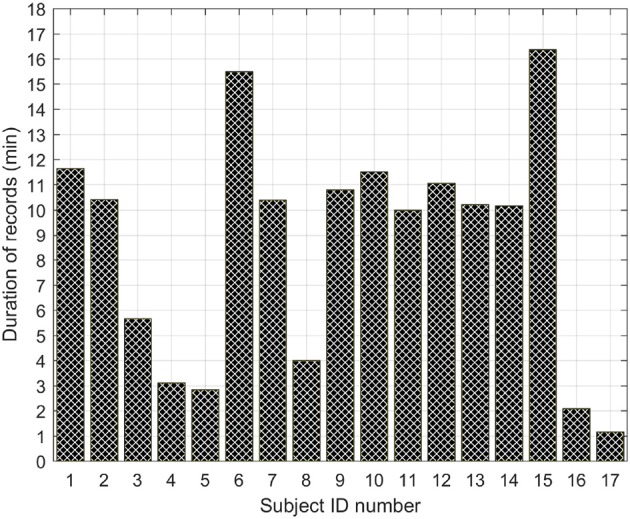
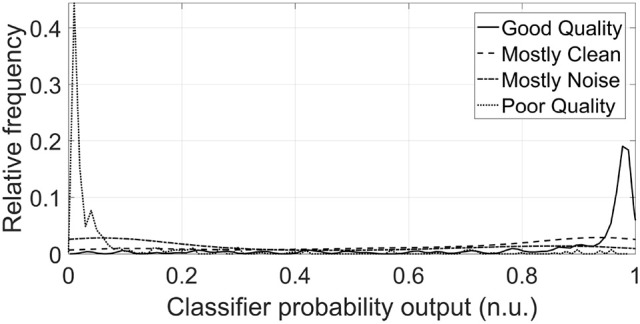
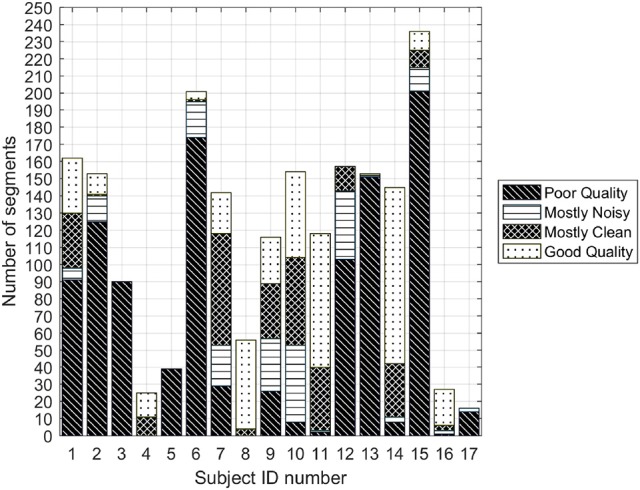
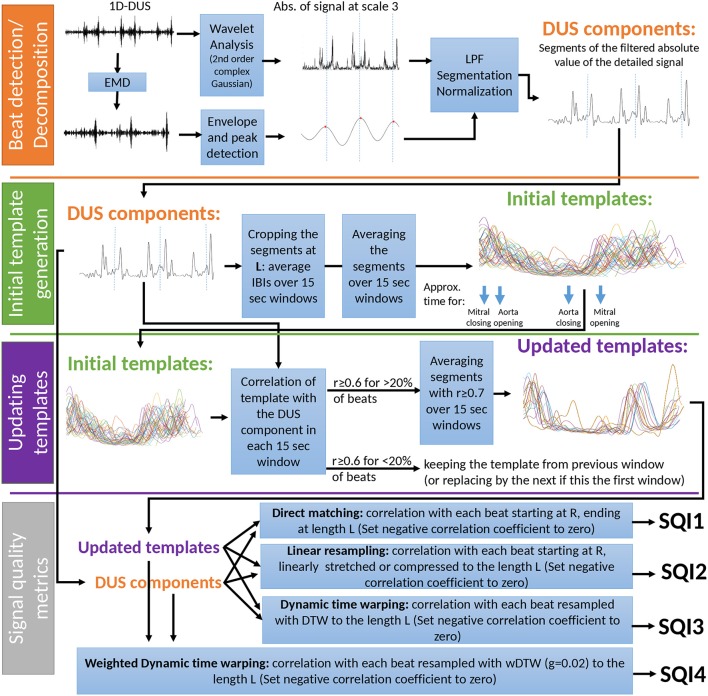
One dimensional Doppler Ultrasound (DUS) is a low cost method for fetal auscultation. However, accuracy of any metrics derived from the DUS signals depends on their quality, which relies heavily on operator skills. In low resource settings, where skill levels are sparse, it is important for the device to provide real time signal quality feedback to allow the re-recording of data. Retrospectively, signal quality assessment can help remove low quality recordings when processing large amounts of data. To this end, we proposed a novel template-based method, to assess DUS signal quality. Data used in this study were collected from 17 pregnant women using a low-cost transducer connected to a smart phone. Recordings were split into 1990 segments of 3.75 s duration, and hand labeled for quality by three independent annotators. The proposed template-based method uses Empirical Mode Decomposition (EMD) to allow detection of the fetal heart beats and segmentation into short, time-aligned temporal windows. Templates were derived for each 15 s window of the recordings. The DUS signal quality index (SQI) was calculated by correlating the segments in each window with the corresponding running template using four different pre-processing steps: (i) no additional preprocessing, (ii) linear resampling of each beat, (iii) dynamic time warping (DTW) of each beat and (iv) weighted DTW of each beat. The template-based SQIs were combined with additional features based on sample entropy and power spectral density. To assess the performance of the method, the dataset was split into training and test subsets. The training set was used to obtain the best combination of features for predicting the DUS quality using cross validation, and the test set was used to estimate the classification accuracy using bootstrap resampling. A median out of sample classification accuracy on the test set of 85.8% was found using three features; template-based SQI, sample entropy and the relative power in the 160 to 660 Hz range. The results suggest that the new automated method can reliably assess the DUS quality, thereby helping users to consistently record DUS signals with acceptable quality for fetal monitoring.
一维多普勒超声(DUS)是一种用于胎儿听诊的低成本方法。然而,从DUS信号得出的任何指标的准确性都取决于其质量,而这在很大程度上依赖于操作者的技能。在资源匮乏的环境中,技能水平参差不齐,设备提供实时信号质量反馈以允许重新记录数据非常重要。回顾性地,信号质量评估有助于在处理大量数据时去除低质量记录。为此,我们提出了一种基于模板的新颖方法来评估DUS信号质量。本研究中使用的数据是通过连接到智能手机的低成本换能器从17名孕妇身上收集的。记录被分成1990个持续时间为3.75秒的片段,并由三名独立的注释者手动标注质量。所提出的基于模板的方法使用经验模态分解(EMD)来检测胎儿心跳并分割成短的、时间对齐的时间窗口。为记录的每个15秒窗口导出模板。通过使用四个不同的预处理步骤将每个窗口中的片段与相应的运行模板进行关联来计算DUS信号质量指数(SQI):(i)不进行额外预处理,(ii)对每个心跳进行线性重采样,(iii)对每个心跳进行动态时间规整(DTW),以及(iv)对每个心跳进行加权DTW。基于模板的SQI与基于样本熵和功率谱密度的其他特征相结合。为了评估该方法的性能,将数据集分为训练子集和测试子集。训练集用于通过交叉验证获得预测DUS质量的最佳特征组合,测试集用于使用自助重采样估计分类准确率。使用三个特征在测试集上发现样本外分类准确率的中位数为85.8%;基于模板的SQI、样本熵和160至660赫兹范围内的相对功率。结果表明,新的自动化方法可以可靠地评估DUS质量,从而帮助用户始终如一地记录质量可接受的DUS信号用于胎儿监测。