Larrainzar Estíbaliz, Wienkoop Stefanie
Department of Environmental Sciences, Universidad Pública de NavarraPamplona, Spain.
Department of Ecogenomics and Systems Biology, University of ViennaVienna, Austria.
Front Plant Sci. 2017 Jul 18;8:1267. doi: 10.3389/fpls.2017.01267. eCollection 2017.
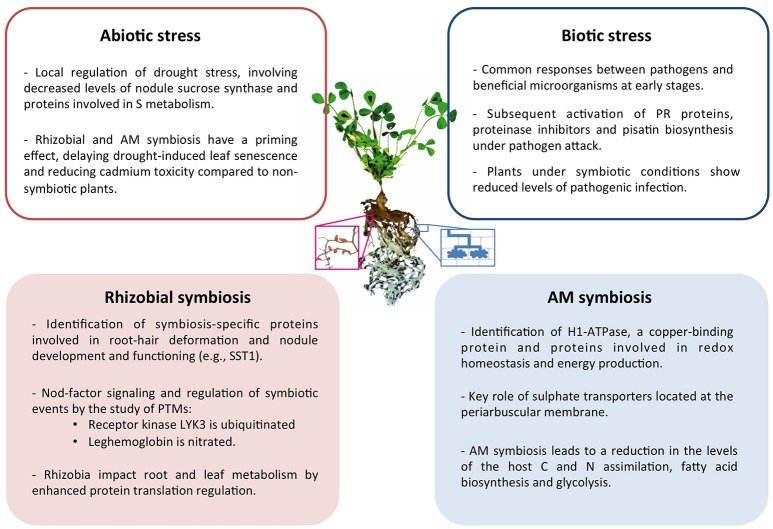
Legume plants are key elements in sustainable agriculture and represent a significant source of plant-based protein for humans and animal feed worldwide. One specific feature of the family is the ability to establish nitrogen-fixing symbiosis with bacteria. Additionally, like most vascular flowering plants, legumes are able to form a mutualistic endosymbiosis with arbuscular mycorrhizal (AM) fungi. These beneficial associations can enhance the plant resistance to biotic and abiotic stresses. Understanding how symbiotic interactions influence and increase plant stress tolerance are relevant questions toward maintaining crop yield and food safety in the scope of climate change. Proteomics offers numerous tools for the identification of proteins involved in such responses, allowing the study of sub-cellular localization and turnover regulation, as well as the discovery of post-translational modifications (PTMs). The current work reviews the progress made during the last decades in the field of proteomics applied to the study of the legume- and -AM symbioses, and highlights their influence on the plant responses to pathogens and abiotic stresses. We further discuss future perspectives and new experimental approaches that are likely to have a significant impact on the field including peptidomics, mass spectrometric imaging, and quantitative proteomics.
豆科植物是可持续农业的关键要素,也是全球人类植物性蛋白质和动物饲料的重要来源。该科植物的一个显著特点是能够与细菌建立固氮共生关系。此外,与大多数维管束开花植物一样,豆科植物能够与丛枝菌根(AM)真菌形成互利共生的内共生关系。这些有益的共生关系可以增强植物对生物和非生物胁迫的抗性。了解共生相互作用如何影响和提高植物的胁迫耐受性,是在气候变化背景下维持作物产量和食品安全的相关问题。蛋白质组学提供了众多工具来鉴定参与此类反应的蛋白质,有助于研究亚细胞定位和周转调控,以及发现翻译后修饰(PTM)。本文综述了过去几十年蛋白质组学在豆科植物与AM共生研究领域取得的进展,并强调了它们对植物应对病原体和非生物胁迫反应的影响。我们还讨论了未来可能对该领域产生重大影响的新观点和新实验方法,包括肽组学、质谱成像和定量蛋白质组学。