Department of Psychiatry, School of Medicine, University of California San Diego, 9500 Gilman Drive MC 0804, La Jolla, CA 92093-0804, United States.
Department of Psychiatry, School of Medicine, University of California San Diego, 9500 Gilman Drive MC 0804, La Jolla, CA 92093-0804, United States; Center for Stress and Mental Health (CESAMH), VA San Diego Healthcare System, San Diego, CA, United States.
Neuropharmacology. 2017 Oct;125:254-262. doi: 10.1016/j.neuropharm.2017.07.031. Epub 2017 Aug 1.
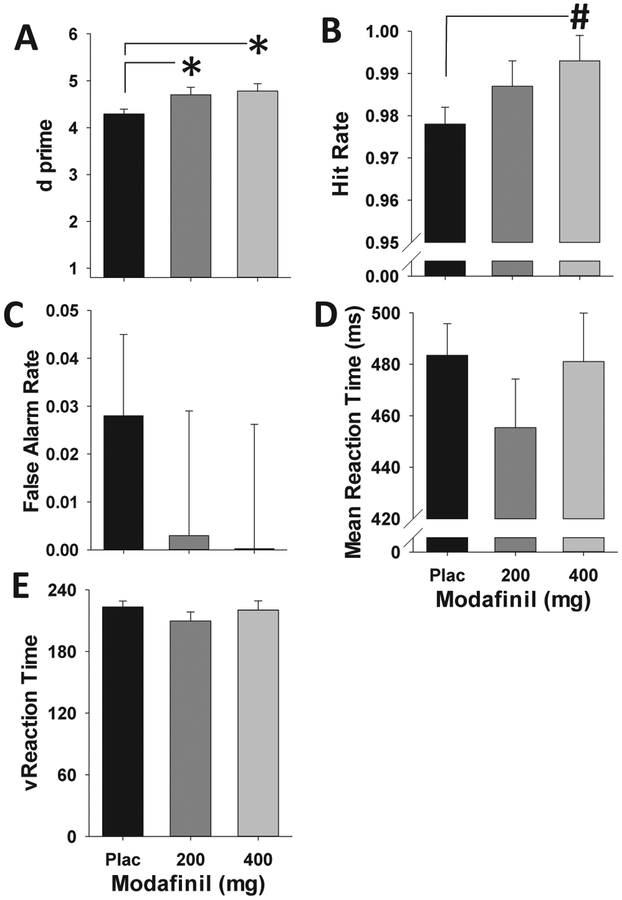
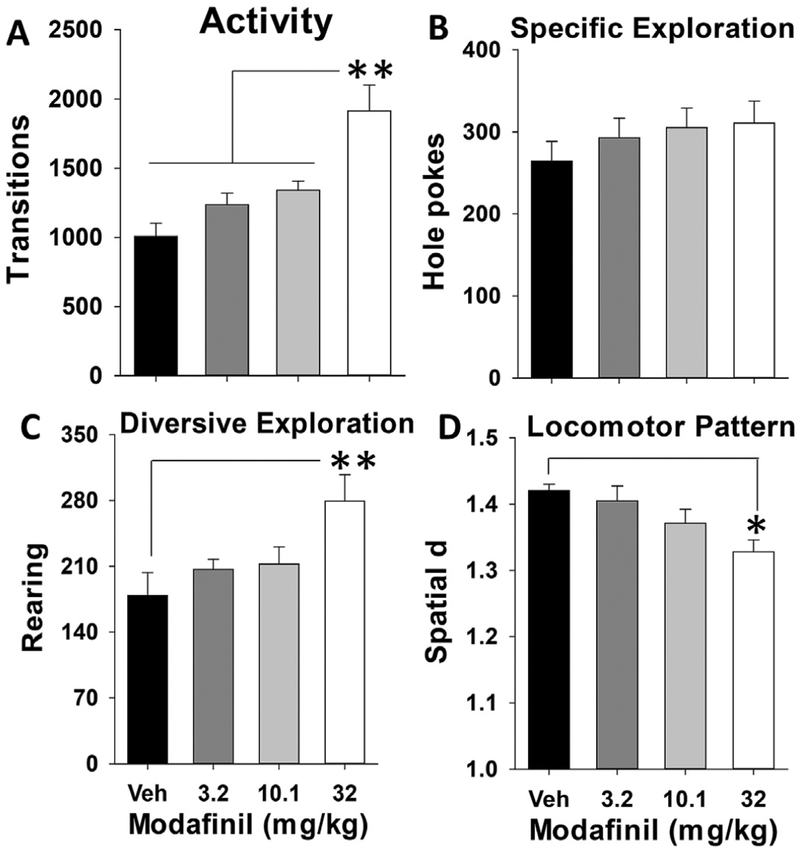
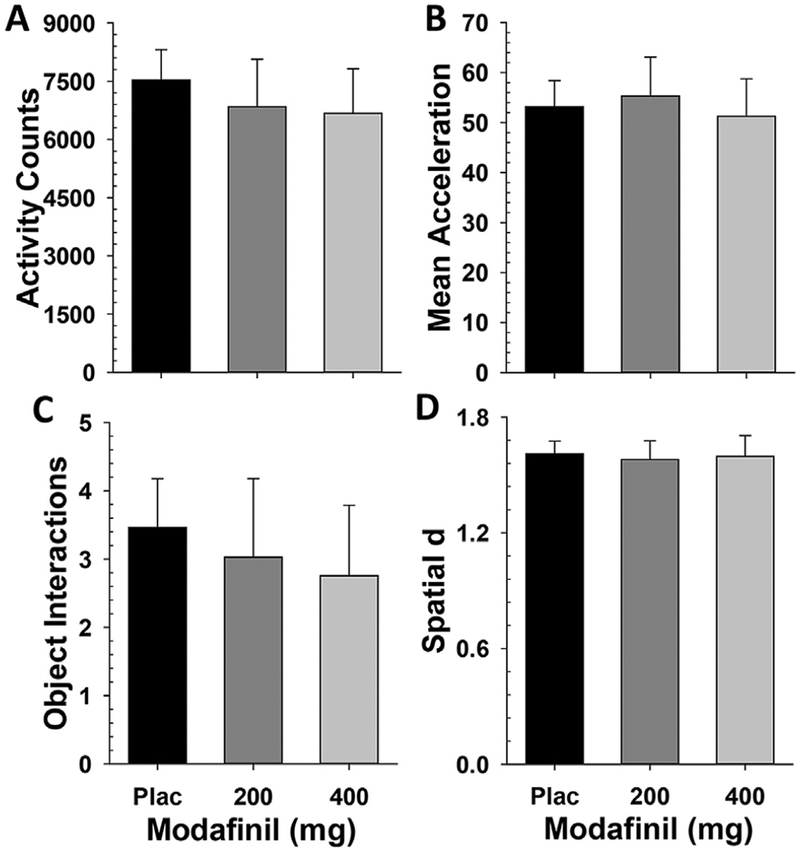
The wake-promoting drug modafinil is frequently used off-label to improve cognition in psychiatric and academic populations alike. The domain-specific attentional benefits of modafinil have yet to be quantified objectively in healthy human volunteers using tasks validated for comparison across species. Further, given that modafinil is a low-affinity inhibitor for the dopamine and norepinephrine transporters (DAT/NET respectively) it is unclear if any effects are attributable to a non-specific increase in arousal, a feature of many catecholamine reuptake inhibitors (e.g., cocaine, amphetamine). These experiments were designed to test for domain-specific enhancement of attention and cognitive control by modafinil (200 and 400 mg) in healthy volunteers using the 5-choice continuous performance task (5C-CPT) and Wisconsin Card Sort Task (WCST). An additional cross-species assessment of arousal and hyperactivity was performed in this group and in mice (3.2, 10, or 32 mg/kg) using species-specific versions of the behavioral pattern monitor (BPM). Modafinil significantly enhanced attention (d prime) in humans performing the 5C-CPT at doses that did not affect WCST performance or induce hyperactivity in the BPM. In mice, only the highest dose elicited increased activity in the BPM. These results indicate that modafinil produces domain-specific enhancement of attention in humans not driven by hyperarousal, unlike other drugs in this class, and higher equivalent doses were required for hyperarousal in mice. Further, these data support the utility of using the 5C-CPT across species to more precisely determine the mechanism(s) underlying the pro-cognitive effects of modafinil and potentially other pharmacological treatments.
促醒药物莫达非尼常用于改善精神科和学术界人群的认知功能。然而,使用经过物种间比较验证的任务,在健康人类志愿者中,尚未客观地量化莫达非尼对特定领域注意力的益处。此外,由于莫达非尼是多巴胺和去甲肾上腺素转运体(分别为 DAT/NET)的低亲和力抑制剂,因此尚不清楚任何作用是否归因于唤醒的非特异性增加,这是许多儿茶酚胺再摄取抑制剂(例如可卡因,安非他命)的特征。这些实验旨在使用 5 选择连续性能任务(5C-CPT)和威斯康星卡片分类任务(WCST)测试健康志愿者中莫达非尼(200 和 400mg)对注意力和认知控制的特定领域增强作用。在该组和小鼠(3.2、10 或 32mg/kg)中进行了额外的跨物种唤醒和多动评估,使用行为模式监测器(BPM)的特定于物种的版本。莫达非尼可显著增强人类在执行 5C-CPT 时的注意力(d 精密度),而不会影响 WCST 性能或在 BPM 中引起多动。在小鼠中,只有最高剂量会在 BPM 中引起活动增加。这些结果表明,与该类别的其他药物不同,莫达非尼在人类中产生特定于注意力的增强作用,而不是由过度唤醒驱动的,并且在小鼠中需要更高的等效剂量才能引起过度唤醒。此外,这些数据支持在跨物种中使用 5C-CPT 更准确地确定莫达非尼和其他潜在药理学治疗的促认知作用的机制。