Chong Huiqing, Li Qingxin
Institute of Chemical and Engineering Sciences, Agency for Science, Technology and Research, 1 Pesek Road, Jurong Island, 627833, Singapore.
Microb Cell Fact. 2017 Aug 5;16(1):137. doi: 10.1186/s12934-017-0753-2.
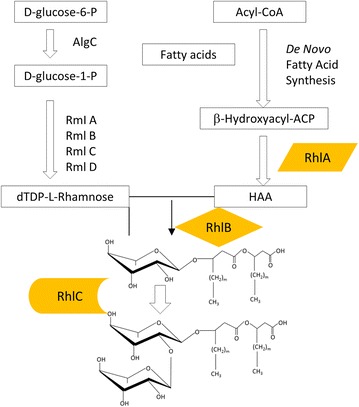
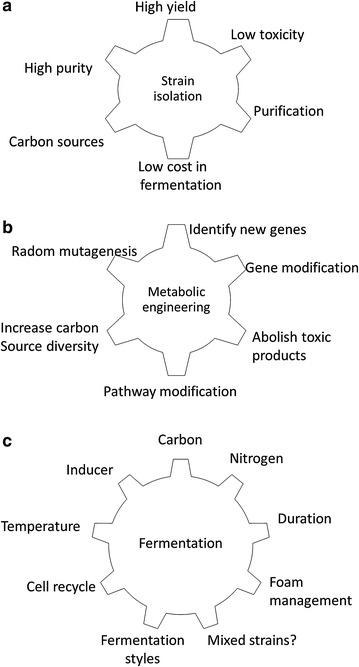
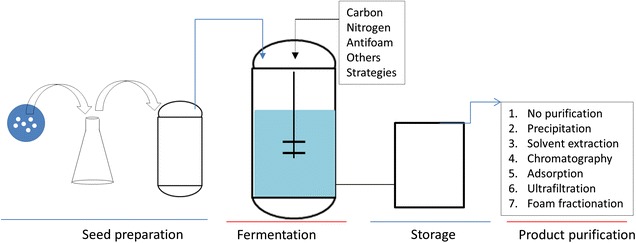
Rhamnolipids are a class of biosurfactants which contain rhamnose as the sugar moiety linked to β-hydroxylated fatty acid chains. Rhamnolipids can be widely applied in many industries including petroleum, food, agriculture and bioremediation etc. Pseudomonas aeruginosa is still the most competent producer of rhamnolipids, but its pathogenicity may cause safety and health concerns during large-scale production and applications. Therefore, extensive studies have been carried out to explore safe and economical methods to produce rhamnolipids. Various metabolic engineering efforts have also been applied to either P. aeruginosa for improving its rhamnolipid production and diminishing its pathogenicity, or to other non-pathogenic strains by introducing the key genes for safe production of rhamnolipids. The three key enzymes for rhamnolipid biosynthesis, RhlA, RhlB and RhlC, are found almost exclusively in Pseudomonas sp. and Burkholderia sp., but have been successfully expressed in several non-pathogenic host bacteria to produce rhamnolipids in large scales. The composition of mono- and di-rhamnolipids can also be modified through altering the expression levels of RhlB and RhlC. In addition, cell-free rhamnolipid synthesis by using the key enzymes and precursors from non-pathogenic sources is thought to not only eliminate pathogenic effects and simplify the downstream purification processes, but also to circumvent the complexity of quorum sensing system that regulates rhamnolipid biosynthesis. The pathogenicity of P. aeruginosa can also be reduced or eliminated through in vivo or in vitro enzymatic degradation of the toxins such as pyocyanin during rhamnolipid production. The rhamnolipid production cost can also be significantly reduced if rhamnolipid purification step can be bypassed, such as utilizing the fermentation broth or the rhamnolipid-producing strains directly in the industrial applications of rhamnolipids.
鼠李糖脂是一类生物表面活性剂,其糖部分含有鼠李糖,并与β-羟基脂肪酸链相连。鼠李糖脂可广泛应用于石油、食品、农业和生物修复等多个行业。铜绿假单胞菌仍然是鼠李糖脂的最主要生产者,但其致病性可能在大规模生产和应用过程中引发安全和健康问题。因此,人们进行了广泛研究以探索安全经济的鼠李糖脂生产方法。各种代谢工程方法也已应用于铜绿假单胞菌以提高其鼠李糖脂产量并降低其致病性,或将鼠李糖脂安全生产的关键基因导入其他非致病菌株。鼠李糖脂生物合成的三种关键酶,RhlA、RhlB和RhlC,几乎仅在假单胞菌属和伯克霍尔德菌属中发现,但已成功在几种非致病宿主细菌中表达以大规模生产鼠李糖脂。单鼠李糖脂和双鼠李糖脂的组成也可通过改变RhlB和RhlC的表达水平来改变。此外,利用来自非致病源的关键酶和前体进行无细胞鼠李糖脂合成,不仅被认为可以消除致病影响并简化下游纯化过程,还能规避调节鼠李糖脂生物合成的群体感应系统的复杂性。在鼠李糖脂生产过程中,通过体内或体外酶解毒素如绿脓菌素,也可降低或消除铜绿假单胞菌的致病性。如果可以绕过鼠李糖脂纯化步骤,例如在鼠李糖脂的工业应用中直接利用发酵液或产鼠李糖脂菌株,鼠李糖脂的生产成本也可显著降低。