Watanabe Masaaki, Nakatani Eiji, Yoshikawa Hiroo, Kanno Takahiro, Nariai Yoshiki, Yoshino Aya, Vieth Michael, Kinoshita Yoshikazu, Sekine Joji
Department of Oral and Maxillofacial Surgery, Shimane University Faculty of Medicine, 89-1 Enya-cho, Izumo, Shimane, 693-8501, Japan.
Translational Research Informatics Center, Foundation for Biomedical Research and Innovation, 1-5-4, Minatojima minamimachi, Kobe, Hyogo, 650-0047, Japan.
BMC Gastroenterol. 2017 Aug 7;17(1):92. doi: 10.1186/s12876-017-0650-5.
Dental erosion (DE), one of oral hard tissue diseases, is one of the extraoesophageal symptoms defined as the Montreal Definition and Classification of gastroesophageal reflux disease (GERD). However, no study evaluated the relationship between GERD and oral soft tissues. We hypothesized that oral soft tissue disorders (OSTDs) would be related to GERD. The study aimed to investigate the association OSTDs and GERD.
GERD patients (105 cases), older and younger controls (25 cases each) were retrospectively examined for oral symptoms, salivary flow volume (Saxon test), swallowing function (repetitive saliva swallowing test [RSST]), teeth (decayed, missing, and filled [DMF] indices), and soft tissues (as evaluation of OSTDs, gingivitis; papillary, marginal, and attached [PMA] gingival indexes, simplified oral hygiene indices [OHI-S], and inflammatory oral mucosal regions). Clinical histories, which included body mass index [BMI], the existence of alcohol and tobacco use, and bruxism, were also investigated. A P value of <0.05 was defined as statistically significant.
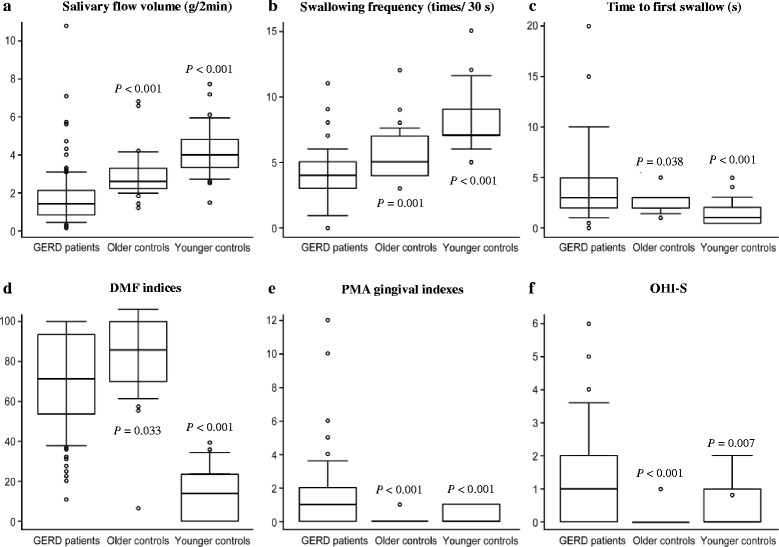
GERD patients, older and younger controls participated and aged 66.4 ± 13.0, 68.3 ± 8.2 and 28.7 ± 2.6 years old, respectively. The most common oral symptom in the GERD patients was oral dryness. Salivary flow volume and swallowing function in the GERD patients were significantly lower than in either of the controls (all P < 0.05). Inflammatory oral mucosal regions were found only in the GERD patients. The DMF indices, as a measure of dental caries, in the GERD patients were higher than in the younger controls (P < 0.001), but lower than in the older controls (P = 0.033). The PMA gingival indexes, as a measurement for gingival inflammation, and OHI-S, as a measure for oral hygiene, in the GERD patients were significantly higher than in either of the controls (all P < 0.05). Though no significant differences in BMI, the existence of alcohol and tobacco use were found, bruxism, as an exacerbation factor of periodontal disease, in the GERD patients was significantly more frequent than in either control group (P = 0.041).
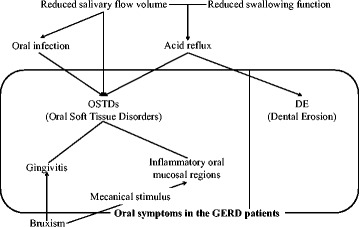
OSTDs were associated with GERD, which was similar to the association between DE and GERD.
牙侵蚀(DE)是口腔硬组织疾病之一,是被定义为蒙特利尔胃食管反流病(GERD)分类中的食管外症状之一。然而,尚无研究评估GERD与口腔软组织之间的关系。我们推测口腔软组织疾病(OSTD)与GERD有关。本研究旨在调查OSTD与GERD之间的关联。
对GERD患者(105例)、老年对照组(各25例)和年轻对照组(各25例)进行回顾性检查,评估口腔症状、唾液流量(萨克森试验)、吞咽功能(重复唾液吞咽试验[RSST])、牙齿情况(龋失补牙[DMF]指数)以及软组织情况(作为OSTD评估,包括牙龈炎;乳头、边缘和附着[PMA]牙龈指数、简化口腔卫生指数[OHI-S]以及炎性口腔黏膜区域)。还调查了临床病史,包括体重指数[BMI]、是否存在饮酒和吸烟情况以及磨牙症。P值<0.05被定义为具有统计学意义。
GERD患者、老年对照组和年轻对照组参与研究,年龄分别为66.4±13.0岁、68.3±8.2岁和28.7±2.6岁。GERD患者中最常见的口腔症状是口腔干燥。GERD患者的唾液流量和吞咽功能显著低于任何一组对照组(所有P<0.05)。仅在GERD患者中发现炎性口腔黏膜区域。作为龋齿衡量指标的DMF指数,GERD患者高于年轻对照组(P<0.001),但低于老年对照组(P=0.033)。作为牙龈炎症衡量指标的PMA牙龈指数以及作为口腔卫生衡量指标的OHI-S,GERD患者显著高于任何一组对照组(所有P<0.05)。尽管在BMI、饮酒和吸烟情况方面未发现显著差异,但作为牙周病加重因素的磨牙症,GERD患者比任何一组对照组都更频繁(P=0.041)。
OSTD与GERD有关,这与DE和GERD之间的关联相似。