Xing Guangnan, Liu Kai, Gai Junyi
Soybean Research Institute/National Center for Soybean Improvement/MOA Key Laboratory for Biology and Genetic Improvement of Soybean (General)/State Key Laboratory for Crop Genetics and Germplasm Enhancement/Jiangsu Collaborative Innovation Center for Modern Crop Production, Nanjing Agricultural University, Nanjing, 210095 Jiangsu People's Republic of China.
Plant Methods. 2017 Aug 7;13:66. doi: 10.1186/s13007-017-0215-1. eCollection 2017.
Common cutworm (CCW; Fabricius) is a major leaf-feeding pest of soybean in Asia. The previous methods of measuring antixenosis against CCW using adult plant under field or net-room conditions were time-consuming, labor-intensive and precision-inferior. To solve the problems, this study aimed at (i) establishing a high-throughput phenotyping method for evaluating antixenosis against CCW at early seedling stage, (ii) using the procedure to evaluate the antixenosis of an insect-resistant versus -susceptible germplasm population (IRSGP), (iii) validating the proposed method through comparing the results with the historical phenotypic data and phenotyping-genotyping consistency data using PAV (presence/absence variation) markers linked with the identified loci - and -, (iv) and evaluating the efficiency of the novel method through comparisons to the previous methods.
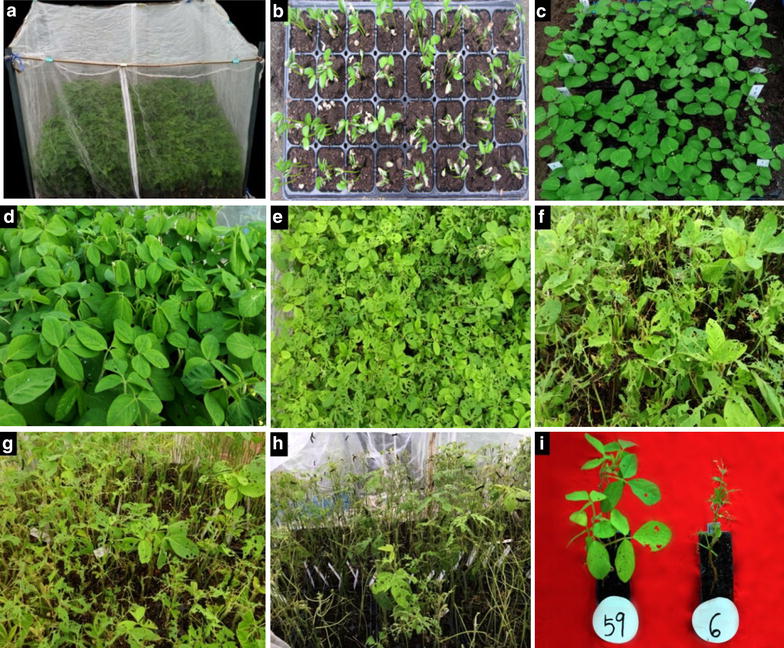
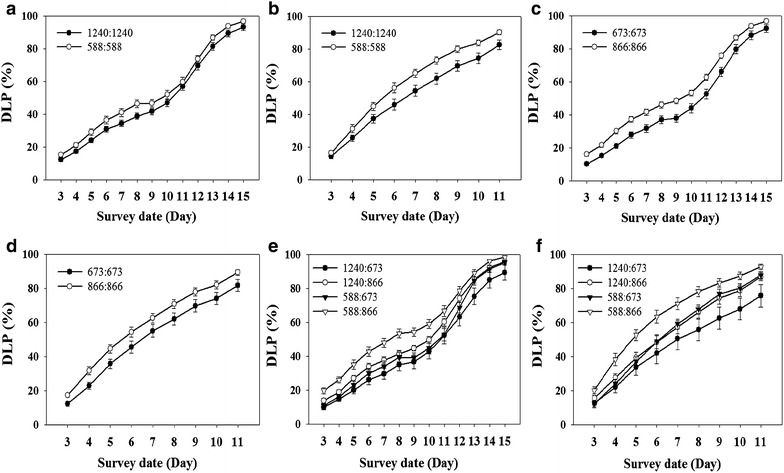
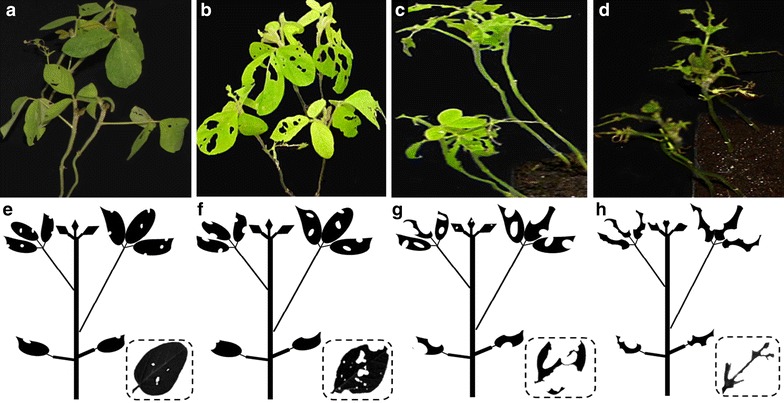
A dynamic and efficient evaluation procedure characterized with using V1 stage soybean seedlings infested with third-instar larvae in a micro-net-room in greenhouse with damaged leaf percentage (DLP) as indicator was established and designated V1TMD method. The middle term testing stage is the best dates for identifying resistant and susceptible accessions. The results from the V1TMD method were relatively stable, precise and accurate in comparison with the previous method with the detected most resistant and susceptible accessions consistent to the previous results. The DLP values differentiated obviously to coincide with the resistant and susceptible alleles of the PAV markers Gm07PAV0595 and Gm07PAV0389 tightly linked to the two resistance-related loci, - and -, respectively, in IRSGP. Thus V1TMD is a high-throughput phenotyping method with its estimated efficiency 12 times and period shortening 4 times of those of the previous method.
A dynamic and efficient V1TMD method for testing antixenosis against CCW was established, with highly resistant and highly susceptible accessions as standard checks and DLP as indicator. The method is remarkably quick, highly reproducible, and capable of testing large samples, therefore, is a high-throughput phenotyping method.
小地老虎(CCW;夜蛾科)是亚洲大豆的一种主要食叶害虫。以往在田间或网室条件下使用成年植株测定对小地老虎的抗生性的方法耗时、费力且精度较低。为解决这些问题,本研究旨在:(i)建立一种高通量表型分析方法,用于在幼苗早期评估对小地老虎的抗生性;(ii)使用该方法评估抗虫与感虫种质群体(IRSGP)的抗生性;(iii)通过将结果与历史表型数据以及使用与已鉴定位点连锁的PAV(存在/缺失变异)标记的表型-基因型一致性数据进行比较,验证所提出的方法;(iv)通过与以往方法进行比较,评估该新方法的效率。
建立了一种动态高效的评估程序,其特点是在温室的微网室中使用接种三龄幼虫的V1期大豆幼苗,以叶片损伤率(DLP)为指标,命名为V1TMD方法。中期测试阶段是鉴定抗性和感病种质的最佳时期。与以往方法相比,V1TMD方法的结果相对稳定、精确且准确,检测到的最抗和最感种质与以往结果一致。在IRSGP中,DLP值明显区分,与分别紧密连锁到两个抗性相关位点的PAV标记Gm07PAV0595和Gm07PAV0389的抗性和感病等位基因一致。因此,V1TMD是一种高通量表型分析方法,其估计效率是以往方法的12倍,周期缩短了4倍。
建立了一种动态高效的V1TMD方法,用于测试对小地老虎的抗生性,以高抗和高感种质作为标准对照,以DLP为指标。该方法非常快速、高度可重复,能够测试大量样本,因此是一种高通量表型分析方法。