Yang Haomin, Brand Judith S, Li Jingmei, Ludvigsson Jonas F, Ugalde-Morales Emilio, Chiesa Flaminia, Hall Per, Czene Kamila
Department of Medical Epidemiology and Biostatistics, Karolinska Institutet, Nobels Väg 12A, 171 77, Stockholm, Sweden.
Department of Pediatrics, Örebro University Hospital, Örebro, Sweden.
BMC Med. 2017 Aug 11;15(1):154. doi: 10.1186/s12916-017-0915-4.
The risk of psoriasis in patients with breast cancer is largely unknown, as available evidence is limited to case findings. We systematically examined the incidence and risk factors of psoriasis in patients with breast cancer.
A Swedish nationwide cohort of 56,235 breast cancer patients (2001-2012) was compared to 280,854 matched reference individuals from the general population to estimate the incidence and hazard ratio (HR) of new-onset psoriasis. We also calculated HRs for psoriasis according to treatment, genetic, and lifestyle factors in a regional cohort of 8987 patients.
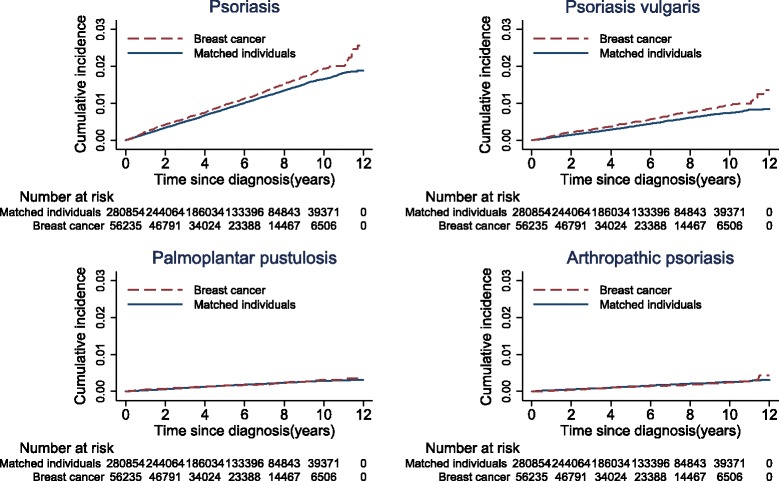
In the nationwide cohort, 599 patients with breast cancer were diagnosed with psoriasis during a median follow-up of 5.1 years compared to 2795 cases in the matched reference individuals. This corresponded to an incidence rate of 1.9/1000 person-years in breast cancer patients vs. 1.7/1000 person-years in matched reference individuals. Breast cancer patients were at an increased risk of psoriasis (HR = 1.17; 95% confidence interval (CI) = 1.07-1.28), especially its most common subtype (psoriasis vulgaris; HR = 1.33; 95% CI = 1.17-1.52). The risk of psoriasis vulgaris was highest shortly after diagnosis but remained increased up to 12 years. Treatment-specific analyses indicated a higher risk of psoriasis in patients treated with radiotherapy (HR = 2.44; 95% CI = 1.44-4.12) and mastectomy (HR = 1.54, 95% CI = 1.03-2.31). Apart from treatment-specific effects, we identified genetic predisposition, obesity, and smoking as independent risk factors for psoriasis in breast cancer patients.
The incidence of psoriasis is slightly elevated among patients with breast cancer, with treatment, lifestyle, and genetic factors defining the individual risk profile.
乳腺癌患者患银屑病的风险很大程度上未知,因为现有证据仅限于病例发现。我们系统地研究了乳腺癌患者银屑病的发病率和危险因素。
将瑞典全国范围内56235例乳腺癌患者(2001 - 2012年)与来自普通人群的280854例匹配的对照个体进行比较,以估计新发银屑病的发病率和风险比(HR)。我们还根据治疗、遗传和生活方式因素,在一个8987例患者的区域队列中计算了银屑病的HR。
在全国队列中,599例乳腺癌患者在中位随访5.1年期间被诊断为银屑病,而匹配的对照个体中有2795例。这相当于乳腺癌患者的发病率为1.9/1000人年,而匹配对照个体为1.7/1000人年。乳腺癌患者患银屑病的风险增加(HR = 1.17;95%置信区间(CI)= 1.07 - 1.28),尤其是其最常见的亚型(寻常型银屑病;HR = 1.33;95% CI = 1.17 - 1.52)。寻常型银屑病的风险在诊断后不久最高,但在长达12年的时间里仍持续增加。特定治疗分析表明,接受放疗(HR = 2.44;95% CI = 1.44 - 4.12)和乳房切除术(HR = 1.54,95% CI = 1.03 - 2.31)的患者患银屑病的风险更高。除了特定治疗的影响外,我们还确定遗传易感性、肥胖和吸烟是乳腺癌患者患银屑病的独立危险因素。
乳腺癌患者中银屑病的发病率略有升高,治疗、生活方式和遗传因素决定了个体的风险状况。