Wang Jing, Fang Yuxing, Wang Xiao, Yang Huichao, Yu Xin, Wang Huali
Peking University Sixth Hospital (Institute of Mental Health)Beijing, China.
National Clinical Research Center for Mental Disorders, Key Laboratory of Mental Health, Ministry of Health, Peking UniversityBeijing, China.
Front Aging Neurosci. 2017 Jul 26;9:243. doi: 10.3389/fnagi.2017.00243. eCollection 2017.
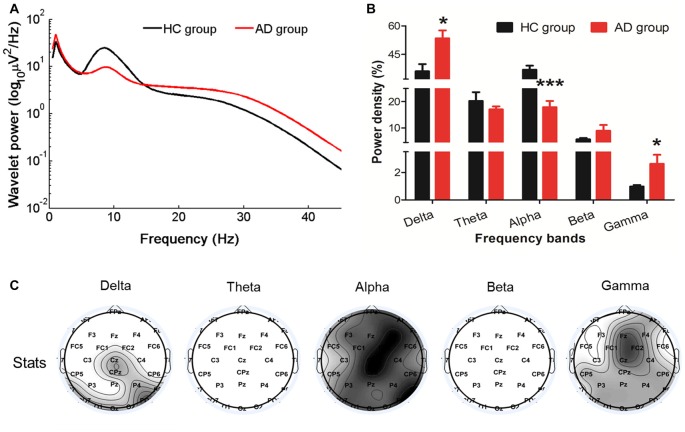
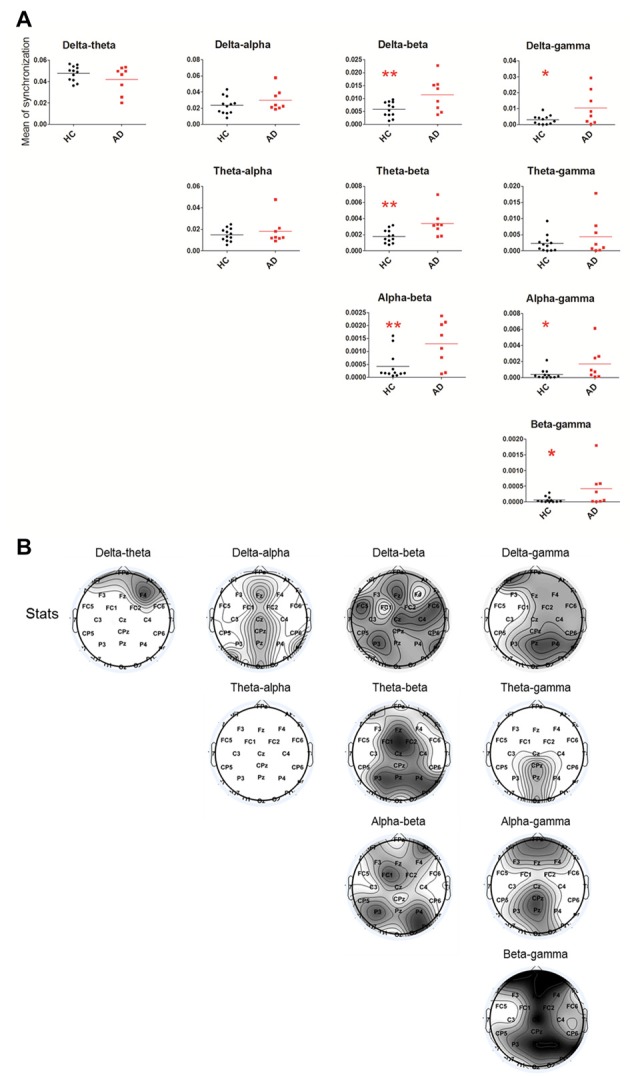
Cognitive impairment, functional decline and behavioral symptoms that characterize Alzheimer's disease (AD) are associated with perturbations of the neuronal network. The typical electroencephalographic (EEG) features in AD patients are increased delta or theta rhythm and decreased alpha or beta rhythm activities. However, considering the role of cross-frequency couplings in cognition, the alternation of cross-frequency couplings in AD patients is still obscure. This study aims to explore the interaction dynamics between different EEG oscillations in AD patients. We recorded the resting eye-closed EEG signals in 8 AD patients and 12 healthy volunteers. By analyzing the wavelet power spectrum and bicoherence of EEG, we found enhanced gamma rhythm power in AD patients in addition to the increased delta and decreased alpha power. Furthermore, an enhancement of the cross-frequency coupling strength between the beta/gamma and low-frequency bands was observed in AD patients compared to healthy controls (HCs). We propose that the pathological increase of ongoing gamma-band power might result from the disruption of the GABAergic interneuron network in AD patients. Furthermore, the cross-frequency overcouplings, which reflect the enhanced synchronization, might indicate the attenuated complexity of the neuronal network, and AD patients have to use more neural resources to maintain the resting brain state. Overall, our findings provide new evidence of the disturbance of the brain oscillation network in AD and further deepen our understanding of the central mechanisms of AD.
认知障碍、功能衰退以及作为阿尔茨海默病(AD)特征的行为症状与神经网络的扰动有关。AD患者典型的脑电图(EEG)特征是δ波或θ波节律增加,α波或β波节律活动减少。然而,考虑到交叉频率耦合在认知中的作用,AD患者交叉频率耦合的变化仍不清楚。本研究旨在探讨AD患者不同脑电振荡之间的相互作用动态。我们记录了8名AD患者和12名健康志愿者闭眼静息状态下的EEG信号。通过分析EEG的小波功率谱和双相干性,我们发现除了δ波功率增加和α波功率降低外,AD患者的γ波节律功率增强。此外,与健康对照(HCs)相比,AD患者β/γ频段与低频段之间的交叉频率耦合强度增强。我们提出,持续γ频段功率的病理性增加可能是由于AD患者GABA能中间神经元网络的破坏所致。此外,反映同步增强的交叉频率过度耦合可能表明神经网络复杂性降低,AD患者必须使用更多神经资源来维持静息脑状态。总体而言,我们的研究结果为AD中脑振荡网络的紊乱提供了新证据,并进一步加深了我们对AD中枢机制的理解。