School of Public Health, Fudan University, Dongan Road, Xuhui District, Shanghai, 200032, China.
Division of Infectious Disease, Chinese Center for Disease Control and Prevention, Beijing, China.
Bull World Health Organ. 2017 Aug 1;95(8):564-573. doi: 10.2471/BLT.17.191668. Epub 2017 May 26.
To ascertain the trends and burden of malaria in China and the costs of interventions for 2011-2015.
We analysed the spatiotemporal and demographic features of locally transmitted and imported malaria cases using disaggregated surveillance data on malaria from 2011 to 2015, covering the range of dominant malaria vectors in China. The total and mean costs for malaria elimination were calculated by funding sources, interventions and population at risk.
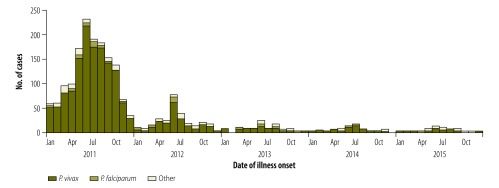
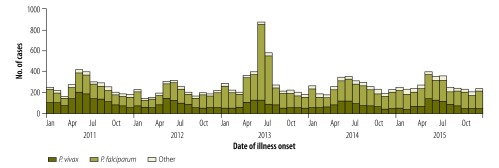
A total of 17 745 malaria cases, including 123 deaths (0.7%), were reported in mainland China, with 15 840 (89%) being imported cases, mainly from Africa and south-east Asia. Almost all counties of China (2855/2858) had achieved their elimination goals by 2015, and locally transmitted cases dropped from 1469 cases in 2011 to 43 cases in 2015, mainly occurring in the regions bordering Myanmar where and are the dominant vector species. A total of United States dollars (US$) 134.6 million was spent in efforts to eliminate malaria during 2011-2015, with US$ 57.2 million (43%) from the Global Fund to Fight AIDS, Tuberculosis and Malaria and US$ 77.3 million (57%) from the Chinese central government. The mean annual investment (US$ 27 million) per person at risk (574 million) was US$ 0.05 (standard deviation: 0.03).
The locally transmitted malaria burden in China has decreased. The key challenge is to address the remaining local transmission, as well as to reduce imported cases from Africa and south-east Asia. Continued efforts and appropriate levels of investment are needed in the 2016-2020 period to achieve elimination.
确定 2011-2015 年中国疟疾的流行趋势和负担以及干预措施的成本。
利用 2011-2015 年疟疾的分层监测数据,分析中国国内传播和输入性疟疾病例的时空和人口统计学特征,这些数据涵盖了中国主要疟疾病媒的范围。根据资金来源、干预措施和风险人群,计算消除疟疾的总费用和平均费用。
中国大陆共报告疟疾病例 17745 例,其中死亡 123 例(0.7%),15840 例(89%)为输入性病例,主要来自非洲和东南亚。到 2015 年,中国几乎所有的县(2855/2858 个)都实现了消除疟疾的目标,本地传播病例从 2011 年的 1469 例下降到 2015 年的 43 例,主要发生在与缅甸接壤的地区,和 是主要的媒介物种。2011-2015 年期间,为消除疟疾共投入 1.346 亿美元,其中全球抗击艾滋病、结核病和疟疾基金投入 5720 万美元(43%),中国中央政府投入 7730 万美元(57%)。5.74 亿风险人群的年均投资(2700 万美元)为 0.05 美元(标准差:0.03)。
中国国内疟疾负担有所下降。主要挑战是解决剩余的本地传播问题,并减少来自非洲和东南亚的输入性病例。在 2016-2020 年期间,需要继续努力并适当增加投资,以实现消除疟疾的目标。