Bello-Martínez J, Jiménez-Estrada M, Rosas-Acevedo J L, Avila-Caballero L P, Vidal-Gutierrez M, Patiño-Morales C, Ortiz-Sánchez E, Robles-Zepeda R E
Laboratory of Chemistry of Natural Products, School of Chemical and Biological Sciences, Guerrero State University, Chilpancingo, Guerrero, Mexico.
Department of Natural Products, Institute of Chemistry, Mexico National Autonomous University (UNAM), Ciudad de México, Mexico.
Pharmacogn Mag. 2017 Jul;13(Suppl 2):S289-S293. doi: 10.4103/pm.pm_466_16. Epub 2017 Jul 11.
is a tree that grows in Central America, commonly known as "Palo de Brasil," which is used in the traditional medicine for the treatment of cancer and gastric ulcers.
The aim of this study was to isolate the compounds responsible for antiproliferative activity of .
A bioassay-guided fractionation of ethanol extract of was performed using 3-(4, 5-dimethylthiazol-2-yl)-2, 5-diphenyltetrazolium bromide cell proliferation assay to measure the antiproliferative activity on six human cancer cell lines (A549, LS180, HeLa, SiHa, MDA-MB-231, and NCI-H1299) and one human noncancer cell line (ARPE-19). The ethanol extract was partitioned with hexane, dichloromethane, and ethyl acetate. The active dichloromethane fraction was fractioned by silica-column chromatography, and active subfractions were separated using preparative-thin layer chromatography. The chemical structure of an isolated compound was elucidated with different chemical and spectroscopic methods.
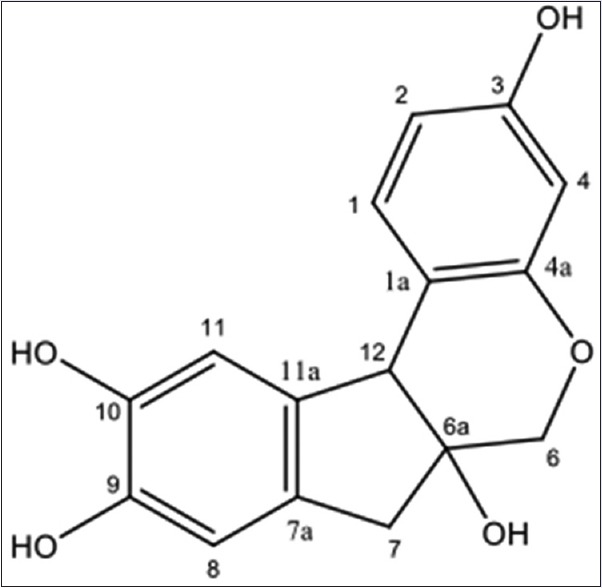
The flavonoid brazilin (1) was isolated from the heartwood of . The measurement of antiproliferative activity showed that brazilin can inhibit the growth of SiHa, MDA-MB-231, A549, and NCI-H1299 cell lines by 50% at doses of 44.3, 48.7, 45.4, and 48.7 μM, respectively. Furthermore, the flavonoid showed a high antiproliferative activity on LS 180 and HeLa with IC50 values of 62.2 and 71.9 μM, respectively. Brazilin also exhibited a high antiproliferative activity on the human noncancer cell line ARPE-19 with an IC50 value of 37.9 μM.
Brazilin: (6a, 11b)-7,11b-Dihidro-6-indeno[2,1-c] cromeno-3,6a, 9,10-tetrol was isolated; this compound demonstrated antiproliferative activity against several human cancer cell lines. This work demonstrated that brazilin, a flavonoid isolated and characterized of , has antiproliferative activity against cancer cell lines.
The flavonoid brazilin was isolated from the heartwood of Brazilin is able to inhibit the growth of SiHa, MDA-MB-231, A549 and NCI- H1299 cancerous cell linesBrazilin exhibited a moderate antiproliferative activity on the human non-cancer cell line ARPE-19Brazilin demonstrated to have antiproliferative activity against human cancer cell lines and could be a potential source of anticancer agents. MTT: [3-(4, 5-dimethylthiazol-2-yl)-2, 5-diphenyltetrazolium]; FBS: Fetal bovine serum; TLC: Thin layer chromatography.
巴西苏木是一种生长在中美洲的树,通常被称为“巴西木”,在传统医学中用于治疗癌症和胃溃疡。
本研究的目的是分离出巴西苏木中具有抗增殖活性的化合物。
采用3-(4,5-二甲基噻唑-2-基)-2,5-二苯基四氮唑溴盐细胞增殖试验对巴西苏木乙醇提取物进行生物活性导向分离,以测定其对六种人类癌细胞系(A549、LS180、HeLa、SiHa、MDA-MB-231和NCI-H1299)和一种人类非癌细胞系(ARPE-19)的抗增殖活性。乙醇提取物用己烷、二氯甲烷和乙酸乙酯进行分配。活性二氯甲烷部分通过硅胶柱色谱进行分离,活性亚部分通过制备薄层色谱进行分离。用不同的化学和光谱方法阐明分离出的化合物的化学结构。
从巴西苏木的心材中分离出黄酮类化合物巴西苏木素(1)。抗增殖活性测定表明,巴西苏木素在44.3、48.7、45.4和48.7 μM剂量下分别能抑制SiHa、MDA-MB-231、A549和NCI-H1299细胞系生长50%。此外,该黄酮类化合物对LS 180和HeLa表现出高抗增殖活性,IC50值分别为62.2和71.9 μM。巴西苏木素对人类非癌细胞系ARPE-19也表现出高抗增殖活性,IC50值为37.9 μM。
分离出巴西苏木素(6a,11b)-7,11b-二氢-6-茚并[2,1-c]色烯-3,6a,9,10-四醇;该化合物对几种人类癌细胞系具有抗增殖活性。这项工作表明,从巴西苏木中分离和鉴定的黄酮类化合物巴西苏木素对癌细胞系具有抗增殖活性。
从巴西苏木的心材中分离出黄酮类化合物巴西苏木素。巴西苏木素能够抑制SiHa、MDA-MB-231、A549和NCI-H1299癌细胞系的生长。巴西苏木素对人类非癌细胞系ARPE-19表现出中等抗增殖活性。巴西苏木素对人类癌细胞系具有抗增殖活性,可能是抗癌药物的潜在来源。MTT:[3-(4,5-二甲基噻唑-2-基)-2,5-二苯基四氮唑];FBS:胎牛血清;TLC:薄层色谱。