Almeneessier Aljohara S, Bahammam Ahmed S, Sharif Munir M, Bahammam Salman A, Nashwan Samar Z, Pandi Perumal Seithikurippu R, Cardinali Daniel P, Alzoghaibi Mohammad
Department of Family and Community Medicine, College of Medicine, King Saud University, Riyadh, Saudi Arabia.
University Sleep Disorders Center, College of Medicine, King Saud University, Riyadh, Saudi Arabia.
Ann Thorac Med. 2017 Jul-Sep;12(3):183-190. doi: 10.4103/atm.ATM_15_17.
We hypothesized that if we control for food composition, caloric intake, light exposure, sleep schedule, and exercise, intermittent fasting would not influence the circadian pattern of melatonin. Therefore, we designed this study to assess the effect of intermittent fasting on the circadian pattern of melatonin.
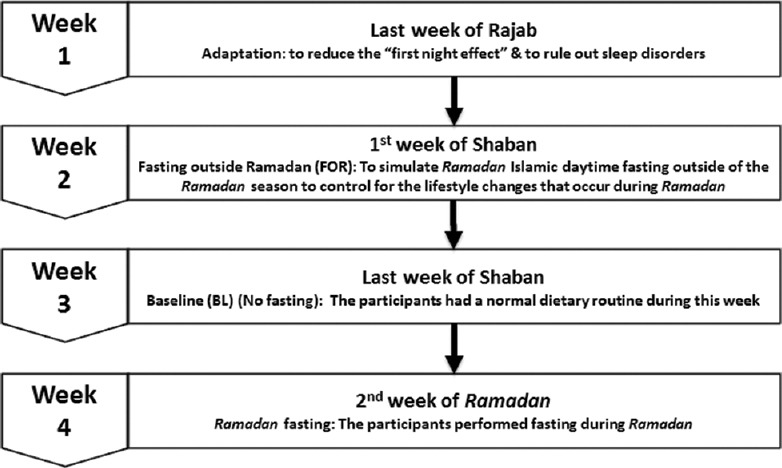
Eight healthy volunteers with a mean age of 26.6 ± 4.9 years and body mass index of 23.7 ± 3.5 kg/m reported to the Sleep Disorders Center (the laboratory) on four occasions: (1) adaptation, (2) 4 weeks before while performing Islamic intermittent fasting for 1 week (fasting outside [FOR]), (3) 1 week before (nonfasting baseline [BL]), and (4) during the 2 week of while fasting (). The plasma levels of melatonin were measured using enzyme-linked immunoassays at 22:00, 02:00, 04:00, 06:00, and 11:00 h. The light exposure, meal composition, energy expenditure, and sleep schedules remained the same while the participants stayed at the laboratory.
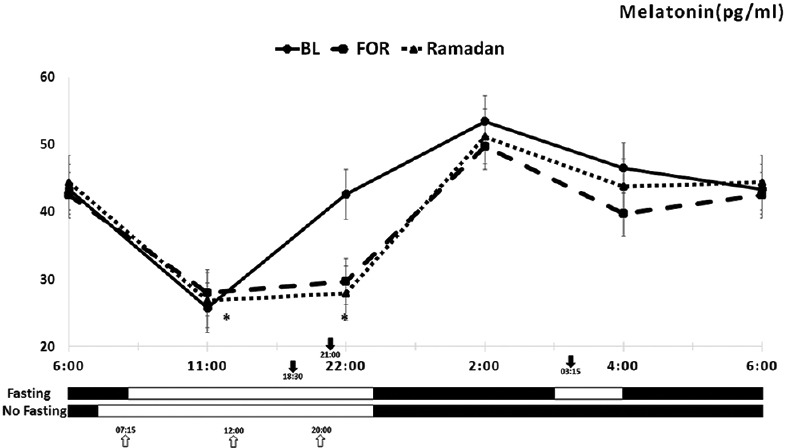
The melatonin levels followed the same circadian pattern during the three monitoring periods (BL, FOR, and ). The peak melatonin level was at 02:00 h and the trough level was at 11:00 h in all studied periods. Lower melatonin levels at 22:00 h were found during fasting compared to BL. Cosinor analysis revealed no significant changes in the acrophase of melatonin levels.
In this preliminary report, under controlled conditions of light exposure, meal composition, energy expenditure, and sleep-wake schedules, intermittent fasting has no significant influence on the circadian pattern of melatonin.
我们假设,如果我们控制食物成分、热量摄入、光照暴露、睡眠时间表和运动,间歇性禁食不会影响褪黑素的昼夜节律模式。因此,我们设计了本研究来评估间歇性禁食对褪黑素昼夜节律模式的影响。
八名平均年龄为26.6±4.9岁、体重指数为23.7±3.5kg/m²的健康志愿者分四次前往睡眠障碍中心(实验室):(1)适应期,(2)在进行为期1周的伊斯兰间歇性禁食前4周(外部禁食[FOR]),(3)在进行禁食前1周(非禁食基线[BL]),以及(4)在禁食的第2周()。在22:00、02:00、04:00、06:00和11:00时使用酶联免疫分析法测量血浆褪黑素水平。参与者待在实验室期间,光照暴露、膳食成分、能量消耗和睡眠时间表保持不变。
在三个监测期(BL、FOR和)内,褪黑素水平遵循相同的昼夜节律模式。在所有研究期间,褪黑素水平的峰值出现在02:00时,谷值出现在11:00时。与BL相比,禁食期间22:00时的褪黑素水平较低。余弦分析显示褪黑素水平的峰相位没有显著变化。
在本初步报告中,在光照暴露、膳食成分、能量消耗和睡眠-清醒时间表的受控条件下,间歇性禁食对褪黑素的昼夜节律模式没有显著影响。