Almeneessier Aljohara S, Alzoghaibi Mohammed, BaHammam Abdulrahman A, Ibrahim Mahmoud G, Olaish Awad H, Nashwan Samar Z, BaHammam Ahmed S
Department of Family Medicine, College of Medicine, King Saud University, Riyadh, Saudi Arabia.
Department of Physiology, College of Medicine, King Saud University, Riyadh, Saudi Arabia.
Ann Thorac Med. 2018 Jan-Mar;13(1):48-54. doi: 10.4103/atm.ATM_181_17.
Food restriction has been demonstrated to increase the alertness in different species and to increase the levels of the wake-promoting neurotransmitter orexin. We hypothesized that diurnal intermittent fasting (DIF) increases orexin-A levels during fasting. Therefore, we conducted this study to assess the effects of DIF, during the month of Ramadan, on orexin, while controlling for lifestyle changes that may accompany Ramadan such as sleep duration, bedtime and wake time, energy expenditure, light exposure, and food.
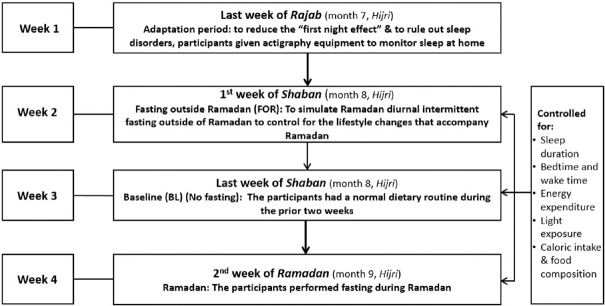
Eight young healthy volunteers (mean age, 25.4 ± 3.5 years) reported to the laboratory on three occasions: (1) 4 weeks before Ramadan while performing DIF for 1 week outside the month of Ramadan (fasting outside Ramadan); (2) 1 week before Ramadan (nonfasting baseline) (BL); and (3) during the 2 week of Ramadan while performing DIF (Ramadan). Plasma levels of orexin-A were measured using an enzyme immunoassay five times at 22:00, 02:00, 04:00, 06:00, and 11:00. Caloric intake, light exposure, and sleep schedule were maintained during the participants' stays in the laboratory in the three study periods.
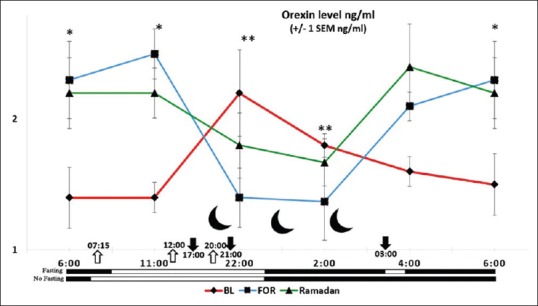
Orexin-A levels increased in the daytime during fasting and decreased at night compared to BL. The differences in orexin-A levels between DIF and BL were significant at 06:00, 11:00, 22:00, and 02:00.
DIF increases orexin-A levels in the plasma during fasting hours. This finding supports findings from animal studies showing that fasting increases alertness.
食物限制已被证明可提高不同物种的警觉性,并提高促进觉醒的神经递质食欲肽的水平。我们假设昼夜间歇性禁食(DIF)会在禁食期间增加食欲肽A的水平。因此,我们进行了这项研究,以评估斋月期间DIF对食欲肽的影响,同时控制可能伴随斋月出现的生活方式变化,如睡眠时间、就寝时间和起床时间、能量消耗、光照暴露和食物摄入。
八名年轻健康志愿者(平均年龄25.4±3.5岁)分三次到实验室报到:(1)斋月前4周,在斋月以外的时间进行1周的DIF(斋月外禁食);(2)斋月前1周(非禁食基线)(BL);(3)斋月的第2周进行DIF(斋月期间)。在22:00、02:00、04:00、06:00和11:00使用酶免疫分析法五次测量血浆中食欲肽A的水平。在三个研究期间,参与者在实验室停留期间保持热量摄入、光照暴露和睡眠时间表不变。
与BL相比,禁食期间白天食欲肽A水平升高,夜间降低。DIF和BL之间食欲肽A水平在06:00、11:00、22:00和02:00时差异显著。
DIF在禁食期间会增加血浆中食欲肽A的水平。这一发现支持了动物研究的结果,即禁食会提高警觉性。