Sinha Institute of Medical Science and Technology, West Bengal, India.
PG Department of Biochemistry, Cell and Molecular Therapeutics Laboratory, Oriental Institute of Science and Technology, Midnapore, West Bengal, India.
Sci Rep. 2017 Aug 15;7(1):8252. doi: 10.1038/s41598-017-07958-3.
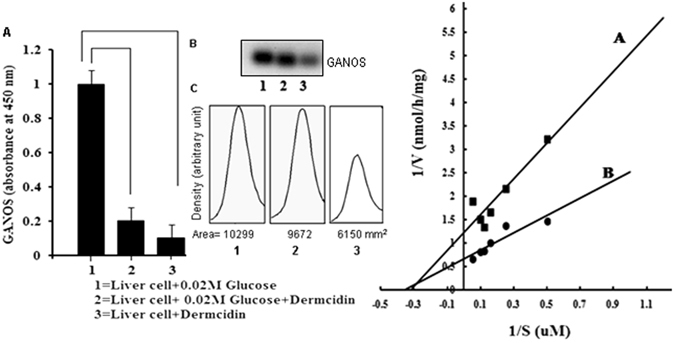
Diabetes is now epidemic worldwide. Several hundred-million peoples are presently suffering from this disease with other secondary-disorders. Stress, hypertension, sedentary life-style, carbohydrate/lipid metabolic-disorders due to genetic or environmental factors attributes to type-1 and/or type-2 diabetes. Present investigation demonstrates that stress-induced protein dermcidin isoform-2 (DCN-2) which appears in the serum of diabetic-patients play a key-role in this disease pathogenesis/severity. DCN-2 suppresses insulin production-release from liver/pancreas. It also increases the insulin-resistance. Stress-induction at the onset/progression of this disease is noticed as the high-level of lipid peroxides/low-level of free-thiols in association with increase of inflammatory-markers c-reactive protein and TNF-α. DCN-2 induced decrease in the synthesis of glucose-activated nitric oxide synthase (GANOS) and lower production of NO in liver has been shown here where NO is demonstrated to lower the expression of glucose trabsporter-4 (GLUT-4) and its translocation on liver membrane surface. This finally impairs glucose transport to organs from the extracellular fluid. Low level of glucose uptake further decreases glucose-induced insulin synthesis. The central role of DCN-2 has been demonstrated in type-1/type-2 diabetic individuals, in rodent hepatocytes and pancreatic-cell, tissue-slices, in-vitro and in-vivo experimental model. It can be concluded that stress-induced decrease in insulin synthesis/function, glucose transport is an interactive consequence of oxidative threats and inflammatory events.
糖尿病现在在全球范围内流行。目前有几亿人患有这种疾病,还有其他继发性疾病。压力、高血压、 sedentary 生活方式、由于遗传或环境因素导致的碳水化合物/脂质代谢紊乱,都可能导致 1 型和/或 2 型糖尿病。目前的研究表明,应激诱导的蛋白 dermcidin 同工型-2(DCN-2)出现在糖尿病患者的血清中,在这种疾病的发病机制/严重程度中起着关键作用。DCN-2 抑制肝脏/胰腺中胰岛素的产生和释放。它还会增加胰岛素抵抗。在这种疾病的发病/进展过程中,应激诱导被认为与脂质过氧化物水平升高和游离巯基水平降低以及炎症标志物 C 反应蛋白和 TNF-α水平升高有关。这里已经证明,DCN-2 诱导的葡萄糖激活型一氧化氮合酶(GANOS)合成减少和肝脏中 NO 生成减少,而 NO 被证明可以降低葡萄糖转运蛋白-4(GLUT-4)的表达及其在肝细胞膜表面的易位。这最终会损害从细胞外液向器官的葡萄糖转运。葡萄糖摄取的减少进一步降低了葡萄糖诱导的胰岛素合成。DCN-2 在 1 型/2 型糖尿病患者、啮齿动物肝细胞和胰腺细胞、组织切片、体外和体内实验模型中都发挥了核心作用。可以得出结论,应激诱导的胰岛素合成/功能下降、葡萄糖转运是氧化威胁和炎症事件的相互作用结果。