Obianwuna Uchechukwu Edna, Agbai Kalu Nenna, Wang Jing, Zhang Haijun, Qi Guanghai, Qiu Kai, Wu Shugeng
National Engineering Research Center of Biological Feed, Institute of Feed Research, Chinese Academy of Agricultural Sciences, Beijing 100081, China.
Department of Animal Science, Ahmadu Bello University, Zaria 810211, Nigeria.
Antioxidants (Basel). 2023 Apr 11;12(4):911. doi: 10.3390/antiox12040911.
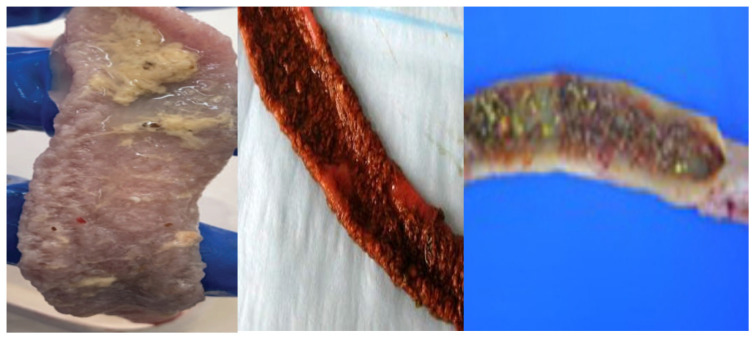
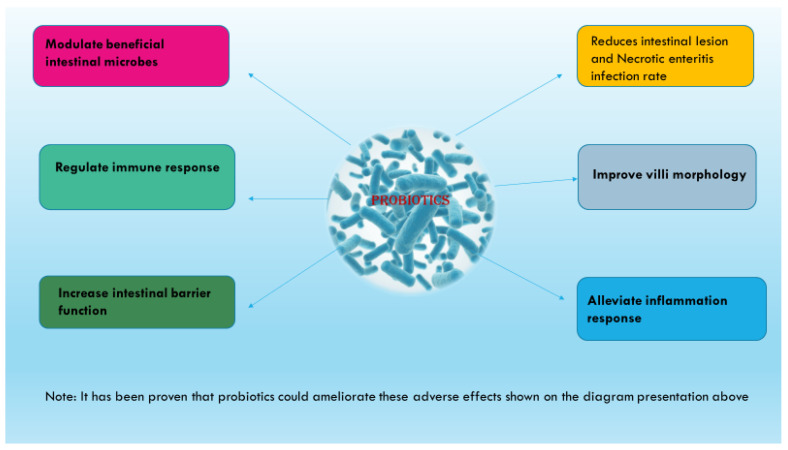
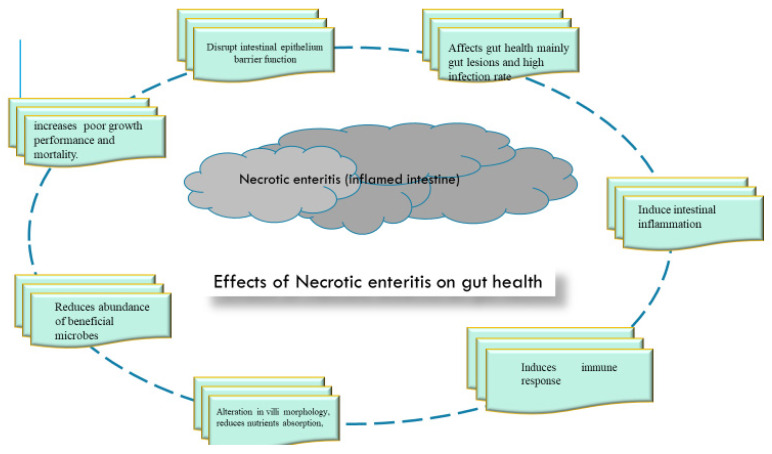
Gut health includes normal intestinal physiology, complete intestinal epithelial barrier, efficient immune response, sustained inflammatory balance, healthy microbiota, high nutrient absorption efficiency, nutrient metabolism, and energy balance. One of the diseases that causes severe economic losses to farmers is necrotic enteritis, which occurs primarily in the gut and is associated with high mortality rate. Necrotic enteritis (NE) primarily damages the intestinal mucosa, thereby inducing intestinal inflammation and high immune response which diverts nutrients and energy needed for growth to response mediated effects. In the era of antibiotic ban, dietary interventions like microbial therapy (probiotics) to reduce inflammation, paracellular permeability, and promote gut homeostasis may be the best way to reduce broiler production losses. The current review highlights the severity effects of NE; intestinal inflammation, gut lesions, alteration of gut microbiota balance, cell apoptosis, reduced growth performance, and death. These negative effects are consequences of; disrupted intestinal barrier function and villi development, altered expression of tight junction proteins and protein structure, increased translocation of endotoxins and excessive stimulation of proinflammatory cytokines. We further explored the mechanisms by which probiotics mitigate NE challenge and restore the gut integrity of birds under disease stress; synthesis of metabolites and bacteriocins, competitive exclusion of pathogens, upregulation of tight junction proteins and adhesion molecules, increased secretion of intestinal secretory immunoglobulins and enzymes, reduction in pro-inflammatory cytokines and immune response and the increased production of anti-inflammatory cytokines and immune boost via the modulation of the TLR/NF-ĸ pathway. Furthermore, increased beneficial microbes in the gut microbiome improve nutrient utilization, host immunity, and energy metabolism. Probiotics along with biosecurity measures could mitigate the adverse effects of NE in broiler production.
肠道健康包括正常的肠道生理功能、完整的肠道上皮屏障、有效的免疫反应、持续的炎症平衡、健康的微生物群、高营养吸收效率、营养代谢和能量平衡。给养殖户造成严重经济损失的疾病之一是坏死性肠炎,它主要发生在肠道,且死亡率很高。坏死性肠炎(NE)主要损害肠道黏膜,从而引发肠道炎症和强烈的免疫反应,这会将生长所需的营养物质和能量转移到免疫反应介导的效应上。在禁用抗生素的时代,像微生物疗法(益生菌)这样的饮食干预措施,以减少炎症、细胞旁通透性,并促进肠道内环境稳定,可能是减少肉鸡生产损失的最佳方法。本综述强调了NE的严重影响;肠道炎症、肠道损伤、肠道微生物群平衡改变、细胞凋亡、生长性能下降和死亡。这些负面影响是由以下原因导致的;肠道屏障功能和绒毛发育受阻、紧密连接蛋白表达和蛋白质结构改变、内毒素易位增加以及促炎细胞因子过度刺激。我们进一步探讨了益生菌减轻NE挑战并在疾病应激下恢复家禽肠道完整性的机制;代谢产物和细菌素的合成、病原体的竞争性排除、紧密连接蛋白和黏附分子的上调、肠道分泌型免疫球蛋白和酶的分泌增加、促炎细胞因子和免疫反应的减少以及通过调节TLR/NF-κ途径增加抗炎细胞因子的产生和免疫增强。此外,肠道微生物群中有益微生物的增加可提高营养物质利用、宿主免疫力和能量代谢。益生菌与生物安全措施相结合,可以减轻NE对肉鸡生产的不利影响。