Divisions of Developmental Biology, Cincinnati Children's Hospital Medical Center, University of Cincinnati College of Medicine, Cincinnati, OH, 45229, USA.
Molecular and Developmental Biology Graduate Program, University of Cincinnati College of Medicine, Cincinnati, OH, 45229, USA.
Neural Dev. 2017 Aug 16;12(1):13. doi: 10.1186/s13064-017-0090-5.
Olfactory bulb (OB) interneurons are known to represent diverse neuronal subtypes, which are thought to originate from a number of telencephalic regions including the embryonic dorsal lateral ganglionic eminence (dLGE) and septum. These cells migrate rostrally toward the OB, where they then radially migrate to populate different OB layers including the granule cell layer (GCL) and the outer glomerular layer (GL). Although previous studies have attempted to investigate regional contributions to OB interneuron diversity, few genetic tools have been used to address this question at embryonic time points when the earliest populations are specified.
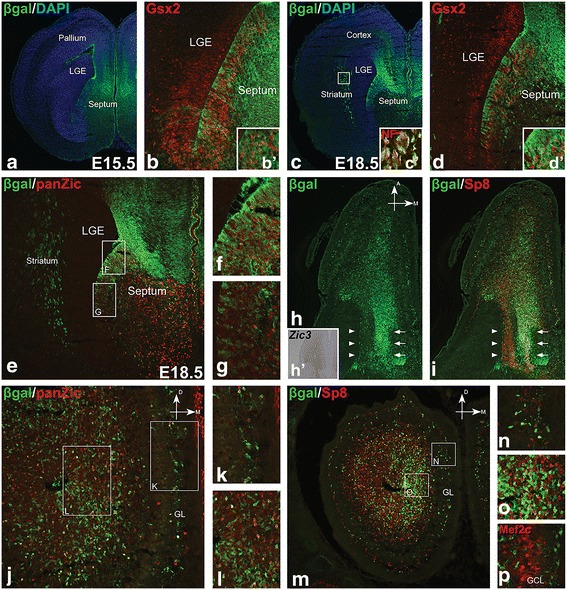
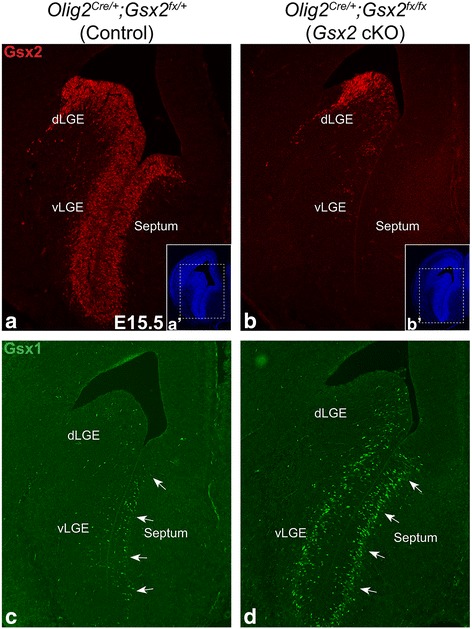
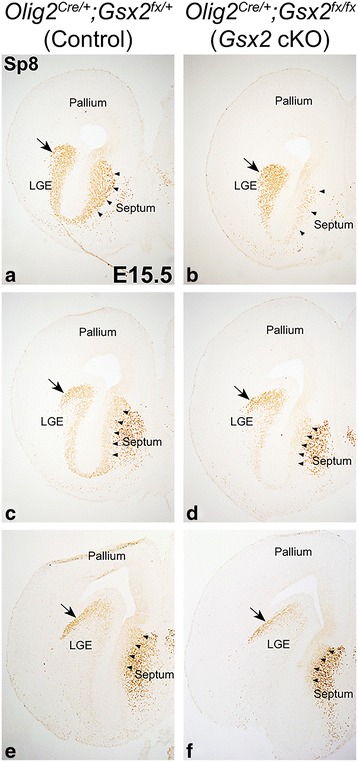
In this study, we utilized Zic3-lacZ and Gsx2e-CIE transgenic mice as genetic fate-mapping tools to study OB interneuron contributions derived from septum and LGE, respectively. Moreover, to address the regional (i.e. septal) requirements of the homeobox gene Gsx2 for OB interneuron diversity, we conditionally inactivated Gsx2 in the septum, leaving it largely intact in the dLGE, by recombining the Gsx2 floxed allele using Olig2 mice.
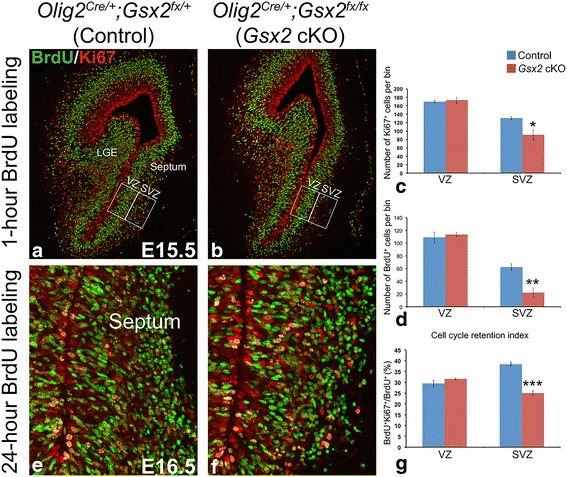
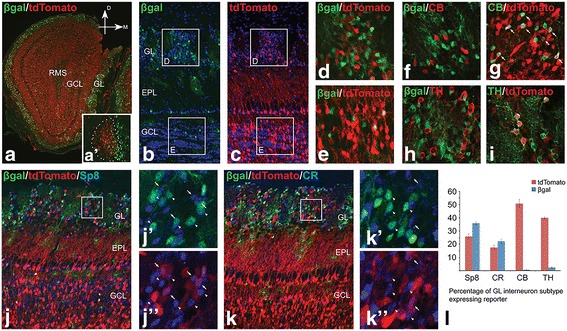
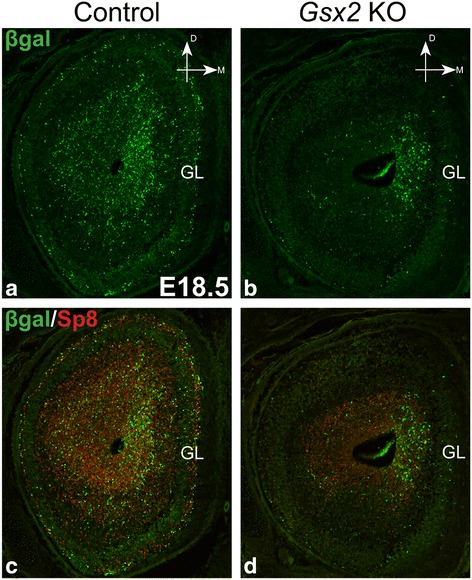
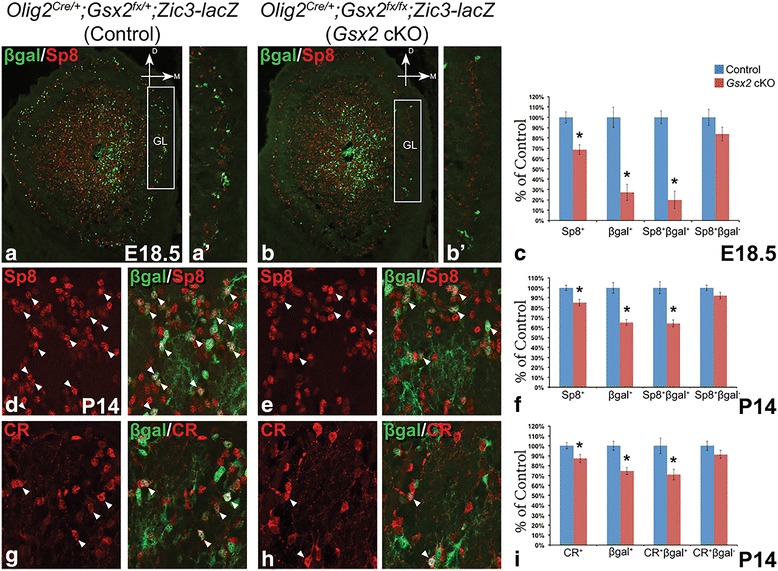
Our fate mapping studies demonstrated that the dLGE and septum gave rise to OB interneuron subtypes differently. Notably, the embryonic septum was found to give rise largely to the calretinin (CR) GL subtype, while the dLGE was more diverse, generating all major GL subpopulations as well as many GCL interneurons. Moreover, Gsx2 conditional mutants (cKOs), with septum but not dLGE recombination, showed impaired generation of CR interneurons within the OB GL. These Gsx2 cKOs exhibited reduced proliferation within the septal subventricular zone (SVZ), which correlated well with the reduced number of CR interneurons observed.
Our findings indicate that the septum and LGE contribute differently to OB interneuron diversity. While the dLGE provides a wide range of OB interneuron subtypes, the septum is more restricted in its contribution to the CR subtype. Gsx2 is required in septal progenitors for the correct expansion of SVZ progenitors specified toward the CR subtype. Finally, the septum has been suggested to be the exclusive source of CR interneurons in postnatal studies. Our results here demonstrate that dLGE progenitors in the embryo also contribute to this OB neuronal subtype.
嗅球(OB)内神经元已知代表多种神经元亚型,这些亚型被认为起源于包括胚胎背外侧神经节隆起(dLGE)和隔区在内的多个端脑区域。这些细胞向 OB 迁移,然后向 OB 的各个层迁移,包括颗粒细胞层(GCL)和外肾小球层(GL)。尽管之前的研究试图调查区域对 OB 内神经元多样性的贡献,但很少有遗传工具可用于解决胚胎时期最早指定的种群问题。
在这项研究中,我们利用 Zic3-lacZ 和 Gsx2e-CIE 转基因小鼠作为遗传命运图谱工具,分别研究源自隔区和 LGE 的 OB 内神经元的贡献。此外,为了解析同源盒基因 Gsx2 对 OB 内神经元多样性的区域(即隔区)需求,我们利用 Olig2 小鼠重组 Gsx2 基因的 floxed 等位基因,使 Gsx2 在隔区条件性失活,而在 dLGE 中保留其大部分活性。
我们的命运图谱研究表明,dLGE 和隔区对 OB 内神经元的亚型有不同的影响。值得注意的是,胚胎隔区主要产生 calretinin(CR)GL 亚型,而 dLGE 则更加多样化,产生了所有主要的 GL 亚群以及许多 GCL 内神经元。此外,在 OB GL 内,具有隔区但无 dLGE 重组的 Gsx2 条件性突变体(cKOs)显示出 CR 内神经元生成减少。这些 Gsx2 cKOs 表现出隔区侧脑室下区(SVZ)增殖减少,与观察到的 CR 内神经元数量减少密切相关。
我们的研究结果表明,隔区和 LGE 对 OB 内神经元多样性的贡献不同。虽然 dLGE 提供了广泛的 OB 内神经元亚型,但隔区对 CR 亚型的贡献更为局限。Gsx2 在 SVZ 祖细胞中是必需的,以确保其向 CR 亚型的正确扩增。最后,在产后研究中,隔区被认为是 CR 内神经元的唯一来源。我们在这里的结果表明,胚胎中的 LGE 祖细胞也有助于这种 OB 神经元亚型的产生。