Liang Yanhui, Wang Fusheng, Zhang Pengyue, Saltz Joel H, Brat Daniel J, Kong Jun
Department of Biomedical Informatics, Stony Brook University, Stony Brook, NY.
Department of Computer Science, Stony Brook University, Stony Brook, NY.
AMIA Jt Summits Transl Sci Proc. 2017 Jul 26;2017:75-84. eCollection 2017.
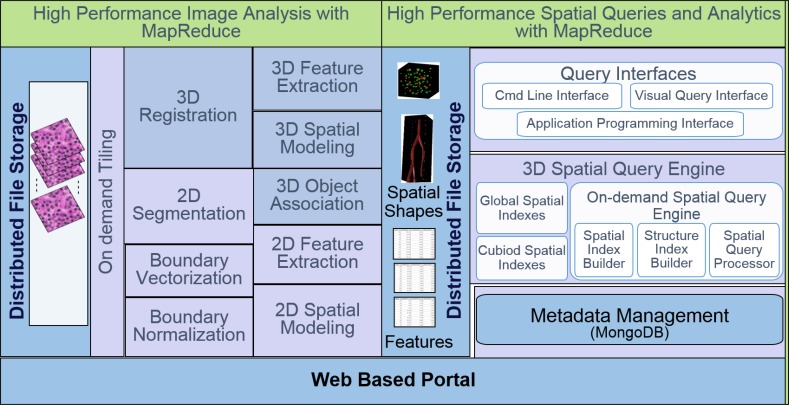
With the rapid advancement in large-throughput scanning technologies, digital pathology has emerged as platform with promise for diagnostic approaches, but also for high-throughput quantitative data extraction and analysis for translational research. Digital pathology and biomarker images are rich sources of information on tissue architecture, cell diversity and morphology, and molecular pathway activation. However, the understanding of disease in three-dimension (3D) has been hampered by their traditional two-dimension (2D) representations on histologic slides. In this paper, we propose a scalable image processing framework to quantitatively investigate 3D phenotypic and cell-specific molecular features from digital pathology and biomarker images in information- lossless 3D tissue space. We also develop a generalized 3D spatial data management framework with multi-level parallelism and provide a sustainable infrastructure for rapid spatial queries through scalable and efficient spatial data processing. The developed framework can facilitate biomedical research by efficiently processing large-scale, 3D pathology and in-situ biomarker imaging data.
随着高通量扫描技术的迅速发展,数字病理学已成为一个具有前景的平台,不仅适用于诊断方法,也适用于转化研究中的高通量定量数据提取和分析。数字病理学和生物标志物图像是关于组织结构、细胞多样性和形态以及分子通路激活的丰富信息来源。然而,对疾病的三维(3D)理解一直受到组织学切片上传统二维(2D)呈现方式的阻碍。在本文中,我们提出了一个可扩展的图像处理框架,用于在无损信息的3D组织空间中从数字病理学和生物标志物图像定量研究3D表型和细胞特异性分子特征。我们还开发了一个具有多级并行性的通用3D空间数据管理框架,并通过可扩展且高效的空间数据处理为快速空间查询提供可持续的基础设施。所开发的框架可以通过高效处理大规模3D病理学和原位生物标志物成像数据来促进生物医学研究。