Vázquez-Del Mercado Mónica, Gomez-Bañuelos Eduardo, Chavarria-Avila Efrain, Cardona-Muñoz Ernesto, Ramos-Becerra Carlos, Alanis-Sanchez Adrián, Cardona-Muller David, Grover-Paez Fernando, Perez-Vazquez Felipe de J, Navarro-Hernandez Rosa-Elena, Valadez-Soto Jorge M, Saldaña-Millan Adan A, Gonzalez-Rosas Lorena, Ramos-Lopez Gabriel, Petri Marcelo H, Bäck Magnus
Instituto de Investigación en Reumatología y del Sistema Musculo Esquelético, Centro Universitario de Ciencias de la Salud Servicio de Reumatología, Especialidad en Reumatología, División de Medicina Interna, Hospital Civil Dr. Juan I. Menchaca Departamento de Fisiología, Centro Universitario de Ciencias de la Salud Departamento de Disciplinas Metodológicas, Filosóficas e Instrumentales, Centro Universitario de Ciencias de la Salud Instituto de Terapéutica Experimental y Clínica, Departamento de Fisiología, Centro Universitario de Ciencias de la Salud, Universidad de Guadalajara Servicio de Cardiología, División de Medicina Interna, OPD Hospital Civil de Guadalajara, Juan I. Menchaca, Guadalajara, Jalisco, Mexico Department of Medicine, Karolinska Institutet and Center for Molecular Medicine, Karolinska University Hospital, Stockholm, Sweden.
Medicine (Baltimore). 2017 Aug;96(33):e7862. doi: 10.1097/MD.0000000000007862.
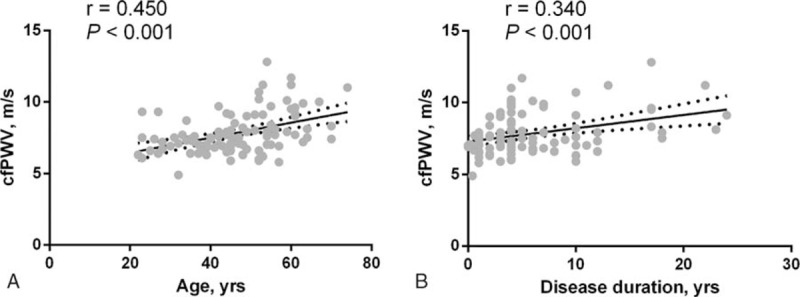
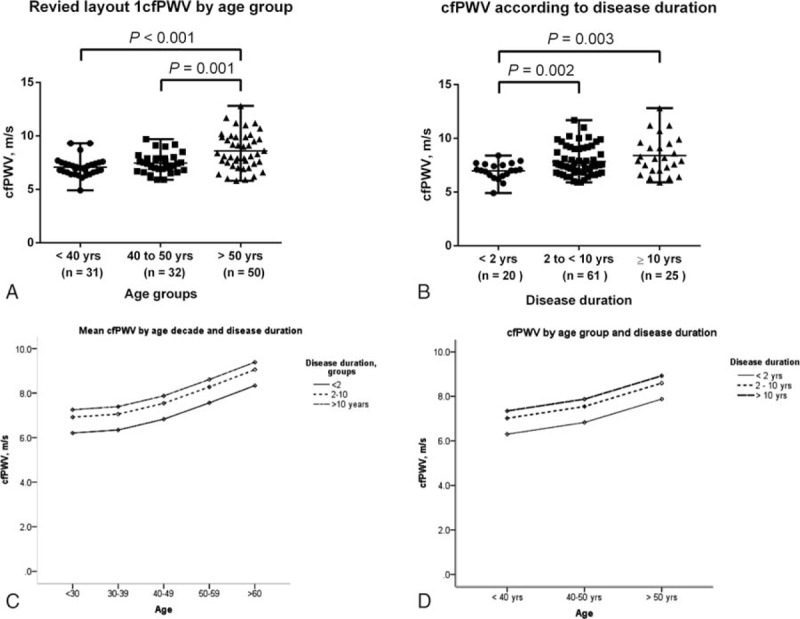
The aim of this study was to analyze the impact of disease duration on carotid to femoral pulse wave velocity (cfPWV) in rheumatoid arthritis (RA) patients without either known traditional cardiovascular risk factors or previous comorbidities.Patients with RA diagnosis attending the rheumatology outpatient clinic of Hospital Civil Juan I. Menchaca, Guadalajara, Mexico, were analyzed. A total of 106 RA patients without known traditional cardiovascular risk factors were selected. All subjects were evaluated for RA disease duration, RA disease activity score on 28 joints (DAS28), serum lipids, rheumatoid factor and anti-cyclic citrullinated peptide (anti-CCP) antibodies. Arterial stiffness was measured as cfPWV by noninvasive tonometry. A multivariate regression model was used to analyze the contribution of RA disease duration and age on cfPWV. cfPWV was positively correlated with age (r = 0.450, P < .001), RA disease duration (r = 0.340, P < .001), total cholesterol (r = 0.312, P = .002), and low density lipoprotein (LDL-c) cholesterol (r = 0.268, P = .012). Patients with a RA disease duration ≥10 years exhibited significantly increased cfPWV compared with patients with disease duration <2 years (8.4 ± 1.8 vs 7.0 ± 0.8) and ≥2 to <10 years (8.4 ± 1.8 vs 7.8 ± 1.3), respectively. Age, RA disease duration, and triglycerides were predictors of cfPWV in multivariate analyses. According to the β-coefficients, each year of disease duration (β = 0.072) had a greater impact on cfPWV than age (β = 0.054).Each year of life with RA contributes to a higher rate of vascular aging or stiffening than a year of life without RA. The cumulative damage provided by RA was most pronounced in patients with disease duration ≥10 years.
本研究的目的是分析疾病持续时间对无已知传统心血管危险因素或既往合并症的类风湿关节炎(RA)患者颈动脉至股动脉脉搏波速度(cfPWV)的影响。对在墨西哥瓜达拉哈拉市胡安·I·门查卡公民医院风湿病门诊就诊的RA诊断患者进行了分析。共选择了106例无已知传统心血管危险因素的RA患者。对所有受试者评估RA疾病持续时间、28个关节的RA疾病活动评分(DAS28)、血脂、类风湿因子和抗环瓜氨酸肽(抗CCP)抗体。通过无创眼压测量法将动脉僵硬度测量为cfPWV。使用多元回归模型分析RA疾病持续时间和年龄对cfPWV的影响。cfPWV与年龄(r = 0.450,P <.001)、RA疾病持续时间(r = 0.340,P <.001)、总胆固醇(r = 0.312,P =.002)和低密度脂蛋白(LDL-c)胆固醇(r = 0.268,P =.012)呈正相关。与疾病持续时间<2年(8.4±1.8 vs 7.0±0.8)和≥2至<10年(8.4±1.8 vs 7.8±1.3)的患者相比,RA疾病持续时间≥10年的患者cfPWV显著增加。在多变量分析中,年龄、RA疾病持续时间和甘油三酯是cfPWV的预测因素。根据β系数,疾病持续时间每增加一年(β = 0.072)对cfPWV的影响大于年龄(β = 0.054)。与无RA的一年相比,患有RA的每一年都会导致更高的血管老化或僵硬率。RA造成的累积损害在疾病持续时间≥10年的患者中最为明显。