Jia Xuan, Xi Bei-Dou, Li Ming-Xiao, Yang Yang, Wang Yong
Key Laboratory of Cleaner Production and Integrated Resource Utilization of China National Light Industry, Beijing Technology and Business University, Beijing, China.
State Key Laboratory of Environmental Criteria and Risk Assessment, Chinese Research Academy of Environmental Sciences, Beijing, China.
PLoS One. 2017 Aug 17;12(8):e0183158. doi: 10.1371/journal.pone.0183158. eCollection 2017.
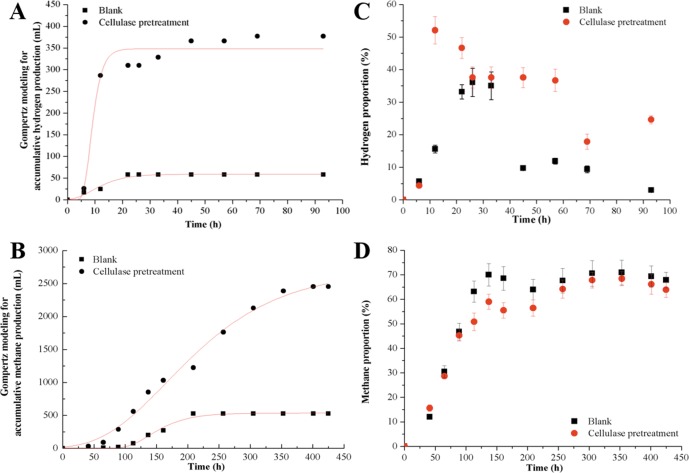
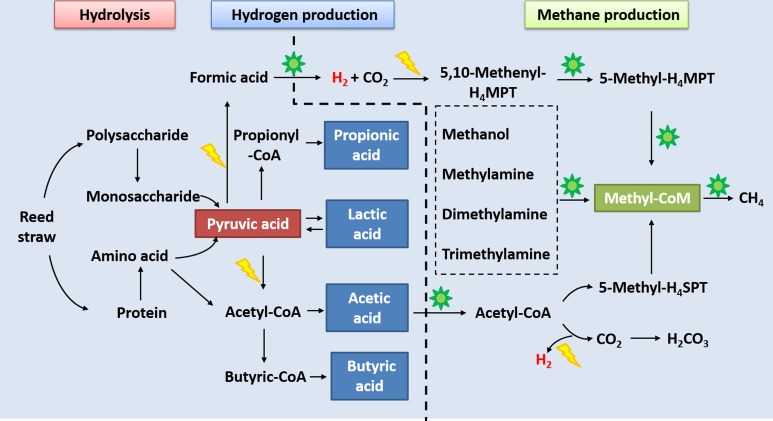
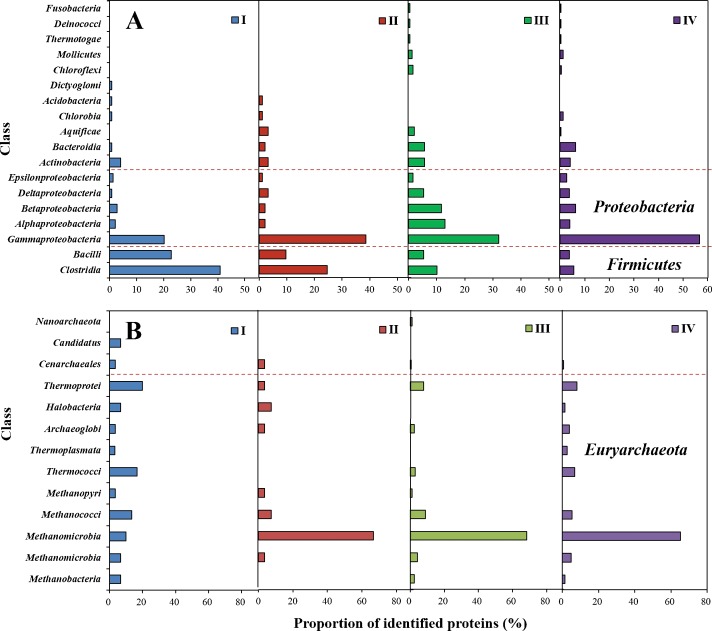
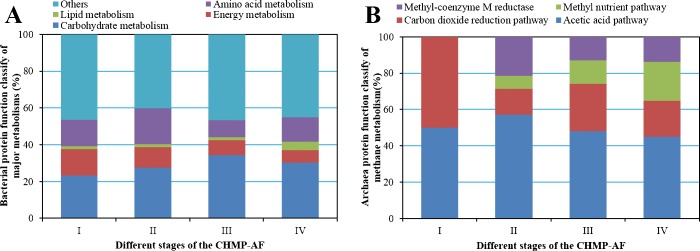
A metaproteomic approach was used to analyse the proteins expressed and provide functional evidence of key metabolic pathways in the combined production of hydrogen and methane by anaerobic fermentation (CHMP-AF) for reed straw utilisation. The functions and structures of bacteria and archaea populations show significant succession in the CHMP-AF process. There are many kinds of bacterial functional proteins, mainly belonging to phyla Firmicutes, Proteobacteria, Actinobacteria and Bacteroidetes, that are involved in carbohydrate metabolism, energy metabolism, lipid metabolism, and amino acid metabolism. Ferredoxin-NADP reductase, present in bacteria in genus Azotobacter, is an important enzyme for NADH/NAD+ equilibrium regulation in hydrogen production. The archaeal functional proteins are mainly involved in methane metabolism in energy metabolism, such as acetyl-CoA decarboxylase, and methyl-coenzyme M reductase, and the acetic acid pathway exhibited the highest proportion of the total. The archaea of genus Methanosarcina in phylum Euryarchaeota can produce methane under the effect of multi-functional proteins through acetic acid, CO2 reduction, and methyl nutrient pathways. The study demonstrates metaproteomics as a new way of uncovering community functional and metabolic activity. The combined information was used to identify the metabolic pathways and organisms crucial for lignocellulosic biomass degradation and biogas production. This also regulates the process from its protein levels and improves the efficiency of biogas production using reed straw biomass.
采用宏蛋白质组学方法分析厌氧发酵联合产氢产甲烷过程(CHMP-AF)中表达的蛋白质,并为芦苇秸秆利用提供关键代谢途径的功能证据。在CHMP-AF过程中,细菌和古菌种群的功能和结构呈现出显著的演替。有多种细菌功能蛋白,主要属于厚壁菌门、变形菌门、放线菌门和拟杆菌门,参与碳水化合物代谢、能量代谢、脂质代谢和氨基酸代谢。固氮菌属细菌中的铁氧化还原蛋白-NADP还原酶是产氢过程中调节NADH/NAD+平衡的重要酶。古菌功能蛋白主要参与能量代谢中的甲烷代谢,如乙酰辅酶A脱羧酶和甲基辅酶M还原酶,其中乙酸途径在总量中占比最高。广古菌门甲烷八叠球菌属的古菌可通过乙酸、CO2还原和甲基营养途径在多功能蛋白的作用下产生甲烷。该研究证明宏蛋白质组学是揭示群落功能和代谢活性的一种新方法。综合信息用于识别对木质纤维素生物质降解和沼气生产至关重要的代谢途径和生物体。这也从蛋白质水平调控该过程,提高利用芦苇秸秆生物质生产沼气的效率。