Decker Sebastian O, Sigl Annette, Grumaz Christian, Stevens Philip, Vainshtein Yevhen, Zimmermann Stefan, Weigand Markus A, Hofer Stefan, Sohn Kai, Brenner Thorsten
Department of Anesthesiology, Heidelberg University Hospital, 110, Im Neuenheimer Feld, D-69120 Heidelberg, Germany.
Fraunhofer IGB, 12, Nobelstraße, D-70569 Stuttgart, Germany.
Int J Mol Sci. 2017 Aug 18;18(8):1796. doi: 10.3390/ijms18081796.
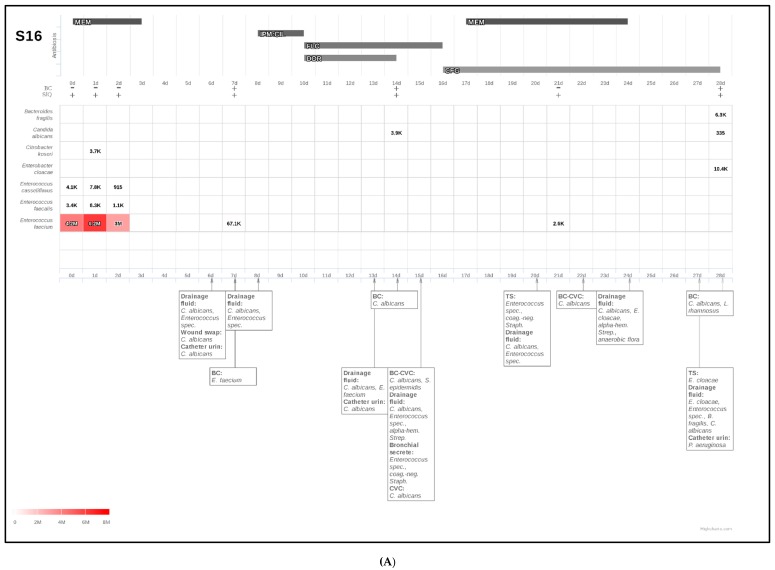
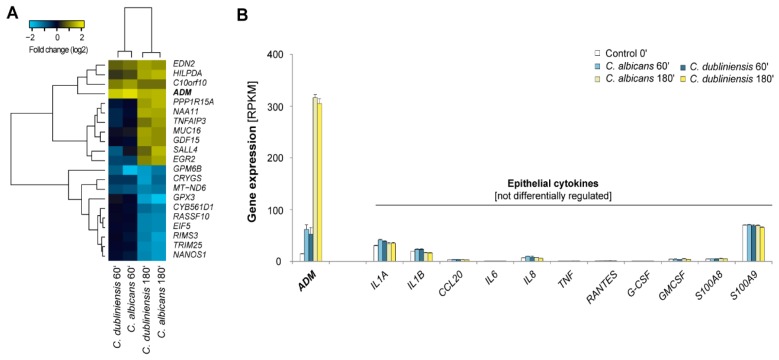
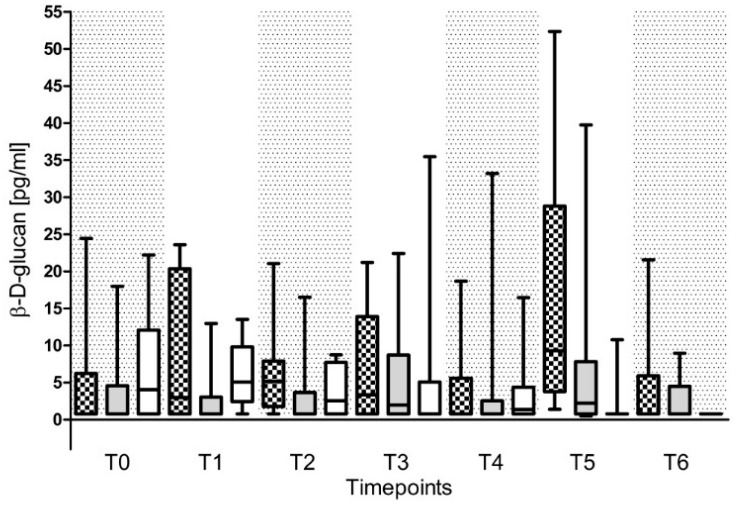
Fungi are of increasing importance in sepsis. However, culture-based diagnostic procedures are associated with relevant weaknesses. Therefore, culture- and next-generation sequencing (NGS)-based fungal findings as well as corresponding plasma levels of β-d-glucan, interferon gamma (INF-γ), tumor necrosis factor alpha (TNF-α), interleukin (IL)-2, -4, -6, -10, -17A, and mid-regional proadrenomedullin (MR-proADM) were evaluated in 50 septic patients at six consecutive time points within 28 days after sepsis onset. Furthermore, immune-response patterns during infections with spp. were studied in a reconstituted human epithelium model. In total, 22% ( = 11) of patients suffered from a fungal infection. An NGS-based diagnostic approach appeared to be suitable for the identification of fungal pathogens in patients suffering from fungemia as well as in patients with negative blood cultures. Moreover, MR-proADM and IL-17A in plasma proved suitable for the identification of patients with a fungal infection. Using RNA-seq., adrenomedullin (ADM) was shown to be a target gene which is upregulated early after an epithelial infection with spp. In summary, an NGS-based diagnostic approach was able to close the diagnostic gap of routinely used culture-based diagnostic procedures, which can be further facilitated by plasmatic measurements of MR-proADM and IL-17A. In addition, ADM was identified as an early target gene in response to epithelial infections with spp.
真菌在脓毒症中的重要性日益增加。然而,基于培养的诊断方法存在相关缺陷。因此,我们对50例脓毒症患者在脓毒症发作后28天内的6个连续时间点进行了基于培养和下一代测序(NGS)的真菌检测,以及相应的血浆β-d-葡聚糖、干扰素γ(INF-γ)、肿瘤坏死因子α(TNF-α)、白细胞介素(IL)-2、-4、-6、-10、-17A和中段前肾上腺髓质素(MR-proADM)水平检测。此外,还在重组人上皮模型中研究了感染 菌属期间的免疫反应模式。总共有22%(n = 11)的患者发生了真菌感染。基于NGS的诊断方法似乎适用于识别患有真菌血症的患者以及血培养阴性的患者。此外,血浆中的MR-proADM和IL-17A被证明适用于识别真菌感染患者。使用RNA测序,肾上腺髓质素(ADM)被证明是上皮感染 菌属后早期上调的靶基因。总之,基于NGS的诊断方法能够弥补常规基于培养的诊断方法的诊断差距,血浆中MR-proADM和IL-17A的检测可进一步促进这一过程。此外,ADM被确定为对 菌属上皮感染作出反应的早期靶基因。