Shi Quan, Qian Zhiyong, Liu Donghua, Liu Hongchen
Department of Stomatology, Chinese PLA General HospitalBeijing, China.
School of Biological Science and Medical Engineering, Beihang UniversityBeijing, China.
Front Physiol. 2017 Aug 7;8:574. doi: 10.3389/fphys.2017.00574. eCollection 2017.
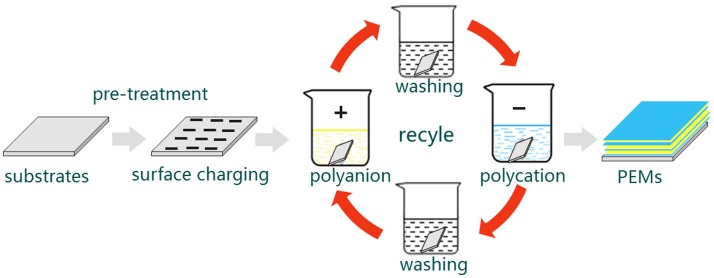
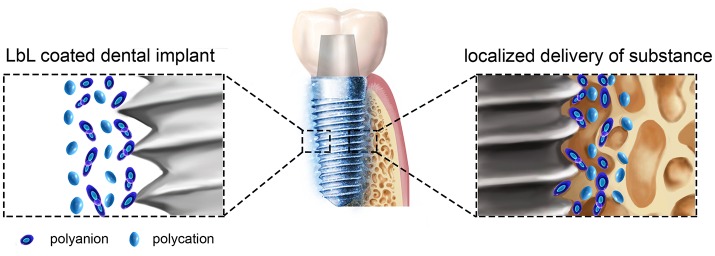
implants that are composed of titanium and titanium alloys as raw materials are widely used in the fields of biology and medicine. In the field of dental medicine, titanium is considered to be an ideal dental implant material. Good osseointegration and soft tissue closure are the foundation for the success of dental implants. Therefore, the enhancement of the osseointegration and antibacterial abilities of titanium and its alloys has been the focus of much research. With its many advantages, layer-by-layer (LbL) assembly is a self-assembly technique that is used to develop multilayer films based on complementary interactions between differently charged polyelectrolytes. The LbL approach provides new methods and applications for the surface modification of dental titanium implant. In this review, the application of the LbL technique to surface modification of titanium including promoting osteogenesis and osseointegration, promoting the formation and healing of soft tissues, improving the antibacterial properties of titanium implant, achieving local drug delivery and sustained release is summarized.
以钛及钛合金为原材料制成的植入物在生物医学领域有着广泛应用。在牙科医学领域,钛被认为是一种理想的牙科植入材料。良好的骨整合和软组织封闭是牙科植入成功的基础。因此,增强钛及其合金的骨整合和抗菌能力一直是众多研究的重点。层层(LbL)组装凭借其诸多优点,是一种用于基于带不同电荷的聚电解质之间的互补相互作用来制备多层膜的自组装技术。LbL方法为牙科钛植入物的表面改性提供了新的方法和应用。在本综述中,总结了LbL技术在钛表面改性中的应用,包括促进骨生成和骨整合、促进软组织的形成与愈合、改善钛植入物的抗菌性能、实现局部药物递送和缓释。