Witalis Ewa, Mikoluc Bozena, Motkowski Radoslaw, Sawicka-Powierza Jolanta, Chrobot Agnieszka, Didycz Bozena, Lange Agata, Mozrzymas Renata, Milanowski Andrzej, Nowacka Maria, Piotrowska-Depta Mariola, Romanowska Hanna, Starostecka Ewa, Wierzba Jolanta, Skorniewska Magdalena, Wojcicka-Bartlomiejczyk Barbara Iwona, Gizewska Maria, Car Halina
Medical and Rehabilitation Centre in Gdansk, Gdansk, Poland.
Department of Pediatrics, Rheumatology, Immunology and Metabolic Bone Diseases, Medical University of Bialystok, ul. Waszyngtona 17, 15-274 Bialystok, Poland.
Nutr Metab (Lond). 2017 Aug 17;14:57. doi: 10.1186/s12986-017-0207-1. eCollection 2017.
The aim of the study was to assess both patients' and their parents' knowledge of phenylketonuria (PKU) treatment and compliance with PKU diet.
The study included 173 PKU patients aged 10-19 and 110 parents of PKU children who were enrolled in the study on the basis of questionnaire data. The study also included 45 patients aged ≥20.
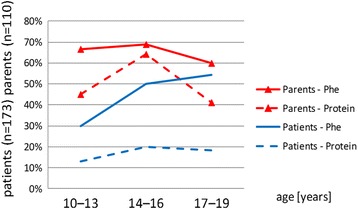
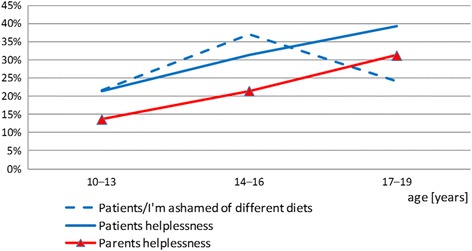
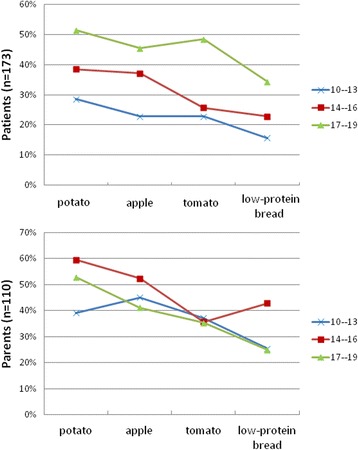
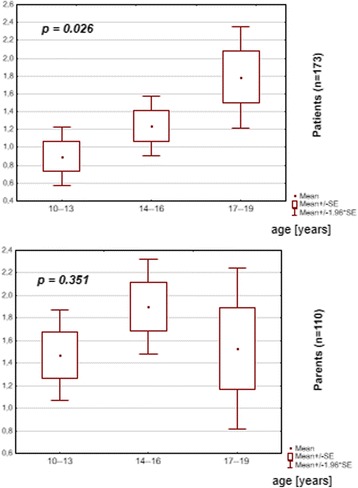
Our study demonstrated that only 45% ( = 74) of PKU patients knew daily Phe intake recommendations, 27% of patients ( = 41) knew the Phe content in a minimum of three out of four researched food products. Patients' knowledge concerning Phe intake ( = 0.0181) and the knowledge of selected food products ( = 0.041819) improved with age. We did not establish such a correlation in the group of PKU children's parents. Approximately 31% of patients and 22% of parents reported helplessness, which increased with the child's age, associated with the necessity to adhere to the diet; 30% of patients reported feeling ashamed of the fact that they could not eat all food products. Regardless of age, children were more likely than parents to report helplessness ( = 0.032005). Among patients, 41.40% declared that they would wish to select products unassisted but their parents did not permit them to do so. The question of whether parents teach children self-reliance in meal preparation was answered affirmatively by 98% of parents and only 81% of children ( = 0.0001).
Our data demonstrated that parents' and children's knowledge concerning treatment recommendations and food products does not have a direct impact on attitude to the PKU diet. Limiting children's independence in meal selection, growing helplessness in the face of dietary adherence and shame resulting from the necessity to follow a different diet observed in PKU families are responsible for shaping and perpetuating a consistently negative attitude to the diet. The care of PKU paediatric patients requires consistent, long-term family and individual therapy which may counteract the effects of learned helplessness. In regard to the educational effort, a good parent-child relationship as well as the teaching of behaviours motivating patients to comply with the diet are of great importance.
本研究旨在评估患者及其父母对苯丙酮尿症(PKU)治疗的了解程度以及对PKU饮食的依从性。
本研究纳入了173名年龄在10至19岁的PKU患者以及110名PKU患儿的父母,这些父母是根据问卷调查数据纳入研究的。研究还包括45名年龄≥20岁的患者。
我们的研究表明,只有45%(n = 74)的PKU患者知道每日苯丙氨酸(Phe)摄入量建议,27%的患者(n = 41)知道四种研究食品中至少三种的Phe含量。患者关于Phe摄入量的知识(p = 0.0181)和所选食品的知识(p = 0.041819)随着年龄增长而提高。我们在PKU患儿父母组中未发现这种相关性。约31%的患者和22%的父母表示无助,这种无助感随着孩子年龄的增长而增加,与坚持饮食的必要性有关;30%的患者表示因不能食用所有食品而感到羞愧。无论年龄大小,孩子比父母更有可能表示无助(p = 0.032005)。在患者中,41.40%宣称他们希望自己选择食品,但父母不允许他们这样做。98%的父母肯定地回答了父母是否教导孩子在准备膳食方面自力更生的问题,而只有81%的孩子回答是(p = 0.0001)。
我们的数据表明,父母和孩子关于治疗建议和食品的知识对PKU饮食态度没有直接影响。限制孩子在膳食选择上的独立性、面对饮食依从性时日益增加的无助感以及PKU家庭中因必须遵循不同饮食而产生的羞愧感,是形成并持续对该饮食持一贯消极态度的原因。PKU儿科患者的护理需要持续、长期的家庭和个体治疗,这可能抵消习得性无助的影响。在教育方面,良好的亲子关系以及教导促使患者遵守饮食的行为非常重要。