Miñano-Espin Javier, Casáis Luis, Lago-Peñas Carlos, Gómez-Ruano Miguel Ángel
Facultad de Ciencias de la Actividad Física y del Deporte, Universidad Politécnica de Madrid, Madrid, Spain.
Facultad de Ciencias de la Educación y del Deporte, Universidad de Vigo, Campus Pontevedra, Spain.
J Hum Kinet. 2017 Aug 1;58:169-176. doi: 10.1515/hukin-2017-0086. eCollection 2017 Sep.
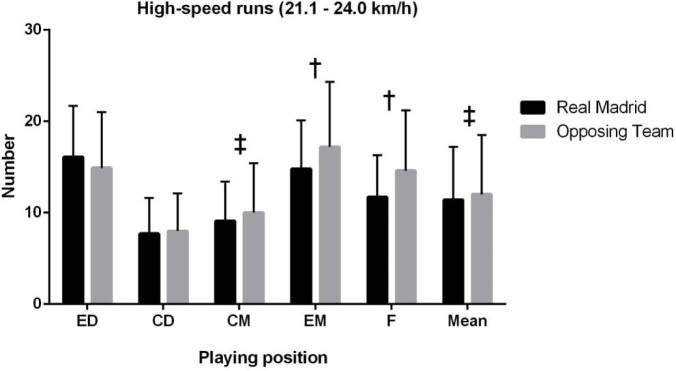
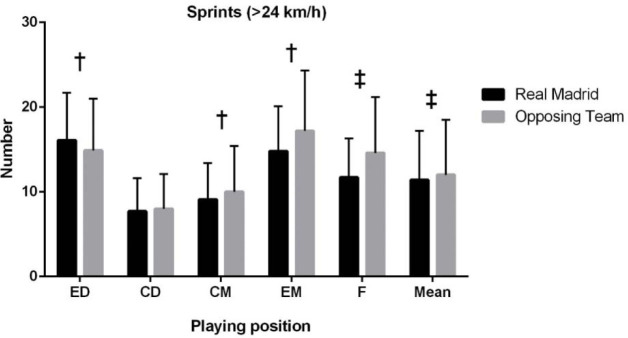
Real Madrid was named as the best club of the 20th century by the International Federation of Football History and Statistics. The aim of this study was to compare if players from Real Madrid covered shorter distances than players from the opposing team. One hundred and forty-nine matches including league, cup and UEFA Champions League matches played by the Real Madrid were monitored during the 2001-2002 to the 2006-2007 seasons. Data from both teams (Real Madrid and the opponent) were recorded. Altogether, 2082 physical performance profiles were examined, 1052 from the Real Madrid and 1031 from the opposing team (Central Defenders (CD) = 536, External Defenders (ED) = 491, Central Midfielders (CM) = 544, External Midfielders (EM) = 233, and Forwards (F) = 278). Match performance data were collected using a computerized multiple-camera tracking system (Amisco Pro®, Nice, France). A repeated measures analysis of variance (ANOVA) was performed for distances covered at different intensities (sprinting (>24.0 km/h) and high-speed running (21.1-24.0 km/h) and the number of sprints (21.1-24.0 km/h and >24.0 km/h) during games for each player sectioned under their positional roles. Players from Real Madrid covered shorter distances in high-speed running and sprint than players from the opposing team (p < 0.01). While ED did not show differences in their physical performance, CD (p < 0.05), CM (p < 0.01), EM (p < 0.01) and F (p > 0.01) from Real Madrid covered shorter distances in high-intensity running and sprint and performed less sprints than their counterparts. Finally, no differences were found in the high-intensity running and sprint distances performed by players from Real Madrid depending on the quality of the opposition.
国际足球历史与统计联合会将皇家马德里评为20世纪最佳俱乐部。本研究的目的是比较皇家马德里球员与对手球队球员的跑动距离是否更短。在2001 - 2002赛季至2006 - 2007赛季期间,对皇家马德里参加的149场比赛(包括联赛、杯赛和欧洲冠军联赛)进行了监测。记录了两队(皇家马德里和对手)的数据。总共检查了2082份体能表现档案,其中1052份来自皇家马德里,1031份来自对手球队(中后卫(CD)= 536份,边后卫(ED)= 491份,中场球员(CM)= 544份,边锋(EM)= 233份,前锋(F)= 278份)。比赛表现数据使用计算机化多摄像头跟踪系统(Amisco Pro®,法国尼斯)收集。对每个按位置角色划分的球员在比赛中不同强度下的跑动距离(冲刺(>24.0公里/小时)和高速奔跑(21.1 - 24.0公里/小时))以及冲刺次数(21.1 - 24.0公里/小时和>24.0公里/小时)进行了重复测量方差分析(ANOVA)。皇家马德里球员在高速奔跑和冲刺中的跑动距离比对手球队球员更短(p < 0.01)。虽然边后卫在体能表现上没有差异,但皇家马德里的中后卫(p < 0.05)、中场球员(p < 0.01)、边锋(p < 0.01)和前锋(p > 0.01)在高强度奔跑和冲刺中的跑动距离更短,且冲刺次数比对手少。最后,根据对手的水平,未发现皇家马德里球员在高强度奔跑和冲刺距离上存在差异。