Böhm Brigitte, Schade Benjamin, Bauer Benjamin, Hoffmann Bernd, Hoffmann Donata, Ziegler Ute, Beer Martin, Klaus Christine, Weissenböck Herbert, Böttcher Jens
Bavarian Animal Health Service, Senator-Gerauer-Straße 23, 85586, Poing, Germany.
Institute of Diagnostic Virology, Friedrich-Loeffler-Institute, Südufer 10, 17493, Greifswald-Insel Riems, Germany.
BMC Vet Res. 2017 Aug 22;13(1):267. doi: 10.1186/s12917-017-1192-3.
Tick-borne encephalitis (TBE) is the most important viral tick borne zoonosis in Europe. In Germany, about 250 human cases are registered annually, with the highest incidence reported in the last years coming from the federal states Bavaria and Baden-Wuerttemberg. In veterinary medicine, only sporadic cases in wild and domestic animals have been reported; however, a high number of wild and domestic animals have tested positive for the tick-borne encephalitis virus (TBEV) antibody.
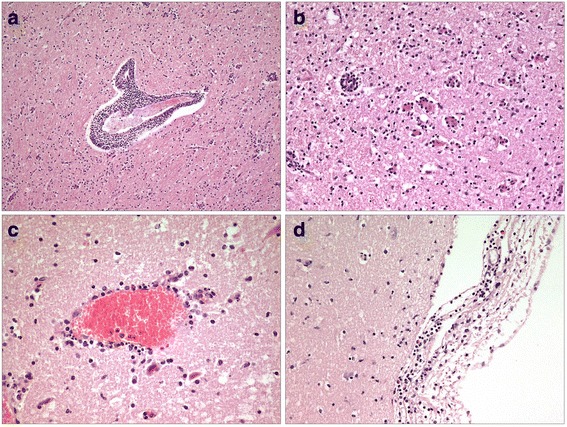
In May 2015, a five-month-old lamb from a farm with 15 Merino Land sheep and offspring in Nersingen/Bavaria, a TBEV risk area, showed impaired general health with pyrexia and acute neurological signs. The sheep suffered from ataxia, torticollis, tremor, nystagmus, salivation and finally somnolence with inappetence and recumbency. After euthanasia, pathological, histopathological, immunohistochemical, bacteriological, parasitological and virological analyses were performed. Additionally, blood samples from the remaining, healthy sheep in the herd were taken for detection of TBEV antibody titres. At necropsy and accompanying parasitology, the sheep showed a moderate to severe infection with Trichostrongylids, Moniezia and Eimeria species. Histopathology revealed mild to moderate necrotising, lymphohistiocytic and granulocytic meningoencephalitis with gliosis and neuronophagia. Immunohistochemistry for TBEV was negative. RNA of a TBEV strain, closely related to the Kumlinge A52 strain, was detected in the brain by quantitative reverse transcriptase polymerase chain reaction (RT-qPCR) and subsequent PCR product sequencing. A phylogenetic analysis revealed a close relationship to the TBEV of central Europe. TBEV was cultured from brain tissue. Serologically, one of blood samples from the other sheep in the herd was positive for TBEV in an enzyme-linked immunosorbent assay (ELISA) and in a serum neutralisation test (SNT), and one was borderline in an ELISA.
To the authors' knowledge this is the first report of a natural TBEV infection in a sheep in Europe with clinical manifestation, which describes the clinical presentation and the histopathology of TBEV infection.
蜱传脑炎(TBE)是欧洲最重要的病毒性蜱传人畜共患病。在德国,每年约有250例人类病例登记在册,近年来发病率最高的是巴伐利亚州和巴登 - 符腾堡州。在兽医学中,仅报告了野生动物和家畜中的散发病例;然而,大量野生动物和家畜的蜱传脑炎病毒(TBEV)抗体检测呈阳性。
2015年5月,来自内尔辛根/巴伐利亚州一个有15只美利奴羊及其后代的农场的一只5个月大的羔羊,该地区为TBEV风险区,其总体健康状况受损,伴有发热和急性神经症状。这只羊患有共济失调、斜颈、震颤、眼球震颤、流涎,最终嗜睡、食欲不振并卧地不起。安乐死后,进行了病理、组织病理、免疫组化、细菌学、寄生虫学和病毒学分析。此外,采集了该羊群中其余健康羊的血样以检测TBEV抗体滴度。尸检及伴随的寄生虫学检查显示,这只羊感染了中度至重度的毛圆线虫、莫尼茨绦虫和艾美耳球虫。组织病理学显示轻度至中度坏死性、淋巴细胞性和粒细胞性脑膜脑炎,并伴有胶质增生和噬神经元现象。TBEV免疫组化检测为阴性。通过定量逆转录聚合酶链反应(RT-qPCR)及随后的PCR产物测序,在脑中检测到与库姆林格A52株密切相关的TBEV毒株的RNA。系统发育分析显示与中欧的TBEV关系密切。从脑组织中培养出了TBEV。血清学检测中,该羊群中另一只羊的一份血样在酶联免疫吸附试验(ELISA)和血清中和试验(SNT)中TBEV呈阳性,另一份在ELISA中处于临界值。
据作者所知,这是欧洲首例有临床表现的绵羊自然感染TBEV的报告,描述了TBEV感染的临床表现和组织病理学。