Rebouças de Araújo Ítalo Diego, Coriolano de Aquino Nayara, Véras de Aguiar Guerra Andreza Conceição, Ferreira de Almeida Júnior Renato, Mendonça Araújo Renata, Fernandes de Araújo Júnior Raimundo, Silva Farias Kléber Juvenal, Fernandes José Veríssimo, Sousa Andrade Vânia
Centro de Biociências (CB), Departamento de Microbiologia e Parasitologia, Universidade Federal do Rio Grande do Norte (UFRN), Natal, RN, 59072-970, Brazil.
Centro de Ciências, Departamento de Química Orgânica e Inorgânica, Universidade Federal do Ceará (UFC), Fortaleza, CE, 60021-940, Brazil.
BMC Complement Altern Med. 2017 Aug 22;17(1):419. doi: 10.1186/s12906-017-1918-6.
This study evaluated the in vitro activity of essential oil extracted from the leaves of Myracrodruon urundeuva.
The oil was obtained by hydro-distillation and characterized by Gas Chromatography coupled to Mass Spectrometry (GC-MS) and Gas Chromatography with Flame Ionization Detector (GC-FID). The antibacterial activity was evaluated by the broth microdilution technique and the MIF was determined by using growth indicator CTT (2,3,5-triphenyl-tetrazolium) and CBM in BHI agar. The oil's cytotoxicity was evaluated in HeLa, HEK-293, and Vero E6 cells using MTT, 3- (4,5-dimethylthiazol-2-yl) -2,5-diphenyl tetrazolium.
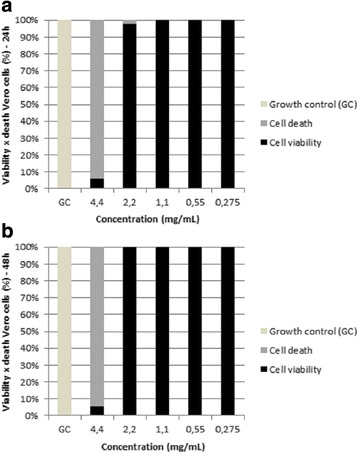
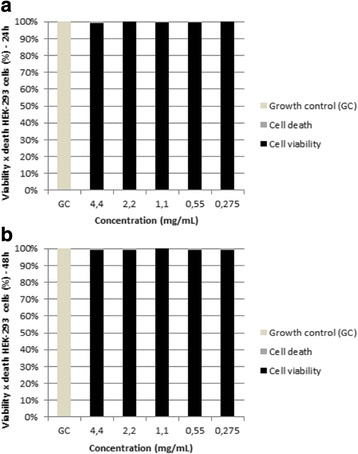
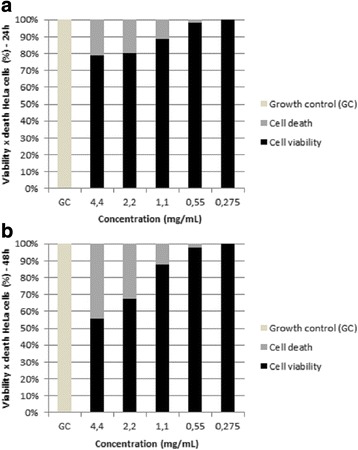
The oil showed chemical markers, including α-pinene (87.85%), trans-caryophyllene (1.57%), limonene (1.49%) and β -pinene (1.42%), and activity against all strains: Staphylococcus aureus (MIC = MBC = 0.22 mg/mL), Staphylococcus epidermidis (MIC = 0.11 mg/mL and MBC = 0.22 mg/mL), Escherichia coli (MIC = 0.88 mg/mL and MBC = 1.75 mg/mL), Pseudomonas aeruginosa (MIC = MBC = 7 mg/mL) and Salmonella Enteritidis (MIC = MBC = 0.44 mg/mL). In vitro cytotoxicity tests showed that the oil is not toxic and has slight antitumor activity.
We conclude that the M. urundeuva oil results are promising, with prospects of being pharmacologically viable.
本研究评估了从乌伦杜瓦杨梅叶中提取的精油的体外活性。
通过水蒸馏法获得该精油,并采用气相色谱 - 质谱联用(GC - MS)和带火焰离子化检测器的气相色谱(GC - FID)对其进行表征。采用肉汤微量稀释技术评估抗菌活性,并使用生长指示剂CTT(2,3,5 - 三苯基 - 四氮唑)和CBM在BHI琼脂中测定最低抑菌浓度(MIF)。使用MTT(3 - (4,5 - 二甲基噻唑 - 2 - 基) - 2,5 - 二苯基四氮唑)在HeLa、HEK - 293和Vero E6细胞中评估该精油的细胞毒性。
该精油显示出化学标志物,包括α - 蒎烯(87.85%)、反式 - 石竹烯(1.57%)、柠檬烯(1.49%)和β - 蒎烯(1.42%),并且对所有菌株均有活性:金黄色葡萄球菌(MIC = MBC = 0.22 mg/mL)、表皮葡萄球菌(MIC = 0.11 mg/mL,MBC = 0.22 mg/mL)、大肠杆菌(MIC = 0.88 mg/mL,MBC = 1.75 mg/mL)、铜绿假单胞菌(MIC = MBC = 7 mg/mL)和肠炎沙门氏菌(MIC = MBC = 0.44 mg/mL)。体外细胞毒性试验表明该精油无毒且具有轻微的抗肿瘤活性。
我们得出结论,乌伦杜瓦杨梅精油的结果很有前景,具有药理学可行性的前景。