Pumipuntu Natapol, Kulpeanprasit Suphang, Santajit Sirijan, Tunyong Witawat, Kong-Ngoen Thida, Hinthong Woranich, Indrawattana Nitaya
Department of Microbiology and Immunology, Faculty of Tropical Medicine, Mahidol University, Bangkok, Thailand.
Faculty of Medicine and Allied Health, HRH Princess Chulabhorn College of Medical Science Bangkok, Thailand.
Vet World. 2017 Jul;10(7):721-726. doi: 10.14202/vetworld.2017.721-726. Epub 2017 Jul 1.
is one of the most important contagious bacteria causing subclinical bovine mastitis. This bacterial infection is commonly identified by determine the pathogen in bovine milk samples through conventional technique including coagulase test. However, this test has several disadvantages as low sensitivity, risk of biohazard, cost expensive, and limited preparation especially in local area.
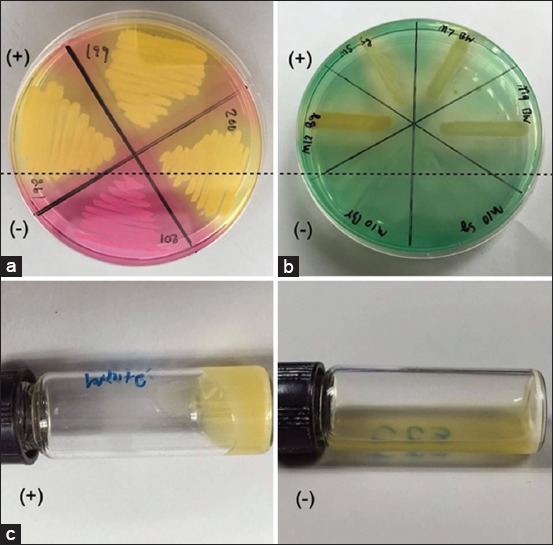
Aim of this study was to compare and assess the screening method, Mannitol fermentation test (Mannitol salt agar [MSA]), and deoxyribonuclease (DNase) test, for identification in milk samples.
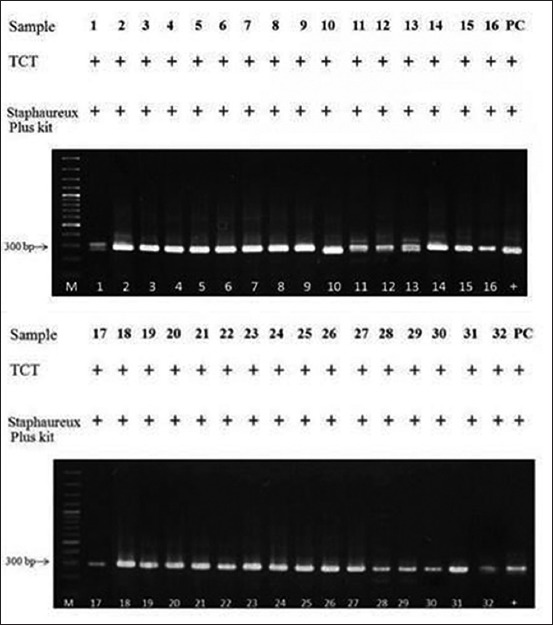
A total of 224 subclinical bovine mastitis milk samples were collected from four provinces of Thailand and determined using conventional method and also subjected to the screening test, MSA and DNase test. The sensitivity, specificity, positive predictive value (PPV), and negative predictive value (NPV) among both tests were analyzed and compared to the tube coagulase test (TCT), as reference method. Immunological test by latex agglutination and molecular assay by determined gene were also used to identify and differentiate .
A total of 130 staphylococci were isolated by selective media, Gram-stain, and catalase test. The number of which identified using TCT, MSA and DNase test were 32, 102, and 74 isolates, respectively. All TCT results were correlated to results of latex agglutination and gene which were 32 . MSA showed 100% sensitivity, 28.57% specificity, 31.37% PPV, and 100% NPV, whereas DNase showed 53.13% sensitivity, 41.84% specificity, 22.97% PPV, and 73.21% NPV. DNase test showed higher specificity value than MSA but the test presented 26.79% false negative results whereas no false-negative result from MSA when comparing to TCT.
MSA had a tendency to be a good preference for screening because of its high sensitivity and NPV. The result from this study will improve a choice to use a screening test to diagnose of veterinary field for prompt disease controlling and effective treatment.
是引起亚临床型牛乳腺炎的最重要的传染性细菌之一。这种细菌感染通常通过常规技术(包括凝固酶试验)来确定牛乳样本中的病原体。然而,该试验存在几个缺点,如灵敏度低、有生物危害风险、成本高以及准备工作有限,特别是在当地。
本研究的目的是比较和评估用于牛奶样本鉴定的筛选方法、甘露醇发酵试验(甘露醇盐琼脂[MSA])和脱氧核糖核酸酶(DNase)试验。
从泰国四个省份收集了总共224份亚临床型牛乳腺炎牛奶样本,先用常规方法进行测定,然后进行筛选试验、MSA和DNase试验。分析并比较了两种试验的灵敏度、特异性、阳性预测值(PPV)和阴性预测值(NPV),并与作为参考方法的试管凝固酶试验(TCT)进行比较。还使用乳胶凝集免疫试验和通过测定基因的分子分析来鉴定和区分。
通过选择性培养基、革兰氏染色和过氧化氢酶试验共分离出130株葡萄球菌。使用TCT、MSA和DNase试验鉴定出的菌株数量分别为32株、102株和74株。所有TCT结果均与乳胶凝集和基因结果相关,均为32株。MSA显示灵敏度为100%,特异性为28.57%,PPV为31.37%,NPV为100%;而DNase显示灵敏度为53.13%,特异性为41.84%,PPV为22.97%,NPV为73.21%。与TCT相比,DNase试验的特异性值高于MSA,但该试验出现了26.79%的假阴性结果,而MSA未出现假阴性结果。
由于其高灵敏度和NPV,MSA倾向于成为筛选的良好选择。本研究结果将改善兽医领域用于诊断的筛选试验的选择,以便及时控制疾病和进行有效治疗。