Mierzejewska Ewa J, Estrada-Peña Agustín, Bajer Anna
Department of Parasitology, Faculty of Biology, University of Warsaw, Warsaw, Poland.
Department of Animal Health, Faculty of Veterinary Medicine, University of Zaragoza, Zaragoza, Spain.
Exp Appl Acarol. 2017 Aug;72(4):399-413. doi: 10.1007/s10493-017-0160-8. Epub 2017 Aug 22.
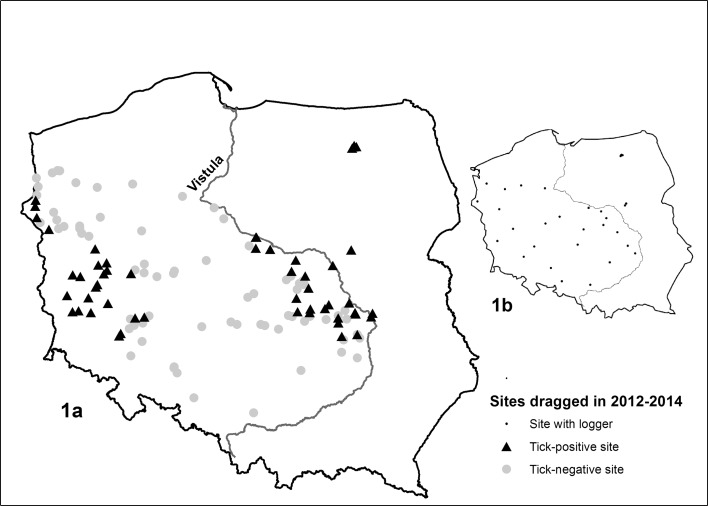
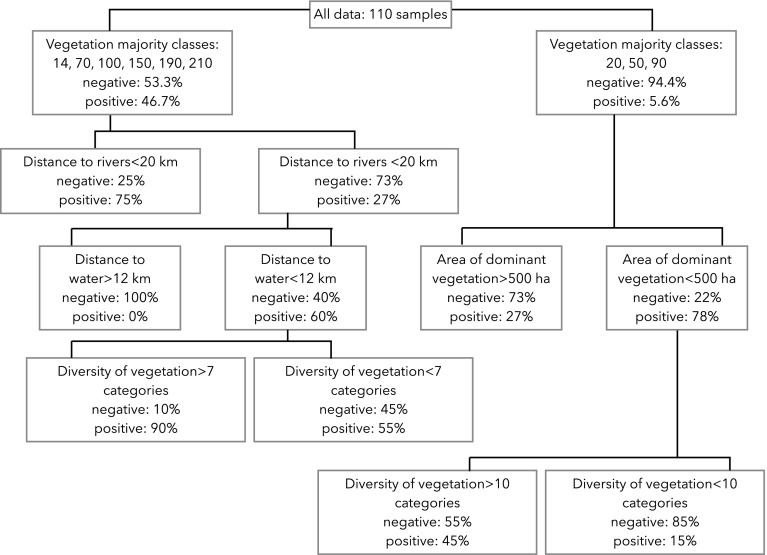
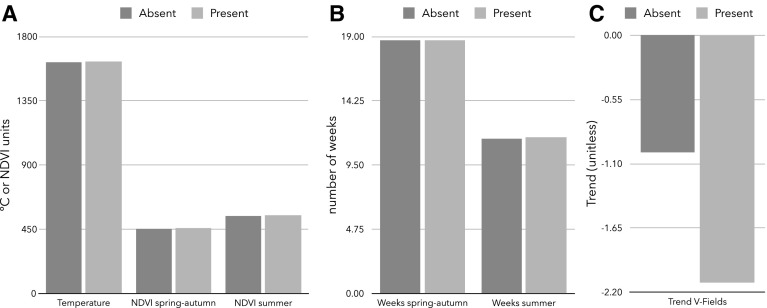
Changes in tick distribution and abundance are among the main drivers of the (re)emergence of transmitted pathogens. We aimed to uncover the reasons of the reported spread of Dermacentor reticulatus in Poland using a variety of proxies of environmental features, ground-measured temperature and remotely-sensed data of temperature and vegetation. Ground-measured temperature was recorded in 2013-2014, in sites where D. reticulatus presence (n = 16) or absence (n = 16) was confirmed. We specifically aimed to test whether changes in phenology of vegetation and the length of the growing season were correlated with field-derived data regarding the presence/absence of D. reticulatus. We also used categorical descriptions of the habitat to capture the vegetation patterns that might delineate the distribution of the tick. We demonstrated that temperature, phenology of vegetation and length of growing season have no correlation with the occurrence of D. reticulatus in Poland. There is, however, a clear association between the trends of the loss of forests and the presence of the tick. This parameter was two times higher at sites colonized by D. reticulatus in comparison to the sites where the population of the tick is not yet established. A spatial analysis demonstrated that the preferred territories for D. reticulatus are those of a highly fragmented landscape within a large patch of homogeneous vegetation, in the vicinity of permanent water courses or reservoirs.
蜱虫分布和数量的变化是病原体(再)出现的主要驱动因素之一。我们旨在利用各种环境特征指标、地面测量温度以及温度和植被的遥感数据,揭示波兰报告的网纹革蜱扩散的原因。2013 - 2014年在已确认存在(n = 16)或不存在(n = 16)网纹革蜱的地点记录了地面测量温度。我们特别旨在测试植被物候变化和生长季节长度是否与关于网纹革蜱存在与否的实地数据相关。我们还使用了栖息地的分类描述来捕捉可能描绘蜱虫分布的植被模式。我们证明,温度、植被物候和生长季节长度与波兰网纹革蜱的出现没有相关性。然而,森林丧失趋势与蜱虫的存在之间存在明显关联。与尚未建立蜱虫种群的地点相比,在网纹革蜱定殖的地点,该参数高出两倍。空间分析表明,网纹革蜱的首选区域是大片同质植被内景观高度破碎的区域,靠近永久性水道或水库。