Laboratoire de Géologie de Lyon, CNRS UMR 5276, Université Lyon 1, Villeurbanne, 69622, France.
Institut Universitaire de France, Paris, France.
Sci Rep. 2017 Aug 23;7(1):8310. doi: 10.1038/s41598-017-08234-0.
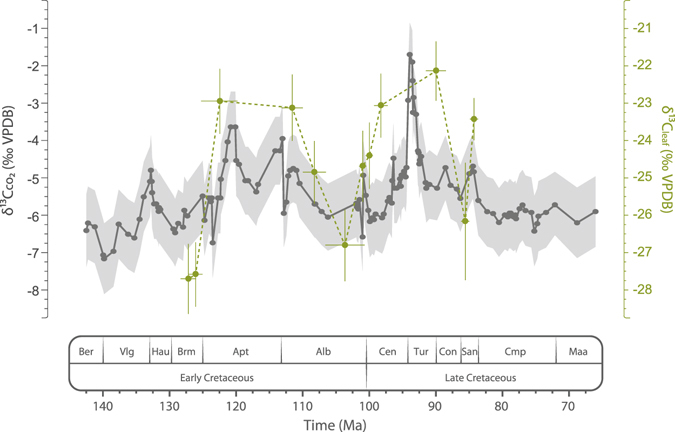
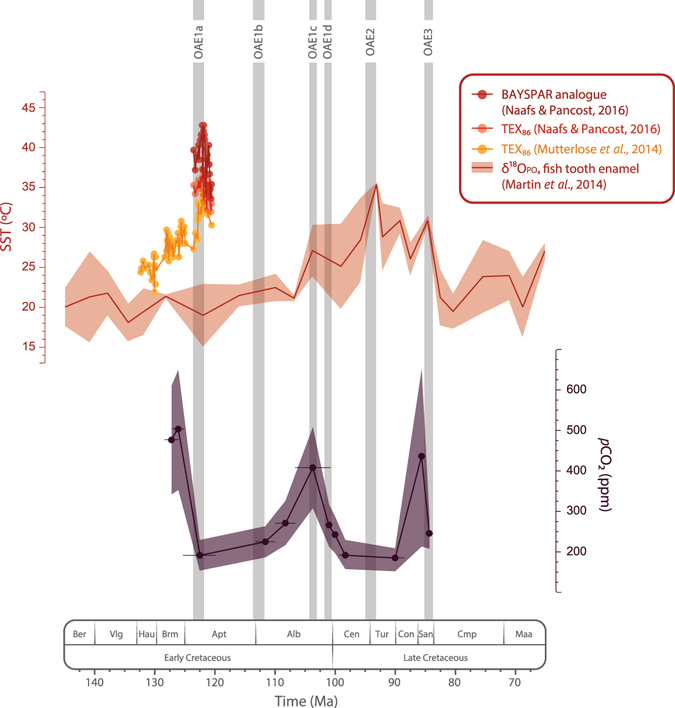
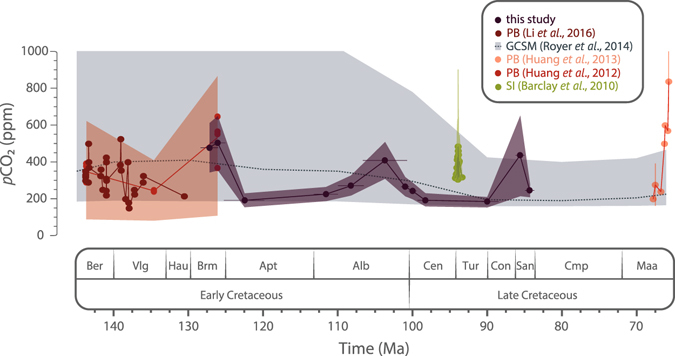
CO is considered the main greenhouse gas involved in the current global warming and the primary driver of temperature throughout Earth's history. However, the soundness of this relationship across time scales and during different climate states of the Earth remains uncertain. Here we explore how CO and temperature are related in the framework of a Greenhouse climate state of the Earth. We reconstruct the long-term evolution of atmospheric CO concentration (pCO) throughout the Cretaceous from the carbon isotope compositions of the fossil conifer Frenelopsis. We show that pCO was in the range of ca. 150-650 ppm during the Barremian-Santonian interval, far less than what is usually considered for the mid Cretaceous. Comparison with available temperature records suggest that although CO may have been a main driver of temperature and primary production at kyr or smaller scales, it was a long-term consequence of the climate-biological system, being decoupled or even showing inverse trends with temperature, at Myr scales. Our analysis indicates that the relationship between CO and temperature is time scale-dependent at least during Greenhouse climate states of the Earth and that primary productivity is a key factor to consider in both past and future analyses of the climate system.
CO 被认为是导致当前全球变暖的主要温室气体,也是地球历史上温度变化的主要驱动因素。然而,这种关系在不同时间尺度和地球不同气候状态下的可靠性仍不确定。在这里,我们在地球温室气候状态的框架内探讨 CO 和温度之间的关系。我们从化石针叶树 Frenelopsis 的碳同位素组成中重建了白垩纪大气 CO 浓度(pCO)的长期演变。我们表明,在巴雷姆期-桑托尼亚期,pCO 的范围约为 150-650ppm,远低于通常认为的白垩纪中期水平。与现有温度记录的比较表明,尽管 CO 可能是温度和生物生产力在千年或更小时间尺度上的主要驱动因素,但它是气候-生物系统的长期结果,在 Myr 尺度上与温度脱钩,甚至呈现相反的趋势。我们的分析表明,CO 和温度之间的关系至少在地球温室气候状态下是依赖时间尺度的,并且在过去和未来的气候系统分析中,初级生产力是一个需要考虑的关键因素。